
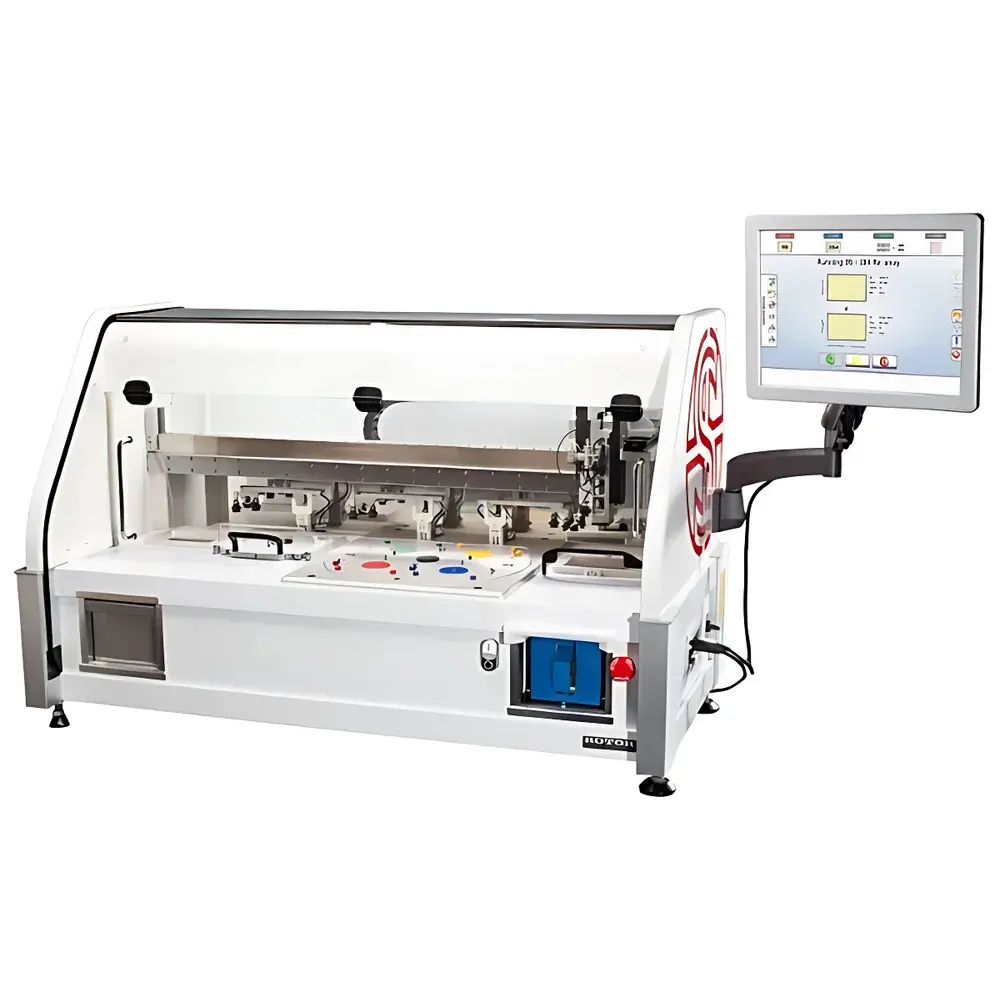
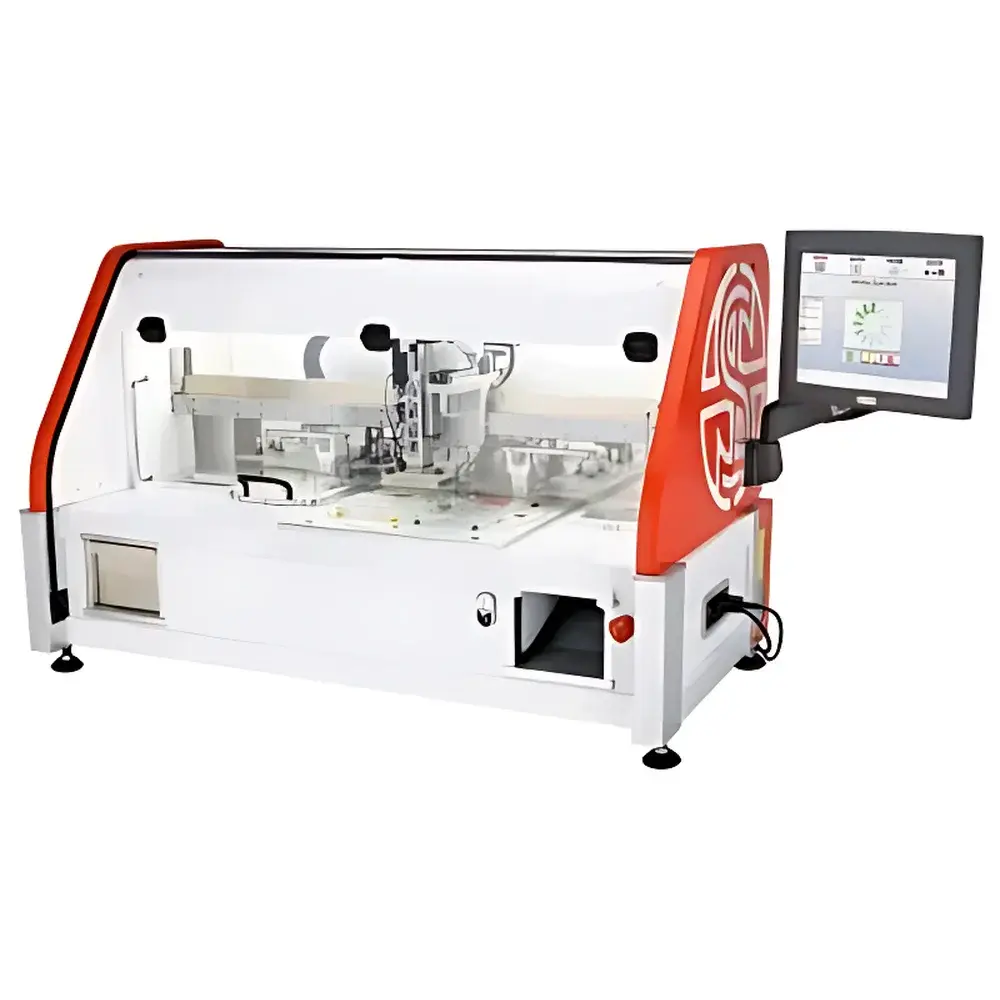
SINGER RoToR HDA High-Throughput Microbial Colony Screening Workstation
| Brand | SINGER |
|---|---|
| Origin | United Kingdom |
| Manufacturer Type | Authorized Distributor |
| Origin Category | Imported |
| Model | RoToR HDA |
| Instrument Type | Microarray Chip System |
| Base Dimensions (L×W×H) | 1150 × 480 × 800 mm |
| Weight | 110 kg |
| Voltage | 240 V |
| Power Consumption | 250–300 W |
| Air Supply Requirement | 3 L/min at 4 bar |
| Compatible Plate Formats | SBS-standard 96-, 384-, 768-, 1536-, 3072-, and 6144-density agar or liquid culture plates |
| Transfer Modes | Replica plating, mating (hybridization), re-arraying, backup, and serial dilution |
Overview
The SINGER RoToR HDA is a precision-engineered high-throughput microbial colony screening workstation designed for reproducible, automated handling of yeast and bacterial arrays on solid agar or in liquid media. Based on the proven principle of contact-based replica plating—where colonies are transferred via sterile, disposable plastic pads pressed against source and target plates—the RoToR HDA delivers deterministic spatial fidelity across densities ranging from 96 to 6144 colonies per plate. Its architecture integrates pneumatic actuation, motorized XYZ stage control, and real-time touchscreen interface to enable rapid, operator-independent execution of complex colony manipulation workflows. The system is purpose-built for functional genomics applications requiring large-scale strain library management—including haploinsufficiency profiling, synthetic genetic array (SGA) analysis, chemical-genetic interaction mapping, and diploid mutant collection curation. With over 60 academic and industrial laboratories worldwide deploying RoToR HDA systems, its design reflects decades of iterative refinement in microbial array robotics, emphasizing mechanical robustness, contamination control, and compliance-ready operational traceability.
Key Features
- Touchscreen-driven graphical user interface with intuitive workflow wizards for replica plating, hybridization (mating), re-arraying, and serial dilution
- Support for all SBS-compliant microplates—including shallow well, deep well, and custom agar-filled formats—across 96, 384, 768, 1536, 3072, and 6144 colony densities
- Integrated UV sterilization chamber with timed irradiation cycle (254 nm) to decontaminate transfer pads and internal surfaces between runs
- Pneumatically actuated, low-inertia transfer head with programmable pressure and dwell time to ensure consistent colony pickup and deposition across heterogeneous growth conditions
- Modular air supply compatibility: operates with external compressed air (3 L/min @ 4 bar) or optional integrated oil-free, low-noise compressor (CE-certified)
- Compact footprint (1150 × 480 × 800 mm) engineered for standard benchtop integration; side-access clearance requirement of only 30 cm
- Reproducible colony transfer efficiency validated across Saccharomyces cerevisiae, Escherichia coli, and other Gram-positive/negative isolates under varied incubation and media conditions
Sample Compatibility & Compliance
The RoToR HDA accommodates both liquid-to-liquid, liquid-to-agar, and agar-to-agar transfers without hardware modification. It accepts standard SBS-format plates (ANSI/SLAS), including non-standard depth variants used in high-density yeast tiling or CRISPR library screening. All transfer pads are single-use, certified DNase/RNase-free, and compatible with common microbiological media (YPD, SC, LB, M9). From a regulatory standpoint, the system supports GLP- and GMP-aligned workflows through audit-trail-enabled software logging (user ID, timestamp, protocol name, plate barcode, success/failure status). While not FDA-cleared as a diagnostic device, its operational repeatability meets ISO/IEC 17025 criteria for method validation in research-grade strain archiving and phenotypic assay preparation. UV lamp intensity and exposure duration comply with IEC 62471 for UV-C safety classification.
Software & Data Management
The RoToR HDA runs proprietary SINGER Control Software v5.x, a Windows-based application supporting protocol creation, batch scheduling, and export of structured CSV logs containing plate coordinates, transfer parameters, and QC metadata. Software features include drag-and-drop plate mapping, conditional logic for multi-step workflows (e.g., “if colony growth > threshold, proceed to mating step”), and barcode scanner integration for sample tracking. All user actions—including login, parameter changes, and run initiation—are timestamped and logged with immutable entries. Exported data conforms to MIAME-compliant annotation standards when paired with downstream analysis platforms such as R/Bioconductor or Python-based colony quantification pipelines. Remote diagnostics and firmware updates are supported via secure HTTPS connection, with optional 21 CFR Part 11-compliant electronic signature modules available upon request.
Applications
- Synthetic Genetic Array (SGA) construction and screening in diploid yeast backgrounds
- Chemical-genetic interaction profiling using compound libraries and mutant arrays
- High-fidelity archiving and recovery of genome-wide deletion collections (e.g., yeast knockout (YKO) or E. coli Keio strains)
- Time-series phenotyping across environmental gradients (temperature, pH, osmolarity, antimicrobial agents)
- Preparation of mating-competent haploid arrays for tetrad dissection or spore isolation workflows
- Automated colony picking support for downstream sequencing library prep or plasmid rescue
FAQ
What is the maximum throughput capacity of the RoToR HDA?
The system processes up to 100 standard 96-well plates per hour under continuous operation, assuming optimized air supply, pre-loaded plates, and minimal manual intervention.
Does the RoToR HDA require dedicated exhaust or ventilation?
No. The unit operates passively without fume extraction; however, placement in a biosafety cabinet is recommended when handling pathogenic or genetically modified organisms.
Can the RoToR HDA perform serial dilutions directly on agar plates?
Yes—using staggered pad contact sequences and programmable spacing offsets, it executes geometric dilution series (e.g., 1:10, 1:100) across multiple target plates in a single run.
Is third-party plate barcode scanning supported?
Yes. The system interfaces with standard USB or RS-232 barcode readers via configurable COM port settings; scanned IDs are auto-populated into run logs.
How is calibration maintained across long-term usage?
Mechanical alignment is factory-verified and requires no routine recalibration; periodic verification using alignment test plates (supplied) ensures positional accuracy within ±0.1 mm across the full travel range.




