
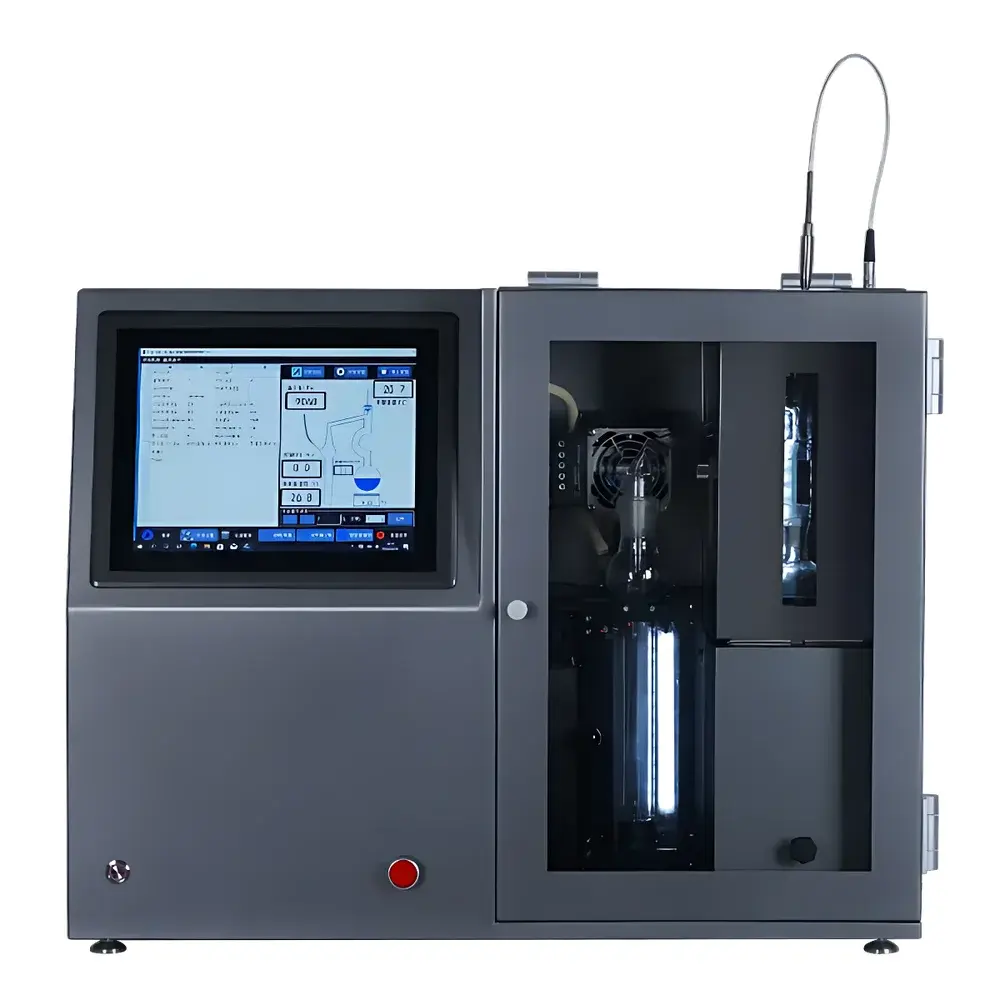
SKY2001-VIII Fully Automated Vacuum Distillation Analyzer
| Brand | Shenko |
|---|---|
| Origin | Shanghai, China |
| Model | SKY2001-VIII |
| Distillation Method | SH/T 0165 |
| Temperature Range (Distillation) | 0–400 °C (vacuum) |
| Temp. Accuracy | ±0.1 °C |
| Receiving Bath Temp. Range | 0–80 °C |
| Temp. Stability | ±0.2 °C |
| Vacuum Control Range | 2–50 mmHg |
| Vacuum Stability | ±0.2 mmHg |
| Volume Measurement Accuracy | ±0.1 mL |
| Data Storage Capacity | ≥5000 test records |
| Power Supply | AC 220 V ±10%, 50/60 Hz |
| Dimensions (W×D×H) | 780 × 395 × 590 mm |
| Net Weight | 63 kg |
Overview
The SKY2001-VIII Fully Automated Vacuum Distillation Analyzer is an engineered solution for high-boiling petroleum products—specifically designed to comply with SH/T 0165, the Chinese standard for high-vacuum distillation of heavy fractions. It applies controlled vacuum distillation principles based on vapor pressure–temperature equilibrium under reduced pressure, enabling precise determination of distillation curves for materials such as vacuum gas oil (VGO), lubricating base oils, and waxy distillates where atmospheric boiling exceeds 350 °C. Unlike conventional atmospheric distillation apparatuses, the SKY2001-VIII maintains dynamic vacuum regulation throughout the run, minimizing thermal degradation and fraction overlap while preserving molecular integrity during volatilization. Its architecture integrates thermodynamic control, real-time optical phase detection, and closed-loop vacuum feedback—ensuring reproducible separation profiles critical for refinery process optimization, feedstock characterization, and quality compliance reporting.
Key Features
- Dynamic vacuum stabilization: Real-time adjustment of residual pressure within ±0.2 mmHg tolerance across the full 2–50 mmHg operating range, preventing bumping and ensuring consistent vapor-phase kinetics.
- Optical liquid-level tracking: High-resolution photodiode sensor paired with micro-stepping motor enables volumetric measurement at 0.1 mL resolution—critical for accurate recovery and endpoint determination in viscous or wax-prone samples.
- Dual-zone thermal management: Independent heating of the distillation flask’s side-arm prevents condensation blockage; air-bath receiving chamber offers stable, uniform temperature control (0–80 °C, ±0.2 °C) without oil contamination or maintenance overhead.
- Intelligent safety interlocks: Automated monitoring includes infrared-based initial boiling point (IBP) detection, over-temperature cutoff (>70 °C in receiver), time-out abort logic for missing IBP, and integrated nitrogen-compatible emergency suppression system (user-supplied N₂ source required).
- Traceable metrology framework: Onboard calibration routines for pressure transducers, graduated cylinder volume verification, and temperature probe offset correction—supporting internal audit readiness and GLP-aligned data integrity.
- Full-process automation: From sample loading to final report generation—including automatic conversion of vacuum-corrected temperatures to ASTM D1160-equivalent atmospheric boiling points using rigorous vapor pressure algorithms.
Sample Compatibility & Compliance
The SKY2001-VIII is validated for use with high-viscosity, high-wax-content petroleum streams including vacuum residua, bright stock, and synthetic lubricant precursors. Its design accommodates samples with pour points up to 45 °C and kinematic viscosities exceeding 100 cSt at 100 °C. All operational parameters align with the procedural constraints defined in SH/T 0165, including specified vacuum ramp rates, temperature ramp limits, and distillate collection timing windows. While SH/T 0165 is the primary reference method, output data may be cross-referenced with ASTM D1160 (Standard Test Method for Distillation of Petroleum Products at Reduced Pressure) and ISO 3405 (Petroleum products — Determination of distillation characteristics) for international reporting. The instrument supports 21 CFR Part 11-compliant electronic signatures when integrated with validated LIMS platforms via its RJ-45 interface.
Software & Data Management
The embedded 12-inch capacitive touchscreen interface runs a deterministic real-time OS, delivering synchronized visualization of distillation rate (mL/min), instantaneous head temperature (°C), cumulative volume (% v/v), and absolute vacuum (mmHg). Each test record includes raw sensor timestamps, calibration metadata, operator ID, and environmental logs (ambient T/RH). Results are stored locally in encrypted binary format with SHA-256 hashing; export options include CSV, PDF, and QR-coded summary labels for traceable offline sharing. The system retains ≥5000 complete test archives with automatic overwrite protection for flagged or failed runs. USB and RS-232 ports support firmware updates and legacy peripheral integration, while the Ethernet port enables scheduled synchronization with enterprise LIMS or centralized QA databases under configurable TLS 1.2 encryption.
Applications
- Refinery crude assay and cut-point validation for vacuum distillation units (VDUs)
- Quality control of lube base oil fractions per API 1509 specifications
- Characterization of heavy feedstocks prior to hydroprocessing or coking
- Research-grade volatility profiling of bio-derived hydrocarbons and synthetic fuels
- Regulatory submission support for customs classification (HS Code 2710) and sulfur content correlation modeling
FAQ
Does the SKY2001-VIII meet ASTM D1160 requirements?
It is configured and validated per SH/T 0165, which is technically harmonized with ASTM D1160. While not certified by ASTM International, its vacuum control fidelity, temperature accuracy, and data reduction algorithms satisfy the performance criteria outlined in Section 7 of ASTM D1160.
Is nitrogen supply mandatory for safe operation?
The emergency fire suppression module requires externally sourced nitrogen (≥99.5% purity, regulated to 0.4–0.6 MPa); however, routine distillation does not require nitrogen flow.
Can the instrument perform atmospheric distillation?
No—it is purpose-built for high-vacuum operation only. Atmospheric distillation is outside its mechanical and thermal design envelope.
What maintenance intervals are recommended for the vacuum system?
Oil-sealed rotary vane pump oil should be replaced every 500 operating hours; vacuum gauge zero calibration is advised quarterly using certified reference pressure standards.
How is temperature correction applied during data reduction?
The system applies iterative Antoine equation-based corrections using user-input barometric pressure and measured vacuum, converting observed boiling points to true atmospheric equivalents per SH/T 0165 Annex B.






