
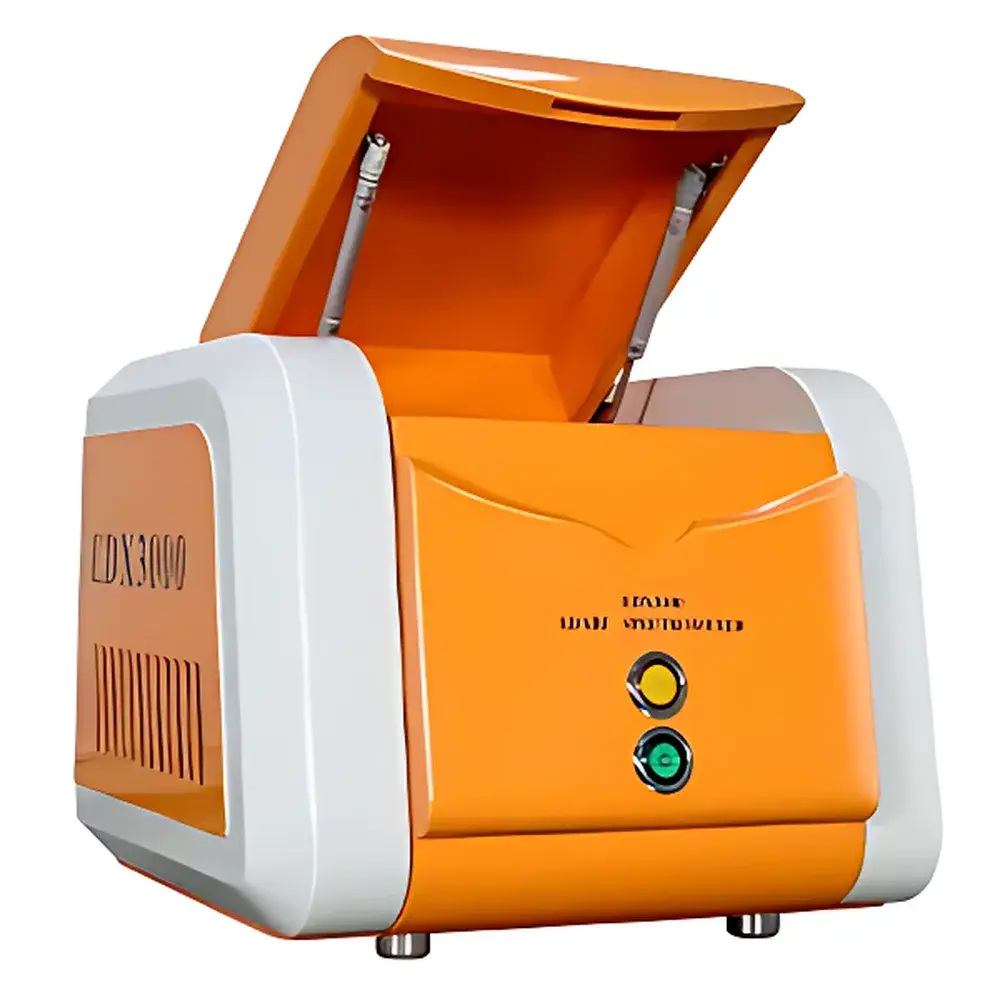
SkyRay EDX3000 Energy Dispersive X-Ray Fluorescence Spectrometer
| Brand | SkyRay Instrument |
|---|---|
| Origin | Jiangsu, China |
| Manufacturer Type | Manufacturer |
| Product Category | Domestic |
| Model | EDX3000 |
| Form Factor | Benchtop/Floor-standing |
| Application Type | General-purpose |
| Elemental Range | S (16) to U (92) |
| Quantitative Range | 1 ppm – 99.9 wt% |
| Energy Resolution | 125 eV (at Mn Kα) |
| Repeatability | ≤0.05% RSD (for major elements >96 wt%) |
| Detector | Si-PIN semiconductor detector |
Overview
The SkyRay EDX3000 is a benchtop/floor-standing energy dispersive X-ray fluorescence (EDXRF) spectrometer engineered for precise, non-destructive elemental analysis of solid and powdered samples in precious metal testing and general materials characterization. Based on the fundamental principle of X-ray fluorescence—where primary X-rays excite inner-shell electrons in sample atoms, resulting in characteristic secondary (fluorescent) X-ray emission—the EDX3000 measures energy spectra to identify and quantify elements from sulfur (Z = 16) to uranium (Z = 92). Its Si-PIN detector delivers a measured energy resolution of 125 eV at the Mn Kα line (5.89 keV), meeting the performance criteria specified in GB/T 18043–2013 for jewelry assay instrumentation. The system employs a long-life, air-cooled microfocus X-ray tube with integrated thermoelectric (Peltier) cooling for the detector—eliminating reliance on liquid nitrogen—and ensures stable spectral acquisition over extended operational cycles.
Key Features
- Thermoelectrically cooled Si-PIN detector with 125 eV resolution at Mn Kα, enabling reliable separation of adjacent peaks in complex precious metal alloys (e.g., Au–Ag–Cu–Zn–Ni–Pd–Pt)
- Digital pulse processor architecture supporting high-count-rate throughput and real-time dead-time correction for improved precision at low and high concentrations
- Integrated high-resolution CCD camera with adjustable magnification for accurate sample positioning and visual documentation of analysis areas
- Single-sample chamber with manually operated safety interlocked lid; conforms to IEC 61010-1 and GB 4793.1 for laboratory electrical safety
- Triple-layer safety protection: hardware-based beam shutter, software-enforced exposure timeout, and mechanical lid interlock preventing X-ray emission during access
- Multi-variable non-linear regression algorithms with element-specific matrix effect correction models—each calibrated independently for gold, platinum, palladium, silver, and base-metal matrices
- Optimized excitation geometry and filter selection for enhanced sensitivity in trace-element detection down to 1 ppm in homogeneous alloys
Sample Compatibility & Compliance
The EDX3000 accommodates flat, irregular, and irregularly shaped solid samples up to Ø40 mm × 25 mm height—including finished jewelry pieces, cast ingots, scrap fragments, and pressed powder pellets. Surface flatness and homogeneity are critical for quantitative accuracy; optional sample leveling fixtures and automatic Z-height adjustment support reproducible measurement geometry. The instrument complies with national standard GB/T 18043–2013 “Jewellery—Determination of gold content—X-ray fluorescence spectrometry method”, and its analytical protocols are aligned with ISO 22058 (precious metals—XRF analysis) and ASTM E1621 (standard guide for XRF elemental analysis). Data integrity meets GLP and GMP requirements through audit-trail-enabled software logging (user actions, calibration events, spectrum acquisition metadata).
Software & Data Management
The proprietary SkyRay EDX Analysis Suite provides an intuitive Windows-based interface with multilingual support (English, Chinese, Spanish). It includes preloaded calibration curves for Au, Ag, Pt, Pd, Cu, Zn, Ni, and Sn in common alloy systems (e.g., 14K, 18K, 22K gold; Pt950; Pd950), all traceable to NIST SRM reference materials. All quantitative results include uncertainty estimation based on counting statistics and calibration residuals. Raw spectral data (.eds, .spe) and processed reports (.pdf, .xlsx) are exportable with embedded timestamps, operator ID, and instrument configuration logs. Software supports 21 CFR Part 11-compliant user authentication, electronic signatures, and immutable audit trails—essential for accredited testing laboratories and regulatory submissions.
Applications
- Quality control in jewelry manufacturing: rapid verification of karat purity, plating thickness estimation (via ratio methods), and detection of unauthorized alloying elements
- Refinery and smelting operations: incoming material screening, process stream monitoring, and final product certification for Au, Pt, Pd, and Ag bullion
- Assay and certification labs: compliance testing per national hallmarking regulations (e.g., China’s QB/T 2062, UK Assay Office standards)
- Second-hand precious metal valuation: non-destructive grading of pawned or recycled items without surface preparation
- Research and development of novel alloys: compositional mapping of multi-phase microstructures using sequential point analysis
- Forensic metallurgy and authenticity verification: differentiation between genuine articles and plated or filled counterfeits
FAQ
Does the EDX3000 require liquid nitrogen cooling?
No. It uses a thermoelectrically cooled Si-PIN detector, eliminating cryogenic handling and enabling continuous operation in standard laboratory environments.
Can it analyze irregularly shaped jewelry without sample preparation?
Yes—within geometric constraints (max Ø40 mm × 25 mm height)—but optimal accuracy requires representative surface area and minimal curvature-induced absorption effects.
Is spectral calibration traceable to international standards?
Yes. Factory calibrations are performed using NIST-traceable reference materials (e.g., NIST SRM 1144, 1275a), and users may perform in-house recalibration with certified alloy standards.
What safety certifications does the instrument hold?
It complies with IEC 61010-1 (safety requirements for electrical equipment) and GB 4793.1 (Chinese national standard for measuring instruments), including radiation shielding validation per GBZ 18871.
How is data integrity ensured for regulated environments?
Through 21 CFR Part 11–aligned software features: role-based access control, electronic signatures, automated audit trails, and tamper-evident data archiving.





