
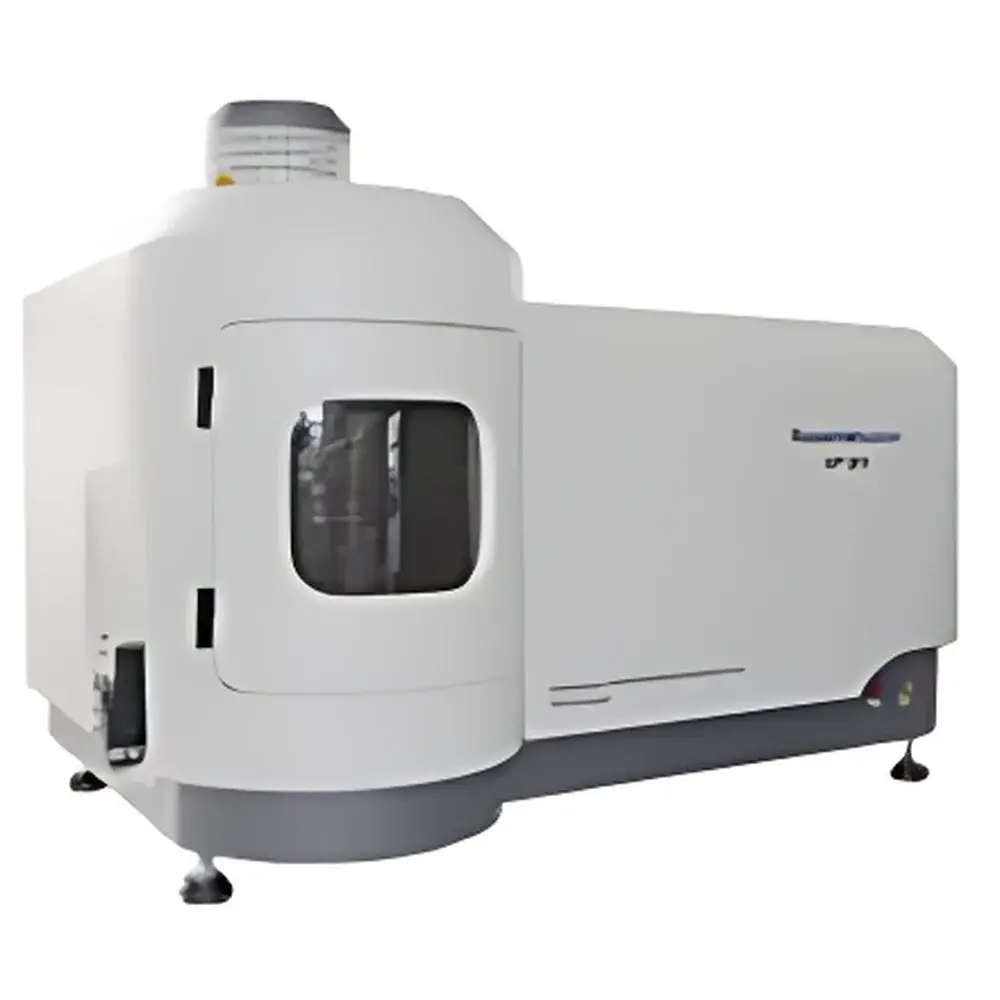
Skyray ICP-3000 Inductively Coupled Plasma Optical Emission Spectrometer
| Brand | Skyray Instrument |
|---|---|
| Origin | Jiangsu, China |
| Manufacturer Type | Original Equipment Manufacturer (OEM) |
| Category | Domestic |
| Model | ICP-3000 |
| Instrument Type | Full-Spectrum Direct-Reading |
| Detection Limits | Zn 213.856 nm: 0.47 µg/L |
| Ni 231.604 nm | 1.73 µg/L |
| Mn 257.61 nm | 0.18 µg/L |
| Cr 267.716 nm | 1.18 µg/L |
| Cu 324.754 nm | 1.1 µg/L |
| Ba 445.403 nm | 0.1 µg/L |
| Precision (RSD) | <0.5% |
| Long-Term Stability (2 h RSD) | <1.0% |
| Wavelength Range | 165–900 nm |
| Optical Resolution | 6.8 pm @ 200 nm |
Overview
The Skyray ICP-3000 Inductively Coupled Plasma Optical Emission Spectrometer (ICP-OES) is a benchtop, full-spectrum direct-reading analytical instrument engineered for high-precision, multi-element quantitative analysis of metals and selected non-metals in liquid and digested solid matrices. It operates on the principle of inductively coupled plasma excitation—where sample aerosols are atomized, ionized, and excited in an argon plasma at ~6,000–10,000 K—followed by optical emission detection across the ultraviolet–visible–near-infrared spectrum (165–900 nm). The system employs a robust, all-solid-state 27.12 MHz RF generator with automatic impedance matching, ensuring stable plasma ignition and sustained power delivery under variable matrix loads. Designed for laboratories requiring regulatory-compliant elemental analysis—including those adhering to ASTM D5185, EPA Method 200.7/6020B, ISO 11885, and USP , the ICP-3000 delivers trace-level sensitivity, excellent short- and long-term stability, and broad linear dynamic range without spectral re-acquisition or hardware realignment.
Key Features
- Full-spectrum CID detector: 1024 × 1024 pixel charge-injection device (CID) with 27.6 mm × 27.6 mm active area; enables simultaneous acquisition across 165–900 nm in a single exposure; supports non-destructive readout (NDRO), region-of-interest (ROI) integration, and sub-2 ms line-specific readout.
- Optimized echelle-grating optics: Zerodur® substrate mid-focal-plane echelle grating (52.67 lp/mm, 64° blaze) paired with high-transmission UV-grade fused silica prism; F/8 aperture design maximizes photon throughput while maintaining <0.0068 nm resolution at 200 nm; thermally stabilized optical chamber (35 ± 0.1 °C) with distributed nitrogen purge (2–4 L/min).
- Intelligent plasma control: Triple-mass-flow-controlled gas delivery (plasma, auxiliary, nebulizer); fully automated RF matching (<1 s response time); solid-state RF generator (700–1600 W, 0.1% output stability); low electromagnetic leakage (<0.5 V/m at 30 cm).
- Modular sample introduction: Four-channel peristaltic pump (12-roller, flow-adjustable); interchangeable quartz torches (standard and high-efficiency variants); optional HF-resistant and high-salt nebulizers; dual-chamber spray chamber with旋流 (vortex) configuration available.
- Self-calibrating wavelength management: Algorithm-driven auto-wavelength calibration using internal reference lines; eliminates routine external lamp-based recalibration; maintains spectral fidelity over extended operation without mechanical movement of optical components.
Sample Compatibility & Compliance
The ICP-3000 accommodates aqueous samples dissolved in HCl, HNO₃, or HF-based digestion media—including EPA SW-846 Methods 3015A, 3050B, and 3052—and supports direct analysis of diluted organic extracts following appropriate matrix separation. It meets key performance criteria for GLP and GMP environments: audit-trail-enabled software logging, user-access controls, electronic signature support (aligned with FDA 21 CFR Part 11 principles), and method validation templates compliant with ISO/IEC 17025. All reported detection limits (e.g., Ba 445.403 nm: 0.1 µg/L; Mn 257.61 nm: 0.18 µg/L) were determined per IUPAC definitions using 3σ of 10 replicate blanks (n = 10, 1% HNO₃), with precision verified via repeated analysis of NIST SRM 1643e (Trace Elements in Natural Water).
Software & Data Management
Skyray’s proprietary ICP Analysis Suite provides a validated, Windows-based platform supporting qualitative screening, semi-quantitative survey mode, and full quantitative calibration (linear, quadratic, and internal standard correction). Key capabilities include background-equivalent concentration (BEC) modeling, interference correction algorithms (e.g., for Ca–As overlap at 189.042 nm), offline spectral reprocessing, and customizable report generation with embedded metadata (instrument parameters, calibration history, QC flagging). Raw spectral data is stored in vendor-neutral HDF5 format; export options include CSV, XML, and PDF with embedded spectra. Software versioning, change logs, and electronic record retention comply with ALCOA+ data integrity principles.
Applications
- Environmental testing: Quantification of regulated metals (As, Cd, Cr, Pb, Hg, Ni, Se, V) in drinking water, wastewater, soil leachates, and airborne particulate filters per EPA 200.7 and ISO 17294-2.
- Geochemical & mining labs: Multi-element profiling (Ca, Mg, Fe, Cu, Zn, REEs) in rock digests, ore concentrates, and exploration core samples; compatible with lithium metaborate fusion protocols.
- Materials science: Trace impurity screening in high-purity silicon, rare-earth magnets, battery cathode precursors, and semiconductor process chemicals (e.g., HF etchants, photoresist solvents).
- Pharmaceutical & clinical research: Elemental impurity testing per ICH Q3D guidelines; quantification of catalyst residues (Pd, Pt, Rh) in API intermediates; monitoring of essential/toxic elements in biological fluids post-digestion.
- Petrochemical QA/QC: Routine analysis of wear metals (Fe, Cu, Al, Si) and additives (Ca, Zn, P, Mg) in lubricants, fuels, and crude oils per ASTM D5185 and D6595.
FAQ
What sample preparation methods are recommended for solid matrices?
Solid samples must undergo acid digestion (e.g., closed-vessel microwave-assisted with HNO₃/HF/H₂O₂) or fusion (lithium metaborate/tetraborate) prior to dilution into 1–5% v/v nitric acid. Certified reference materials (e.g., NIST SRM 2710a, GBW 07312) are advised for method validation.
Does the system support internal standardization for drift correction?
Yes—up to six internal standards (e.g., Sc, Y, In, Bi, Tb, Lu) can be configured per method; ratios are calculated in real time and applied during quantification to compensate for plasma instability and nebulization variability.
Is the optical system purged with argon or nitrogen?
The spectrometer uses high-purity nitrogen (≥99.999%) for continuous distributed purging of the optical chamber; argon is reserved exclusively for plasma generation and sample transport.
Can the instrument operate unattended overnight?
Yes—the system supports scheduled batch analysis with automated rinse cycles, QC checks, and fault recovery protocols; all operational logs and spectral data are timestamped and archived automatically.
What maintenance intervals are recommended for routine operation?
Nebulizer and torch cleaning every 8–10 sample batches; CID detector temperature verification monthly; RF matching network inspection quarterly; full optical alignment verification annually or after physical relocation.



