
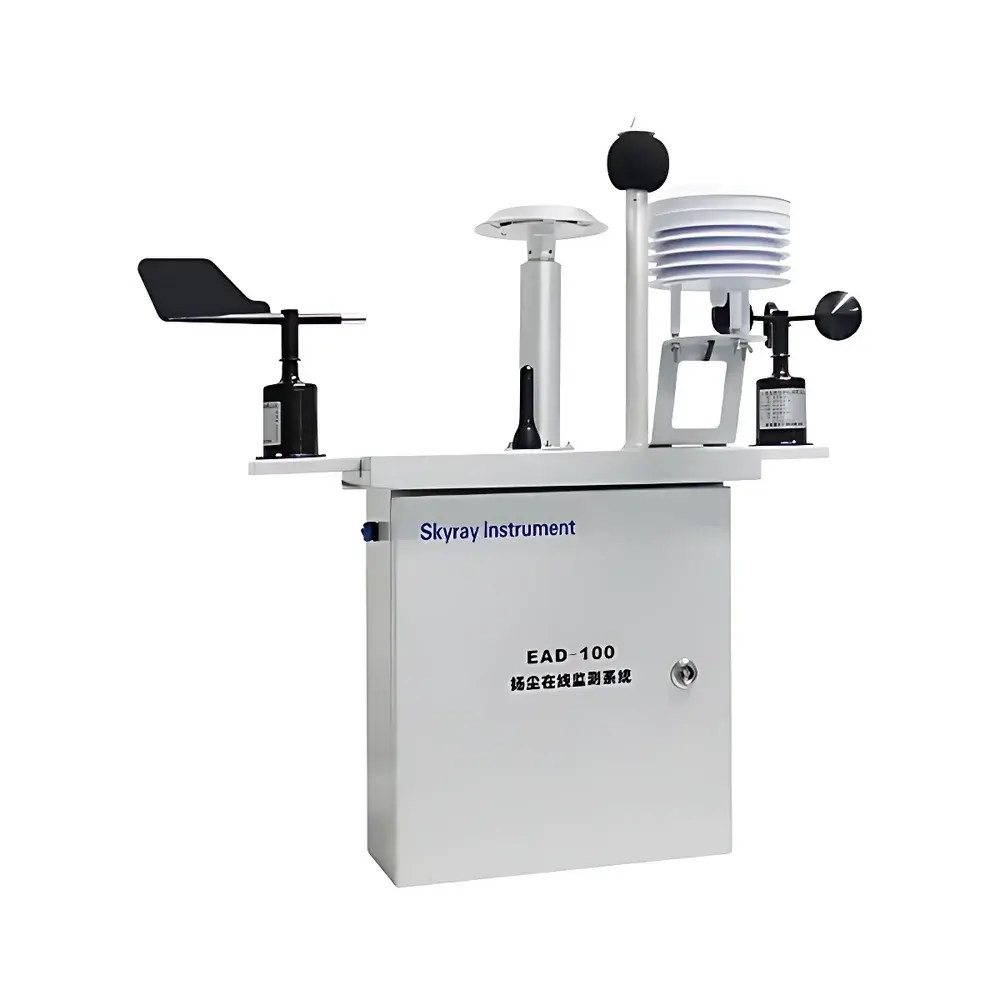
SkyRay Instrument EAD-100 Series Ambient Dust and Noise Online Monitoring System
| Brand | SkyRay Instrument |
|---|---|
| Origin | Jiangsu, China |
| Manufacturer Type | OEM Manufacturer |
| Country of Origin | China |
| Model | EAD-100 Series |
| Price Range | USD 1,400 – 7,000 (FOB) |
| Measurement Principle | Optical Light Scattering |
| Measured Parameters | PM₁₀, PM₂.₅ |
Overview
The SkyRay Instrument EAD-100 Series Ambient Dust and Noise Online Monitoring System is an integrated, regulatory-grade environmental monitoring platform engineered for continuous, real-time quantification of airborne particulate matter and ambient noise levels in uncontrolled outdoor emission environments. Designed in strict alignment with Chinese national ambient air quality standards—including GB 3095-2012 (Ambient Air Quality Standards), HJ 633-2012 (Technical Specification for AQI Calculation), and HJ 212-2017 (Data Transmission Standard for Pollution Source Monitoring Systems)—the EAD-100 employs calibrated optical light scattering detection to determine mass concentrations of PM₂.₅ and PM₁₀ with traceable metrological performance. Its dual-sensor architecture concurrently acquires A-weighted sound pressure level (SPL) data (in dB(A)), atmospheric pressure (hPa), temperature (°C), relative humidity (%RH), wind speed (m/s), and wind direction (°), enabling comprehensive environmental context correlation. The system operates autonomously under harsh field conditions—designed for 24/7 duty cycles with minute-interval data output—and supports audit-ready data integrity per GLP-aligned operational protocols.
Key Features
- Optical light scattering-based particulate measurement with factory-calibrated response curves for PM₂.₅ and PM₁₀, traceable to NIST-traceable reference aerosols;
- Integrated Class 2 sound level meter compliant with IEC 61672-1:2013, delivering real-time LAeq, LAFmax, and statistical noise descriptors;
- Multi-parameter meteorological sub-system co-located with particulate and acoustic sensors to support source attribution and dispersion modeling;
- Industrial-grade, IP65-rated weatherproof enclosure with integrated lightning protection, surge suppression, and thermal management;
- Embedded data acquisition unit supporting Modbus RTU, TCP/IP, and HJ 212-2017-compliant serial/ethernet transmission protocols;
- On-device SD card logging (optional) plus redundant cloud upload via 4G LTE or fiber-optic uplink;
- Auto-triggered evidentiary capture: time-stamped image/video snapshots synchronized with exceedance events (e.g., PM₁₀ > 150 µg/m³ or LAeq > 75 dB(A) for >5 min);
- Remote configuration, firmware updates, and diagnostic telemetry accessible via HTTPS-secured web interface or native iOS/Android application.
Sample Compatibility & Compliance
The EAD-100 is validated for ambient outdoor deployment in heterogeneous microenvironments—including construction sites, bulk material handling terminals (e.g., coal ports, aggregate stockyards), urban arterial roadways, industrial park perimeters, and residential buffer zones. It meets mandatory technical requirements outlined in JJG 846-2015 (Verification Regulation for Dust Concentration Meters) and conforms to the measurement uncertainty framework specified in HJ 168-2020 (Technical Guidelines for Development of Environmental Monitoring Methods). All particulate measurements are referenced to standard temperature and pressure (STP: 25°C, 101.325 kPa) and reported as mass concentration (µg/m³) with documented repeatability (CV ≤ 8% at 50 µg/m³ PM₂.₅). Noise data comply with ISO 1996-2:2017 (acoustics — description, measurement and assessment of environmental noise) and support statutory reporting to municipal ecological environment bureaus under China’s “Three-Year Action Plan for Blue Sky Defense”.
Software & Data Management
The EAD-100 integrates with SkyRay’s proprietary ENSIGHT™ Cloud Platform—a secure, role-based SaaS environment supporting multi-tier user access (field technician, site manager, regulatory reviewer). Raw sensor data undergo automated QA/QC filtering (e.g., dew point validation, signal saturation flagging, zero-drift compensation) prior to storage in a PostgreSQL database with immutable audit trails. Historical datasets are exportable in CSV, Excel, or NetCDF formats; trend visualization includes rolling 1-hr/24-hr/30-day averages, percentile analysis (e.g., L90, L10), and cross-parameter correlation heatmaps. The platform supports electronic signatures, change control logs, and full 21 CFR Part 11–compliant audit history for GMP-aligned environmental compliance programs.
Applications
- Real-time compliance monitoring at construction sites subject to local “Dust Control Ordinances”;
- Baseline ambient noise and particulate characterization for EIA (Environmental Impact Assessment) reporting;
- Perimeter monitoring at thermal power plants, cement production facilities, and open-pit mines;
- Urban traffic noise mapping and PM hotspot identification along high-volume corridors;
- Long-term trend analysis for municipal air quality management plans (AQMPs);
- Automated violation alerting and evidentiary documentation for enforcement actions by Ecological Environment Bureaus or Urban Management Authorities.
FAQ
What calibration standards are used for PM measurement verification?
The EAD-100 is calibrated using polydisperse PSL (polystyrene latex) aerosol standards traceable to NIST SRM 1963, with secondary verification against gravimetric reference samplers per HJ 653-2013.
Is the system compatible with third-party SCADA or EMS platforms?
Yes—via Modbus TCP or HJ 212-2017 protocol stacks; custom API integration (RESTful JSON) is available under NDA.
How is data security ensured during wireless transmission?
All 4G LTE communications use TLS 1.2 encryption; device authentication employs X.509 certificates; cloud storage complies with ISO/IEC 27001-certified infrastructure.
What is the typical maintenance interval and service scope?
Preventive maintenance is recommended every 6 months, including optical path cleaning, microphone diaphragm inspection, and meteorological sensor recalibration; SkyRay offers SLA-backed on-site response within 48 hours in Tier-1 cities.
Can the system operate reliably in high-humidity or coastal salt environments?
Yes—the enclosure features conformal-coated PCBs, stainless-steel fasteners, and hydrophobic optical windows rated for continuous operation at 95% RH and saline aerosol exposure per ISO 9223 C5-M classification.







