
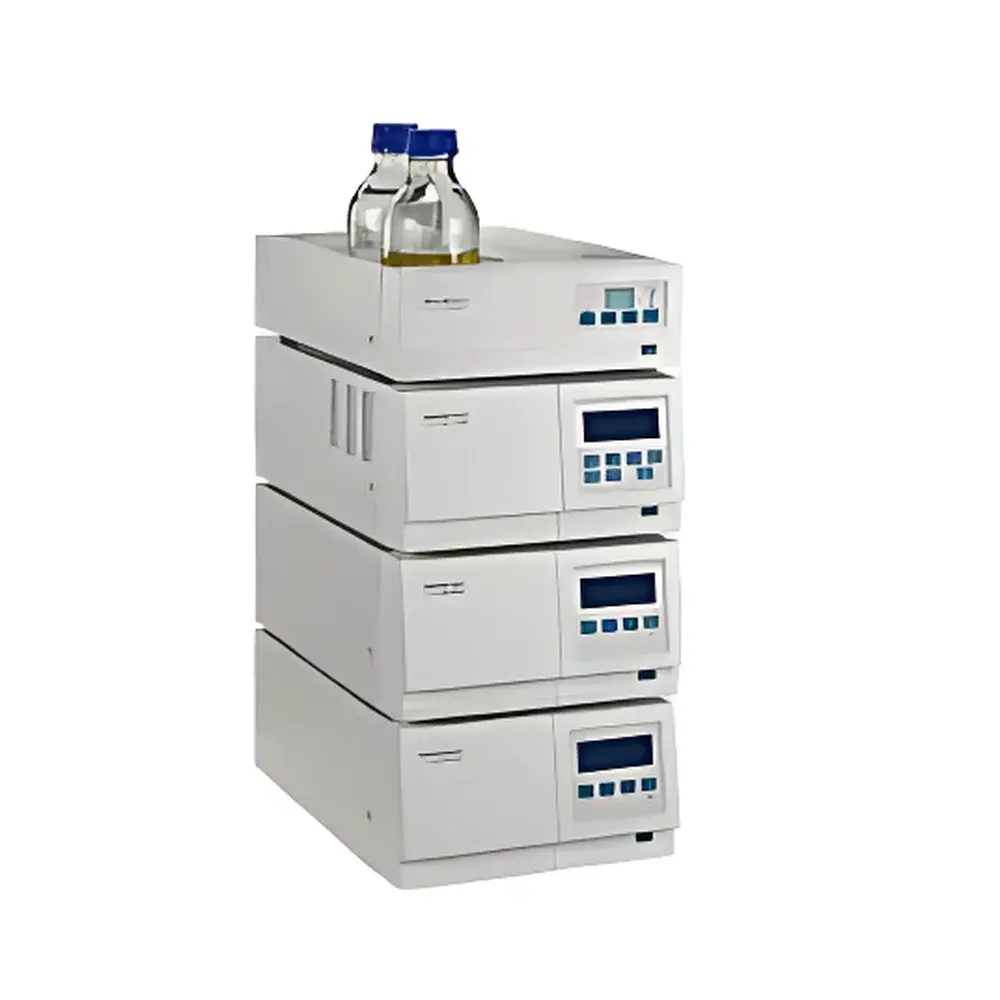
Skyray Instrument LC-310 High-Performance Liquid Chromatograph
| Brand | Skyray Instrument |
|---|---|
| Origin | Jiangsu, China |
| Manufacturer Type | OEM Manufacturer |
| Regional Classification | Domestic (China) |
| Model | LC-310 |
| Price Range | USD 14,000–28,000 |
| Instrument Type | Conventional HPLC System |
| Flow Rate Range | 0–10 mL/min |
| Maximum Operating Pressure | 42 MPa |
| Sample Vial Capacity | 108 positions (2 mL vials) |
| Injection Volume Range | 0–20 µL |
| Column Oven Temperature Range | Ambient +5°C to 80°C |
| UV-Vis Wavelength Range | 190–680 nm |
| Data Acquisition Frequency | 50 Hz |
Overview
The Skyray Instrument LC-310 is a high-performance, modular high-pressure liquid chromatography (HPLC) system engineered for routine analytical laboratories requiring robustness, reproducibility, and regulatory-compliant operation. Based on over a decade of in-house HPLC development experience, the LC-310 implements core principles of modern isocratic and gradient elution chromatography—utilizing dual-piston parallel reciprocating pumps, low-dead-volume fluidic pathways, and digitally controlled UV-Vis detection—to deliver precise retention time stability, high sensitivity, and consistent peak shape across diverse sample matrices. Its architecture adheres to fundamental HPLC design tenets: minimal dwell volume (< 800 µL), thermally stabilized optical path, and pressure-compensated flow control—enabling reliable method transfer, method validation, and long-term operational consistency under GLP and GMP-aligned workflows.
Key Features
- Dual-piston parallel high-pressure pump (LC-P310) with real-time pressure monitoring, programmable flow rate (0.001–9.999 mL/min), and <±0.06% RSD flow precision at 1 mL/min (water, 5–10 MPa)
- UV-Vis detector (LC-UV310) featuring a thermally isolated deuterium lamp housing, precision-machined flow cell with tapered bore geometry (23.8% SNR improvement vs. standard cylindrical cells), and direct digital output via RS232—eliminating analog signal degradation from external A/D conversion
- Column oven (LC-CO310) with PID-controlled temperature regulation from ambient +5°C to 80°C (±0.1°C stability), supporting method robustness for temperature-sensitive separations
- Integrated high-efficiency gradient mixer with narrow-profile laminar-flow channel design, achieving >95% mixing homogeneity within <1.2 mL dwell volume
- Self-diagnostic firmware with predictive fault alerts—including seal wear estimation, pressure anomaly detection, and lamp energy decay tracking—enabling proactive maintenance scheduling
- Modular configuration options: standardized isocratic system or binary high-pressure gradient system, both fully compatible with 4.6 mm ID analytical columns and standard 1/16″ stainless-steel tubing
Sample Compatibility & Compliance
The LC-310 accommodates a broad spectrum of analytes common in pharmaceutical QC, environmental residue testing, food safety screening, and natural product isolation—including thermally labile compounds (e.g., peptides, glycosides), high-MW polymers, polar metabolites, and ionizable small molecules. Its 190–680 nm spectral range supports quantitative analysis of aromatic, conjugated, and heterocyclic species per ICH Q2(R2) and USP . The system meets mechanical and electrical safety requirements per GB/T 18268.1–2010 (IEC 61326-1 equivalent) and electromagnetic compatibility per GB/T 18268.26–2010. While not pre-certified for FDA 21 CFR Part 11, its LC-WS310 workstation software supports audit trail logging, electronic signature integration, and user-access-level permissions—facilitating alignment with Part 11 Annex 11 and ISO/IEC 17025 documentation requirements when configured with validated IT infrastructure.
Software & Data Management
The LC-WS310 Chromatographic Workstation is a Windows-based, fully integrated control and data processing platform built on a deterministic real-time kernel. It provides centralized management of pump gradients, detector wavelength programming, column oven ramping, and event-triggered acquisition—all synchronized to sub-second timing resolution. Data handling complies with ASTM E1947-20 (Standard Guide for Chromatographic Data Exchange) and supports .cdf (NetCDF) export for third-party chemometric tools. Processing modules include baseline correction (Tangent Skim, Linear Drift), peak integration (EMG, Gaussian, Valley-to-Valley), calibration curve fitting (linear, quadratic, weighted least-squares), and report generation compliant with ISO 17025 clause 7.8. Audit trails record all parameter changes, sequence edits, and raw data modifications with timestamp, operator ID, and reason-for-change fields—enabling full traceability during internal audits or regulatory inspections.
Applications
The LC-310 serves as a primary analytical platform in regulated and research environments where method ruggedness and inter-laboratory reproducibility are critical. Typical applications include: residual solvent quantification in APIs (ICH Q3C); pesticide multiresidue analysis in fruits and vegetables (EN 15662:2018); mycotoxin profiling in cereals (AOAC 2005.08); vitamin D metabolite separation in clinical serum samples; polyphenol fingerprinting in herbal extracts; and polymer molecular weight distribution analysis using SEC/GPC mode. Its pressure capability (up to 42 MPa) supports sub-2 µm particle-packed columns for UHPLC-like efficiency when paired with low-dispersion detectors and optimized tubing.
FAQ
Is the LC-310 compatible with modern column technologies, including sub-2 µm particles?
Yes—the system’s low system volume (< 1.2 mL total dwell + delay), high-pressure tolerance (42 MPa), and pulse-dampened dual-piston pump enable stable operation with 1.7–1.9 µm particle columns when used with appropriate frits and zero-dead-volume fittings.
Does the LC-WS310 software support 21 CFR Part 11 compliance?
The software includes configurable audit trail, electronic signature, and role-based access controls; however, full Part 11 compliance requires validation by the end user per their SOPs and supporting IT infrastructure (e.g., secure network, backup policy, change control).
Can the LC-310 perform gradient elution with four solvents?
The standard binary high-pressure configuration supports two mobile phase solvents; quaternary low-pressure mixing requires external selection valve integration and is not natively supported.
What is the minimum detectable concentration for typical small-molecule analytes?
Using a 10-mm pathlength flow cell and standard 4.6 × 150 mm C18 column, LOD for napthalene in methanol is specified at 1 × 10⁻⁸ g/mL (S/N ≥ 3), consistent with ISO 11843-1:2021 detection limit methodology.
Are replacement parts and service support available outside China?
Skyray Instrument maintains authorized distributor networks in Southeast Asia, the Middle East, and Latin America; technical documentation, firmware updates, and spare part catalogs are accessible through registered distributor portals.





