
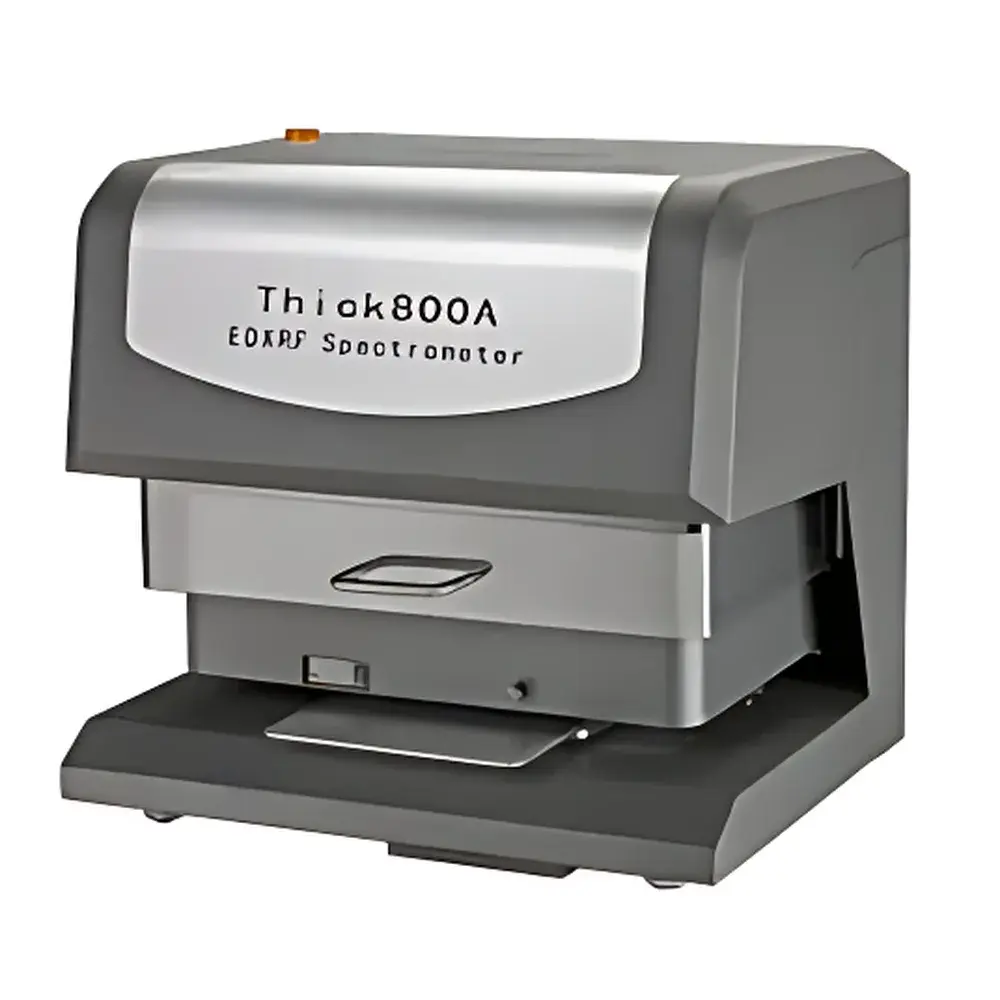
SkyRay Instrument Thick 800A X-Ray Fluorescence Coating Thickness Analyzer
| Brand | SkyRay Instrument |
|---|---|
| Origin | Jiangsu, China |
| Manufacturer Type | OEM Manufacturer |
| Country of Origin | China |
| Model | Thick 800A |
| Pricing | Available Upon Request |
Overview
The SkyRay Instrument Thick 800A is a benchtop energy-dispersive X-ray fluorescence (EDXRF) coating thickness analyzer engineered for high-precision, non-destructive measurement of metallic and alloy coatings on substrates. It operates on the fundamental principle of X-ray fluorescence spectroscopy: primary X-rays from a micro-focus X-ray tube excite atoms in the sample, inducing secondary (fluorescent) X-ray emission characteristic of each element present. By quantifying the intensity ratio between substrate and coating element peaks—and applying matrix-corrected fundamental parameter (FP) algorithms—the system calculates coating thickness with trace-level sensitivity and multi-layer resolution. Designed specifically for industrial quality control in electroplating, precious metal finishing, and jewelry manufacturing, the Thick 800A delivers metrological traceability aligned with ISO 3497 (Metallic coatings — Measurement of coating thickness — X-ray spectrometric methods) and ASTM B568 (Standard Test Method for Thickness of Metallic Coatings by X-Ray Spectrometry).
Key Features
- Automated 2D motorized stage with sub-micron positioning repeatability (<0.005 mm), enabling precise multi-point mapping across irregular or curved surfaces.
- Optimized optical geometry featuring dual coaxial laser alignment system: one for XY sample surface targeting, another for Z-axis height auto-focusing—ensuring consistent source-to-sample distance and beam collimation stability.
- Micro-spot analysis capability using interchangeable collimators down to φ0.1 mm, supporting measurements on fine features such as watch components, connector pins, and micro-electroformed parts.
- High-resolution FAST-SDD (Silicon Drift Detector) with Peltier cooling, delivering superior peak-to-background ratio and energy resolution (<125 eV at Mn Kα), critical for resolving overlapping spectral lines in multi-layer systems (up to five distinct layers).
- Integrated height-sensing mechanism with proximity protection—prevents detector or X-ray tube damage during automatic Z-axis descent onto uneven or elevated samples.
- Robust radiation shielding architecture compliant with IEC 61000-6-3 (EMC) and GBZ 188–2014 (Chinese occupational radiation safety standards); lead-glass viewport and interlocked shutter ensure operator safety during operation.
Sample Compatibility & Compliance
The Thick 800A accommodates flat, convex, concave, and perforated samples up to 500 × 350 × 140 mm (W×D×H) within its open-chamber design. It supports quantitative analysis of elements from sulfur (S, Z=16) to uranium (U, Z=92), with detection limits ranging from low-ppm to bulk concentrations (0.001–99.9 wt%). Certified reference materials (CRMs) traceable to NIST or BAM standards are recommended for daily calibration verification. The instrument meets requirements for GLP-compliant laboratories when paired with audit-trail-enabled software; raw spectral data, acquisition parameters, and analysis logs are stored with time-stamped metadata to support FDA 21 CFR Part 11 compliance in regulated environments.
Software & Data Management
The proprietary QuantMaster™ analysis suite provides intuitive workflow-driven operation: users define measurement positions via mouse-click navigation, configure layer stack models (e.g., Ni/Cu/Fe or Au/Ni/Cu/Brass), select FP or empirical calibration curves, and execute batch analyses with automated report generation (PDF/Excel). Built-in multivariate non-linear recovery routines compensate for absorption/enhancement effects across heterogeneous matrices. All processing algorithms—including independent matrix correction per layer—are fully transparent and user-editable. Data files adhere to ASTM E1349–16 (Standard Practice for XRF Data Exchange Format), facilitating third-party integration and long-term archival.
Applications
- Quality assurance of decorative and functional electroplated coatings (e.g., Cr on ABS plastic, Ni–Au on PCB edge connectors, Sn–Pb on leadframes).
- Thickness verification of precious metal plating in jewelry manufacturing (e.g., 18K gold over silver, rhodium over white gold).
- In-process monitoring of plating bath composition via analysis of anode sludge or coupon deposits.
- Failure analysis of delamination or interdiffusion in diffusion-barrier stacks (e.g., TiW/Cu in semiconductor packaging).
- Regulatory compliance testing for RoHS-restricted substances (e.g., Cd, Pb, Cr⁶⁺) beneath surface coatings.
FAQ
What is the maximum measurable coating thickness?
For most metal-on-metal systems (e.g., Cu on Fe, Ni on Cu), the practical upper limit is approximately 50 µm. Thicker layers may be quantified depending on density contrast and X-ray attenuation—consult application notes for material-specific depth sensitivity curves.
Can the Thick 800A analyze coatings on non-conductive substrates?
Yes. EDXRF is inherently insensitive to electrical conductivity; it routinely measures coatings on plastics, ceramics, and glass—provided the substrate does not fluoresce strongly in the same energy range as the coating elements.
Is external cooling or compressed air required?
No. The FAST-SDD detector uses solid-state Peltier cooling; ambient temperature stability (15–30 °C) is the only environmental requirement.
How often must the instrument be calibrated?
Initial calibration uses certified multi-element thin-film standards. Recalibration frequency depends on usage intensity and regulatory requirements—typically every 8–12 hours of continuous operation or before each production shift in GMP settings.
Does the system support remote diagnostics or network deployment?
Yes. Optional Ethernet interface enables centralized fleet management, firmware updates, and secure remote troubleshooting via encrypted VNC session—fully compatible with enterprise IT security policies.



