
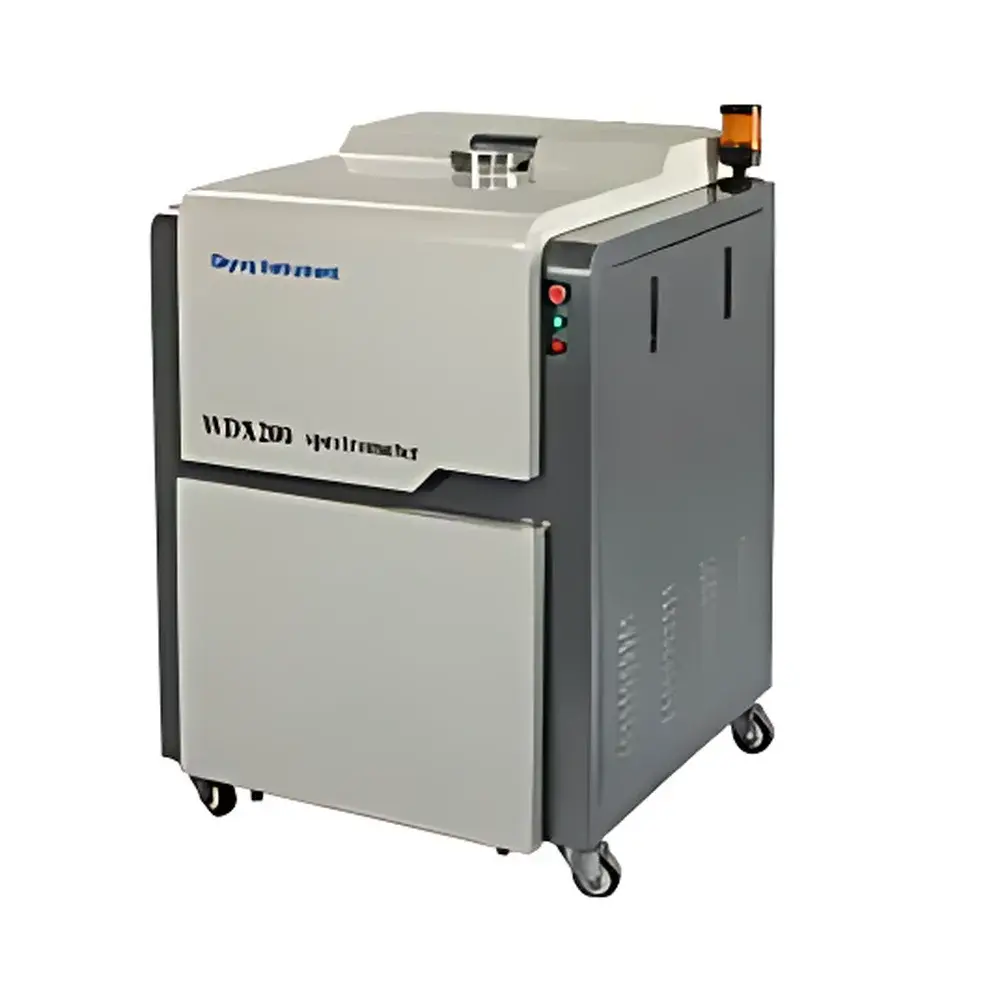
Skyray Instrument WDX200 Wavelength Dispersive X-Ray Fluorescence Spectrometer
| Brand | Skyray Instrument |
|---|---|
| Origin | Jiangsu, China |
| Manufacturer Type | Direct Manufacturer |
| Product Origin | Domestic (China) |
| Model | WDX200 |
| Pricing | Available Upon Request |
Overview
The Skyray Instrument WDX200 is a compact, multi-channel wavelength dispersive X-ray fluorescence (WDXRF) spectrometer engineered for high-precision elemental analysis in industrial quality control laboratories. Based on Bragg diffraction of characteristic X-rays from crystalline analyzing crystals, the WDX200 employs sequential or simultaneous detection of fluorescent radiation emitted by samples under primary X-ray excitation. Its fixed multi-channel architecture—supporting up to 10 dedicated spectral channels—enables rapid, interference-free quantification of elements from sodium (Na, Z=11) to uranium (U, Z=92). Designed specifically for routine analysis in cement production facilities, the system delivers robust performance under continuous operation, meeting the reproducibility and long-term stability requirements of ISO 12677 (Cement — Determination of chemical composition by X-ray fluorescence), ASTM C114 (Standard Test Methods for Chemical Analysis of Hydraulic Cement), and internal QA/QC protocols aligned with ISO/IEC 17025.
Key Features
- Fixed multi-channel configuration with 10 independent spectrometric channels, each equipped with a dedicated analyzing crystal, collimator, and detector assembly
- High-stability X-ray source: 400 W end-window Rh-target X-ray tube (Pd optional) with thin beryllium window for enhanced light-element transmission
- Dual-detector system: Flow-proportional counter for light elements (Na–Mg–Al–Si–P–S–Cl) and sealed proportional counter for medium-to-heavy elements (K–U), each coupled to a 1024-channel pulse height analyzer
- Precision temperature-controlled vacuum chamber: Thermal stability maintained at ±0.1 °C via integrated constant-temperature enclosure, minimizing thermal drift of crystal lattice parameters and detector gain
- High-vacuum measurement chamber: Base pressure <5 Pa achieved via dedicated two-phase 2 L/s rotary vane pump; independent pump station design facilitates maintenance without system downtime
- Gas-flow stabilization: High-accuracy gas density regulation system maintaining flow pressure stability within ±0.003 kPa—critical for consistent proportional counter gain and energy resolution
- Power supply integrity: 200 W high-voltage generator (0–50 kV / 0–4 mA) with 12-hour output stability better than 0.05%, supported by 1 kVA line-conditioned AC input
Sample Compatibility & Compliance
The WDX200 accepts both pressed powder pellets (e.g., cement clinker, limestone, fly ash) and fused beads, as well as solid blocks (e.g., sintered refractories, cast alloys). Sample changers support automated batch processing with integrated vacuum cycling (<3–5 min per sample including evacuation). All analytical methods—including empirical coefficient calibration and fundamental parameter (α-factor) correction—are fully documented and traceable, supporting GLP-compliant data integrity. Software logs include full audit trails for method parameters, calibration updates, and instrument status events. The system supports 21 CFR Part 11–compliant user access control when deployed with validated software configurations, and interfaces with plant-level DCS/QCS systems via RS-232 and TCP/IP protocols.
Software & Data Management
The embedded analysis software provides dual quantitative methodologies: empirical coefficient-based calibration (requiring matrix-matched standards) and theoretical α-coefficient modeling (enabling standardless semi-quantitative screening). Full-spectrum monitoring enables real-time peak tracking, automatic background subtraction, and inter-channel interference correction. All spectral acquisitions are time-stamped and stored with metadata (sample ID, operator, date/time, vacuum status, HV settings). Raw spectra, processed results, and diagnostic logs are exportable in CSV, XML, and PDF formats. Built-in self-diagnostic routines continuously monitor detector count rates, vacuum integrity, temperature deviation, and high-voltage ripple—alerting operators prior to performance degradation.
Applications
- Cement manufacturing: Rapid determination of SiO₂, Al₂O₃, Fe₂O₃, CaO, MgO, SO₃, K₂O, Na₂O, Cl⁻, and free lime content per ASTM C114 and EN 196-2
- Metallurgy: Alloy grade verification (Fe, Mn, Cr, Ni, Mo, V) in steelmaking slags and ferroalloys
- Coal & power generation: Quantification of ash-forming elements (Si, Al, Fe, Ca, Mg, S, Ti) and toxic trace metals (As, Pb, Hg)
- Geology & mining: Bulk geochemical profiling of ores, tailings, and exploration core samples
- Ceramics & glass: Control of raw material composition (feldspar, kaolin, quartz, soda ash) and contaminant screening (Cr, Co, Cd)
- Environmental testing: Heavy metal screening in soils, sediments, and industrial dusts per EPA Method 6200
FAQ
What elements can the WDX200 analyze simultaneously?
It detects up to 10 elements concurrently, selectable from Na (Z=11) to U (Z=92), based on crystal/detector channel configuration.
Is fusion bead preparation required for cement analysis?
Not mandatory—pressed pellets are routinely used for routine QC; fused beads improve accuracy for heterogeneous or volatile-rich samples.
How does the WDX200 ensure long-term calibration stability?
Through active thermal stabilization (±0.1 °C), high-vacuum consistency (<5 Pa), pressure-regulated gas flow (±0.003 kPa), and real-time spectral diagnostics.
Can the system integrate with existing LIMS or MES platforms?
Yes—via standardized RS-232 serial interface or Ethernet (TCP/IP), supporting structured data exchange using ASCII or XML schemas.
What maintenance intervals are recommended for the vacuum system?
Oil changes every 6 months; pump inspection and seal replacement annually—facilitated by the modular, standalone pump station design.
Related Products





