
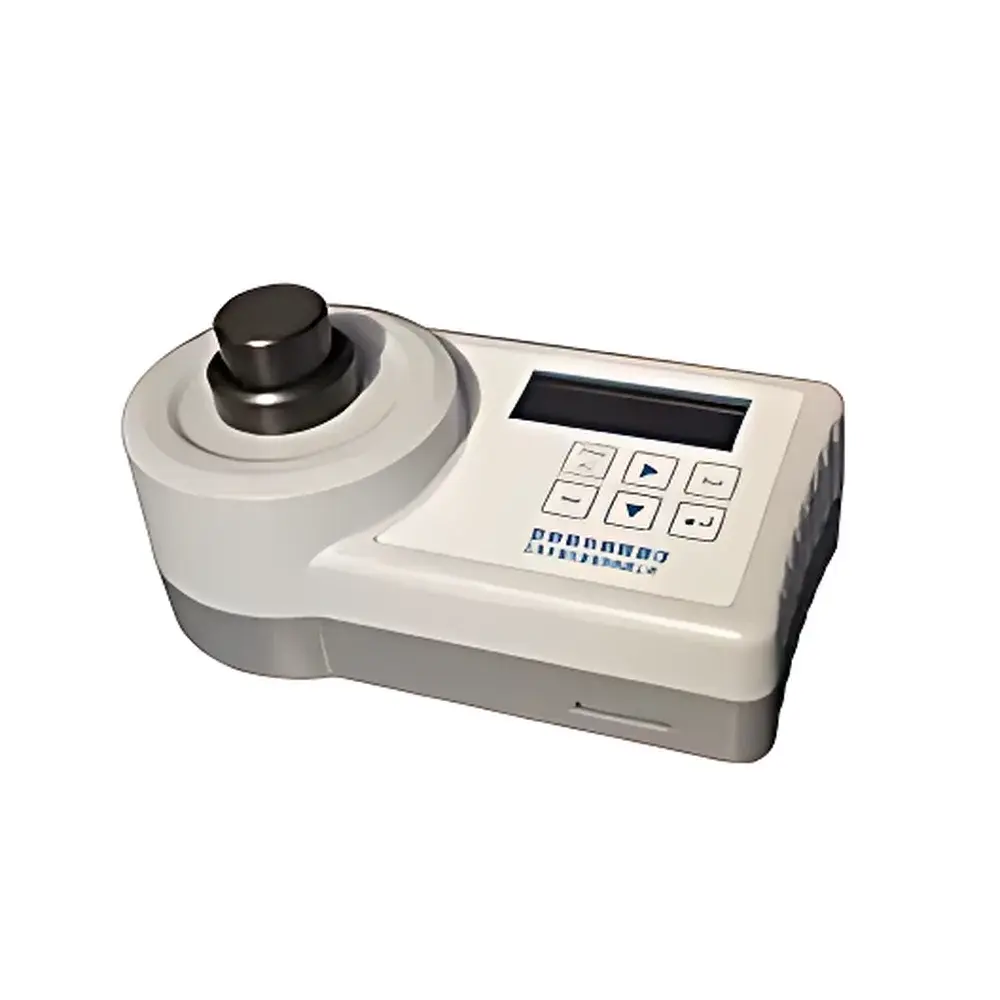
SkyRay WM-3000P Portable Multi-Parameter Water Quality Analyzer
| Brand | SkyRay Instrument |
|---|---|
| Origin | Jiangsu, China |
| Manufacturer Type | Direct Manufacturer |
| Product Category | Domestic |
| Model | WM-3000P |
| Instrument Type | Portable |
| Measurement Principle | Colorimetric Spectrophotometry (DAP/DPD-based for chlorine species |
| Measured Parameters | Free Chlorine, Total Chlorine, Chemical Oxygen Demand (COD) |
| Measurement Range | 0.02–1000 mg/L |
| Accuracy | ≤ ±5% of reading |
| Repeatability | ≤ ±5% RSD |
| Resolution | 0.01 ppm |
| Limit of Detection | 0.01 ppm |
| Power Supply | Two 1.5 V AA batteries (72 h continuous operation) or 220 VAC-to-3 VDC adapter |
| Data Storage | Internal non-volatile memory with timestamped records (date, time, parameter ID, sample ID, result) |
| Ingress Protection | IP41 (dust-protected, vertically dripping water resistant) |
| Compliance | Designed to support ASTM D1253, ISO 7393-2 (chlorine), and ISO 6060 (COD) methodology alignment |
Overview
The SkyRay WM-3000P Portable Multi-Parameter Water Quality Analyzer is an engineered field-deployable instrument designed for on-site quantification of critical regulatory parameters in wastewater effluents, drinking water distribution systems, and industrial discharge streams. It employs standardized colorimetric spectrophotometric detection principles: N,N-diethyl-p-phenylenediamine (DPD) chemistry for free and total residual chlorine measurement, and acidified potassium dichromate digestion followed by photometric determination at 600 nm for Chemical Oxygen Demand (COD). The system integrates optical path stability, temperature-compensated LED light sources, and calibrated solid-state photodetectors to ensure high reproducibility across variable ambient conditions. Its architecture adheres to the fundamental metrological requirements for field-use analytical instruments—robustness, minimal operator dependency, and traceable calibration pathways—making it suitable for routine compliance monitoring under environmental regulatory frameworks such as China’s HJ 501–2009 and HJ 586–2010, while maintaining methodological compatibility with internationally recognized standards.
Key Features
- Simultaneous direct-read capability for free chlorine, total chlorine, and COD without manual reagent switching or external software intervention
- Pre-loaded, factory-validated calibration curves for each parameter group, with automatic curve selection based on measured absorbance range
- Integrated auto-zero and auto-calibration functions using user-defined standard concentrations, reducing drift-related errors during extended field campaigns
- Non-volatile internal memory storing ≥10,000 timestamped results (YYYY-MM-DD HH:MM:SS, parameter code, sample ID, numeric result, operator tag)
- MicroSD card slot enabling secure bulk data transfer to laboratory information management systems (LIMS) or spreadsheet analysis platforms
- Ruggedized housing rated IP41, tested for operational reliability at ambient temperatures from 5 °C to 40 °C and relative humidity up to 85% non-condensing
- Triple-power configuration: dual AA alkaline cells (72 h typical runtime), universal AC/DC adapter (220 VAC input, regulated 3 VDC output), and optional USB-powered operation mode
Sample Compatibility & Compliance
The WM-3000P is validated for use with clarified aqueous samples having turbidity < 5 NTU and suspended solids < 20 mg/L. For COD analysis, it requires prior digestion using the companion WD-100 Portable Digestion Unit—designed per sealed-tube micro-reflux methodology compliant with ISO 6060 Annex A. Chlorine measurements follow EPA 334.0 and ISO 7393-2 protocols, utilizing DPD reagents certified to meet ACS-grade purity specifications. All internal calibration routines are traceable to NIST-traceable reference standards (e.g., potassium permanganate for oxidant equivalence, potassium hydrogen phthalate for COD). The device supports audit-ready documentation: every stored record includes immutable metadata (acquisition timestamp, firmware version, calibration status flag), satisfying GLP-aligned data integrity expectations for regulated environmental testing.
Software & Data Management
No proprietary desktop software is required for basic operation. Data export occurs via FAT32-formatted microSD cards containing CSV files with UTF-8 encoding and ISO 8601 timestamps. Each file header contains instrument serial number, firmware revision, and default unit conventions (mg/L as Cl₂, mg/L O₂). Optional LIMS integration is supported through configurable delimiter-separated import templates. Firmware updates are delivered via signed binary packages verified using SHA-256 checksums; update logs are retained in device memory with version stamping. The system does not implement FDA 21 CFR Part 11 electronic signature functionality but provides full audit trail visibility for all calibration events, measurement sessions, and memory write operations.
Applications
- Regulatory compliance verification for municipal wastewater treatment plant (WWTP) final effluent discharge points
- Real-time process control in chlorine contact tanks and post-filtration disinfection stages of drinking water facilities
- Industrial pretreatment monitoring for electroplating, pharmaceutical, and food processing facilities subject to local discharge limits
- Field validation of online analyzers during commissioning or periodic performance checks
- Educational laboratories requiring portable, curriculum-aligned instrumentation for environmental chemistry modules
- Emergency response scenarios involving accidental chemical release into surface water bodies
FAQ
What digestion method is required for COD measurement with the WM-3000P?
The instrument requires pre-digestion using the WD-100 Portable Digestion Unit, which implements a sealed, micro-reflux dichromate oxidation protocol at 150 °C for 2 hours—aligned with ISO 6060.
Can the WM-3000P measure combined chlorine (chloramines)?
Yes. Total chlorine minus free chlorine (both measured sequentially using DPD methods #1 and #4) yields combined chlorine concentration, following APHA Standard Methods 4500-Cl G.
Is the instrument compatible with third-party LIMS platforms?
Yes—CSV exports contain structured fields compatible with common LIMS ingestion engines; custom mapping templates are available upon request.
Does the device support multi-point calibration for COD?
It stores up to five user-defined calibration points per parameter, with linear regression applied automatically during measurement.
How is measurement traceability maintained?
Each calibration event logs the standard concentration used, date/time, operator ID (if entered), and resulting slope/intercept values—retained indefinitely in protected memory.
Related Products







