
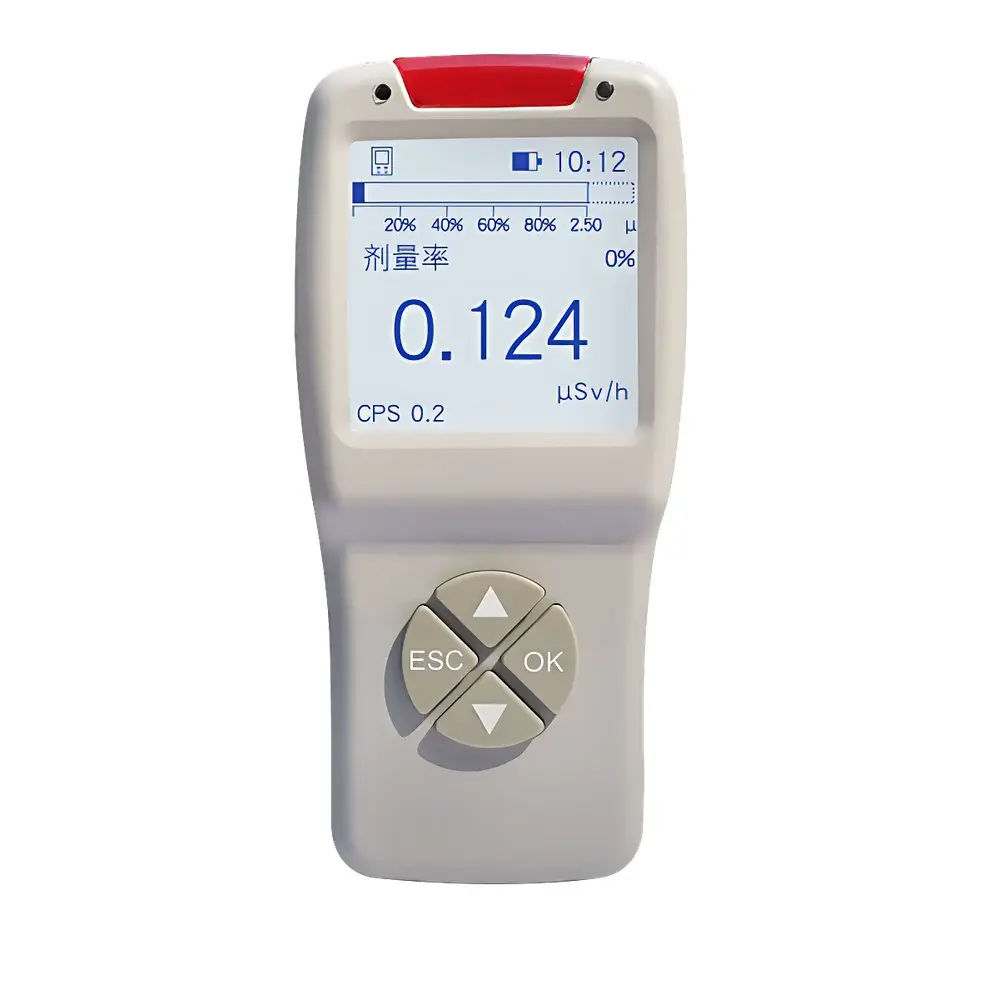
SMACH RD200 Portable Radiation Detector
| Brand | SMACH |
|---|---|
| Model | RD200 |
| Type | Portable Dose Rate & Integrated Dose Meter |
| Detector | Energy-Compensated Geiger-Müller Tube |
| Radiation Type | X-ray and Gamma (γ) |
| Dose Rate Range | 0.01 µSv/h to 15 mSv/h (optional up to 150 mSv/h) |
| Sensitivity | 5 CPS per µSv/h (optional 1200 CPS/µSv/h) |
| Energy Range | 48 keV – 3.0 MeV |
| Energy Response | ≤ ±30% |
| Accuracy | ≤ ±8% |
| Display Units | µSv/h, mSv/h, Sv/h, Gy/h, CPS, µSv, mSv, Sv, Gy |
| Operating Temperature | −10 °C to +50 °C |
| Weight | 280 g (incl. battery) |
| Dimensions | 165 × 72 × 38 mm |
| Power | Rechargeable Li-ion battery |
| Power Consumption | ≤120 mW (excl. backlight) |
| Compliance | Designed for IEC 60846-1:2014 (Radiation protection instrumentation — Dose rate meters and ambient and/or directional dose equivalent rate meters for beta, X and gamma radiation) |
Overview
The SMACH RD200 Portable Radiation Detector is a compact, field-deployable instrument engineered for real-time measurement of ambient dose equivalent rate (H*(10)) and integrated dose accumulation from X-ray and gamma (γ) radiation fields. It employs an energy-compensated Geiger-Müller (GM) tube—optimized to deliver flat energy response across 48 keV to 3.0 MeV—enabling reliable dose rate estimation without energy-dependent over- or under-response typical of uncompensated detectors. Unlike scintillation or semiconductor-based systems, the RD200 leverages robust GM technology for high sensitivity (5 counts per second per µSv/h), rapid response (<1 s for 90% of full-scale reading), and stable operation in variable environmental conditions (−10 °C to +50 °C). Its dual-mode functionality—simultaneous real-time dose rate monitoring and cumulative dose logging—supports both instantaneous hazard assessment and long-term exposure tracking, making it suitable for routine radiological surveys, emergency response, and regulatory compliance verification.
Key Features
- Energy-compensated GM detector with ≤ ±30% energy response deviation over 48 keV–3.0 MeV, compliant with IEC 60846-1:2014 reference requirements for ambient dose equivalent rate meters.
- Dual-threshold alarm system: independently configurable dose rate and integrated dose limits, with automatic timestamped event logging (including date, time, dose rate, and accumulated dose at trigger).
- High-contrast LCD display with auto-adjusting backlight—intensity modulated by ambient light sensor to preserve battery life and ensure readability in low-light or outdoor environments.
- Multi-modal alerting: user-selectable combinations of audible beep (85 dB @ 30 cm), visible LED flash, and tactile vibration—critical for noisy or hands-free operational scenarios.
- Real-time graphical overlay: simultaneous plot of current dose rate and user-defined alarm thresholds on a single time-synchronized axis, facilitating immediate trend interpretation.
- Integrated real-time clock (RTC) with non-volatile memory for audit-trail-capable event logging—supporting GLP/GMP-aligned record retention practices.
- Low-power architecture: total system consumption ≤120 mW (excluding backlight), enabling >100 hours of continuous operation on a single charge of the internal rechargeable Li-ion battery.
Sample Compatibility & Compliance
The RD200 is calibrated for photons emitted by common radioactive sources including 137Cs (662 keV), 60Co (1.17 & 1.33 MeV), and 241Am (59.5 keV), and maintains accuracy within ±8% across its specified range (0.01 µSv/h to 15 mSv/h; optional extended range to 150 mSv/h). It meets the performance criteria for portable survey meters outlined in IEC 60846-1:2014 and is suitable for applications requiring conformance with national radiation protection regulations—including those aligned with IAEA Safety Standards Series No. GSR Part 3 and EU Council Directive 2013/59/Euratom. The instrument does not require source-specific calibration for routine environmental or occupational monitoring, though periodic traceable verification against accredited reference fields (e.g., ISO 4037-1 narrow-spectrum series) is recommended per ISO/IEC 17025 quality management requirements.
Software & Data Management
Data export is supported via USB interface (CDC class, no driver required) to standard Windows/macOS/Linux hosts. Logged events—including alarms, dose rate snapshots, and cumulative dose increments—are stored in CSV format with ISO 8601 timestamps (YYYY-MM-DDTHH:MM:SSZ). The embedded memory retains ≥10,000 timestamped records. While the RD200 operates autonomously without proprietary software, its structured output enables seamless ingestion into laboratory information management systems (LIMS), radiation safety databases, or custom dashboards. Audit trails comply with ALARA documentation principles and support FDA 21 CFR Part 11–aligned electronic record integrity when paired with validated host-side validation protocols.
Applications
- Radiation safety officers conducting routine area surveys in nuclear medicine departments, radiotherapy bunkers, and PET cyclotron facilities.
- Customs and border inspection units screening cargo, scrap metal, and imported goods for orphan sources or illicit radioactive materials.
- Environmental health agencies performing post-incident monitoring following transportation accidents or facility leaks involving sealed sources.
- Geological prospecting teams assessing natural background variability and identifying anomalous uranium/thorium-bearing formations.
- Decommissioning contractors verifying residual dose rates during nuclear facility dismantling and waste characterization.
- Emergency response teams deploying rapid reconnaissance in radiological dispersal device (RDD) or lost-source scenarios.
FAQ
What radiation types does the RD200 detect?
The RD200 is optimized for X-ray and gamma (γ) photon detection. It is not sensitive to alpha or beta particles due to the detector’s inherent window attenuation and geometry.
Is the RD200 suitable for personal dosimetry?
No—it is a survey meter intended for ambient dose rate assessment, not individual dose assignment. For personnel monitoring, use TLD or OSL dosimeters compliant with ISO 14146 and IEC 62387.
How often should the instrument be calibrated?
Annual calibration against traceable standards is recommended. Field verification using check sources (e.g., 137Cs or 241Am) prior to critical measurements is advised per ANSI N323A.
Can the alarm thresholds be customized in the field?
Yes—both dose rate and cumulative dose thresholds are fully programmable via intuitive menu navigation, with settings retained after power cycling.
Does the RD200 meet international shipping requirements for air transport?
Yes—the device contains no hazardous materials beyond the Li-ion battery (UN3481, PI 967 Section II), and complies with IATA Dangerous Goods Regulations for instrument shipment.







