
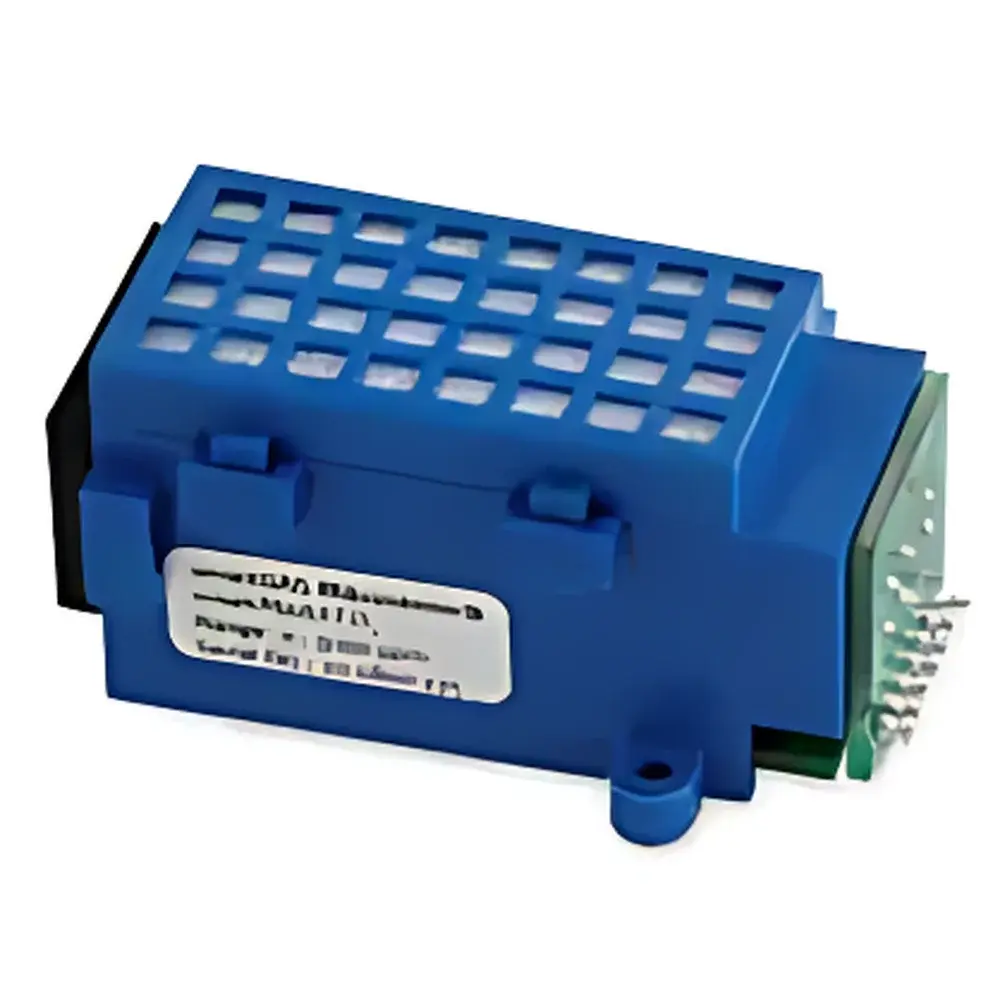
SmartGas CO Sensor – Infrared Dual-Beam Carbon Monoxide Detector
| Brand | SmartGas |
|---|---|
| Origin | Germany |
| Model | CO Sensor |
| Detection Principle | Non-Dispersive Infrared (NDIR) with Dual-Beam Compensation |
| Operating Lifetime | ≥10 years |
| Output Interface | RS-485 Modbus RTU |
| Sensitivity | Sub-ppm detection capability |
| Compliance | CE, RoHS, ATEX Category II 2G (optional), IEC 61000-6-2/6-3 EMC |
Overview
The SmartGas CO Sensor is a high-reliability, industrial-grade carbon monoxide (CO) detection module engineered for continuous ambient air monitoring in demanding environmental, occupational safety, and process control applications. Built upon non-dispersive infrared (NDIR) spectroscopy with dual-beam optical compensation, this sensor eliminates drift caused by light source aging, dust accumulation, or temperature-induced signal variation—ensuring stable baseline performance over extended deployment cycles. Unlike electrochemical or metal-oxide semiconductor (MOS) sensors, the NDIR platform delivers inherent selectivity to CO without cross-sensitivity to H2, CH4, CO2, or volatile organic compounds (VOCs), making it suitable for multi-gas environments where false alarms must be minimized. Designed and assembled in Germany under strict quality control protocols, the sensor meets international requirements for long-term stability and low maintenance in fixed-installation gas detection systems.
Key Features
- Dual-Beam NDIR Architecture: Employs a reference channel and active measurement channel within a single optical path to dynamically compensate for optical attenuation, enabling drift-free operation across temperature ranges from −20 °C to +50 °C.
- 10-Year Design Lifetime: Optimized IR source and detector assembly, combined with hermetically sealed optical chamber, ensures functional integrity without recalibration for up to 120 months under typical indoor or sheltered outdoor conditions.
- Modbus RTU Digital Interface: Standard RS-485 output enables seamless integration into SCADA, BMS, and PLC-based monitoring infrastructures; supports configurable polling intervals, alarm thresholds, and diagnostic status registers per Modbus function codes 03h and 06h.
- High Signal-to-Noise Ratio: Achieves sub-part-per-million (sub-ppm) resolution in standard 0–100 ppm measurement range, with optional extended ranges (e.g., 0–500 ppm) available for industrial combustion or tunnel ventilation applications.
- Robust Mechanical Construction: IP65-rated housing with stainless steel mounting flange and corrosion-resistant optical window; compatible with DIN rail or wall-mount configurations per EN 60715.
Sample Compatibility & Compliance
This CO sensor is calibrated for use in clean, dry, non-condensing ambient air at atmospheric pressure (±10 %). It is not intended for direct exposure to corrosive gases (e.g., Cl2, SO2, H2S), high-humidity (>90 % RH) condensing environments, or particulate-laden airstreams without upstream filtration. The device complies with EU directives including CE marking under the Electromagnetic Compatibility Directive 2014/30/EU and RoHS 2011/65/EU. Optional ATEX-certified variants (II 2G Ex db IIC T4 Gb) are available for installation in Zone 1 hazardous areas. All units undergo factory calibration traceable to NIST-traceable CO reference standards and support user-initiated zero/span verification using certified gas cylinders (ISO 6141).
Software & Data Management
The sensor operates autonomously but interfaces with host systems via open-protocol Modbus RTU. No proprietary software is required for basic operation; however, SmartGas provides a Windows-based configuration utility (SG-ConfigTool) for advanced setup—including linearization coefficient adjustment, analog output mapping (if equipped), and firmware updates. Data logging, alarm event timestamping, and health diagnostics (e.g., signal strength, temperature deviation, lamp intensity decay) are accessible through standard Modbus registers. When deployed in regulated environments (e.g., pharmaceutical cleanrooms or wastewater treatment facilities), the sensor’s deterministic response time (<15 s T90) and audit-ready digital output support compliance with ISO 14644-1, EN 14687, and FDA 21 CFR Part 11 requirements when paired with validated data acquisition software.
Applications
- Indoor air quality (IAQ) monitoring in office buildings, schools, and underground parking garages
- Continuous emission monitoring (CEM) of CO from boiler stacks, incinerators, and industrial furnaces
- Occupational safety systems in confined spaces (tunnels, mines, utility vaults)
- Fire detection pre-alarm layer in HVAC ductwork and smoke management systems
- Process control feedback in syngas production, catalytic converters, and fuel cell test benches
FAQ
What is the recommended calibration interval?
Annual calibration is advised for critical safety applications; biennial calibration may be justified in stable environments with documented historical stability data per ISO 45001 Annex A.9.2.
Can this sensor be used in oxygen-deficient atmospheres?
Yes—the NDIR principle does not require ambient O2; however, operation below 10 % O2 may affect thermal management and should be verified against site-specific risk assessment.
Is field replacement of the optical module possible?
No—the optical assembly is factory-sealed and non-serviceable; full unit replacement is required if optical performance degrades beyond specification limits.
Does the sensor support HART or 4–20 mA analog output?
The base model features RS-485 Modbus only; hybrid versions with simultaneous 4–20 mA + Modbus are available upon request (model suffix “-A”)
Related Products







