
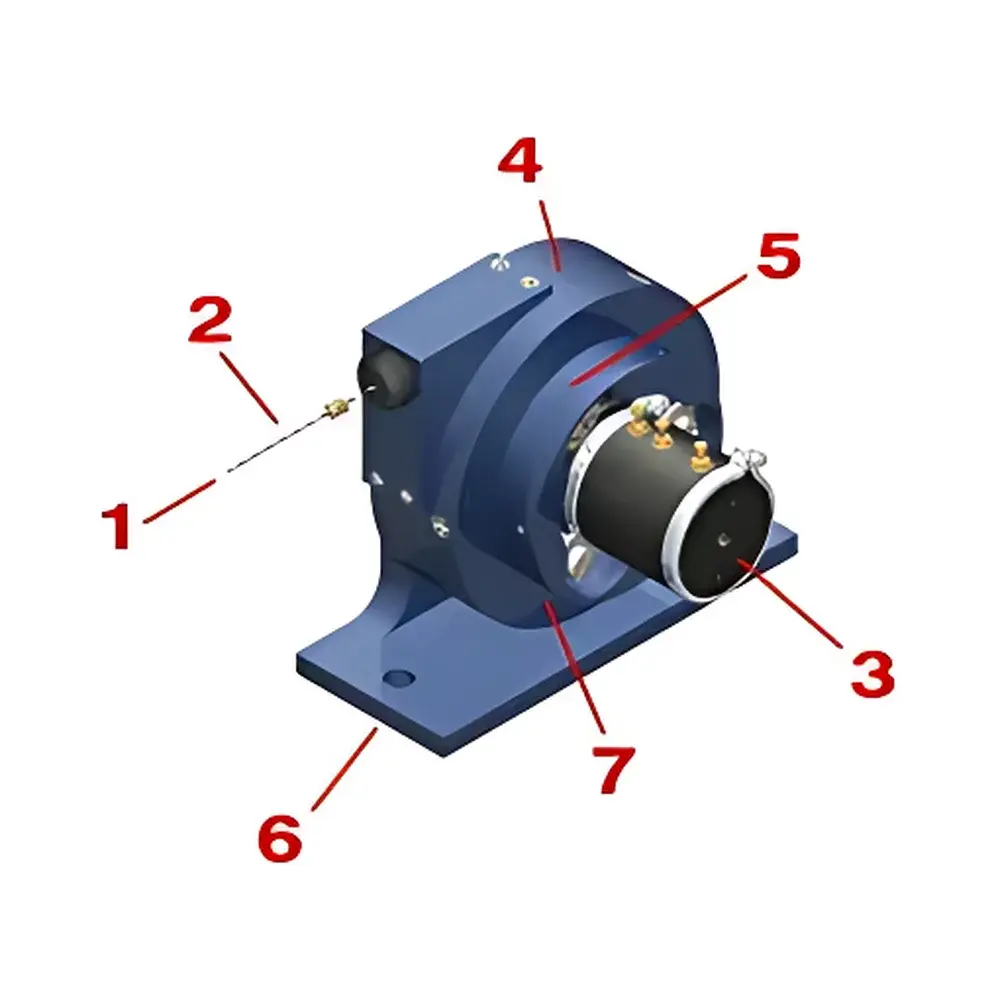
SmartGas YK161H-YK162H High-Tension Displacement Sensor
| Brand | SmartGas |
|---|---|
| Origin | Germany |
| Manufacturer Type | Authorized Distributor |
| Origin Category | Imported |
| Model | YK161H–YK162H |
| Measurement Range | 0–1079.5 mm (15 standard variants) |
| Dimensions (YK161H) | 46.0 mm × 57.9 mm × 41.2 mm |
| Weight | 198 g |
Overview
The SmartGas YK161H–YK162H High-Tension Displacement Sensor is a precision-engineered linear position transducer designed for demanding structural monitoring and environmental infrastructure applications. Unlike conventional LVDT or potentiometric displacement sensors, this series employs a robust tensioned-cable architecture—where a stainless-steel measuring cable is pre-stressed under controlled axial load—to minimize mechanical hysteresis and enhance dynamic response. The sensor operates on the principle of proportional cable extension measurement via high-resolution rotary encoder feedback, delivering stable analog output (e.g., 0–10 V or 4–20 mA) directly correlated to absolute linear displacement. Its primary deployment context includes real-time monitoring of cable-supported structures (e.g., suspension bridges, guyed masts), geotechnical movement detection (e.g., landslide-prone slopes, retaining walls), and industrial tension-control systems where long-term drift resistance and mechanical ruggedness are critical.
Key Features
- Pre-tensioned stainless-steel measuring cable engineered for high-frequency response and low phase lag—optimized for dynamic displacement events up to 100 Hz bandwidth.
- “Heavy-foot” aluminum alloy baseplate with integrated M6 threaded mounting holes and anti-rotation flange geometry—ensures mechanical stability under vibrational loading and thermal cycling.
- Fifteen standardized range variants spanning 0–100 mm to 0–1079.5 mm, enabling precise selection for application-specific stroke requirements without signal interpolation.
- Compact form factor (46.0 × 57.9 × 41.2 mm for YK161H) with IP65-rated housing—suitable for outdoor enclosures, weatherproof junction boxes, or direct mounting in semi-exposed civil infrastructure environments.
- Temperature-compensated analog output circuitry (±0.02 %FS/°C typical drift coefficient) and internal ESD protection (IEC 61000-4-2 Level 3).
- No moving parts beyond the cable spool—eliminates wear-related calibration drift and supports >10 million full-scale cycles per unit lifetime.
Sample Compatibility & Compliance
The YK161H–YK162H series is compatible with both static and quasi-dynamic displacement measurements in ambient temperatures from −25 °C to +70 °C and relative humidity ≤95 % RH (non-condensing). It interfaces seamlessly with industry-standard data acquisition systems (e.g., Campbell Scientific CR-series, National Instruments CompactDAQ, Siemens Desigo CC) via isolated voltage/current outputs. While not classified as a gas detection device per se, its integration into environmental monitoring platforms—including those deployed alongside SmartGas gas alarm systems (e.g., YK160-series toxic gas transmitters)—enables correlated structural integrity assessment during hazardous gas release events (e.g., detecting anchor point displacement during pipeline rupture scenarios). The sensor complies with EN 61326-1 (EMC for industrial environments), EN 61000-6-2/6-4 (immunity/emission standards), and meets RoHS 2011/65/EU material restrictions. CE marking confirms conformity with EU Machinery Directive 2006/42/EC for safety-integrated components.
Software & Data Management
Raw analog signals from the YK161H–YK162H are typically digitized using external DAQ hardware supporting 16-bit or higher resolution ADCs. SmartGas provides optional configuration utilities (Windows-based, USB-connected) for zero/span calibration verification and output scaling—though field recalibration is rarely required due to the sensor’s passive mechanical design and thermal compensation architecture. When integrated into centralized SCADA or cloud-based environmental monitoring platforms (e.g., Siemens Desigo, Honeywell Experion PKS), displacement data is time-stamped, tagged with device ID and range configuration, and stored with audit-trail metadata compliant with ISO/IEC 17025 traceability requirements. Optional Modbus RTU firmware upgrade enables direct serial integration into legacy control networks without intermediary signal conditioning.
Applications
- Structural health monitoring (SHM) of cable-stayed bridges, transmission towers, and wind turbine guy wires.
- Geotechnical instrumentation for slope stability surveillance, dam deformation tracking, and tunnel convergence measurement.
- Industrial tension monitoring in overhead crane rail alignment systems, conveyor belt tracking mechanisms, and press-fit assembly verification.
- Calibration reference for secondary displacement transducers in metrology labs accredited to ISO/IEC 17025.
- Redundant position feedback in fail-safe emergency shutdown systems for chemical storage facilities—where mechanical displacement correlates with containment breach risk.
FAQ
Is the YK161H–YK162H certified for use in hazardous (ATEX/IECEx) zones?
No. This sensor is rated for general industrial environments only and lacks intrinsic safety certification. It must be installed outside classified zones or within explosion-proof enclosures if deployed near flammable gas sources.
Can multiple units be daisy-chained on a single analog input channel?
No. Each sensor requires dedicated signal wiring and isolation to prevent ground loops and crosstalk. Multiplexing is only supported via digital bus protocols (e.g., Modbus RTU) with appropriate firmware.
What is the recommended cable anchoring method for optimal linearity?
A fixed, non-rotating anchor point with ≥3× cable diameter radius bend radius must be used. Sharp bends or frictional guides degrade repeatability and accelerate cable fatigue.
Does SmartGas provide NIST-traceable calibration certificates?
Yes—upon request, factory calibration reports with uncertainty budgets (k=2) per ISO/IEC 17025 are available at additional cost. Field recalibration is not recommended due to mechanical self-calibrating design.
Is firmware or software update capability built into the sensor?
Only models with optional Modbus RTU firmware support over RS-485. Analog-output-only variants (standard configuration) are hardware-defined and immutable.
Related Products







