
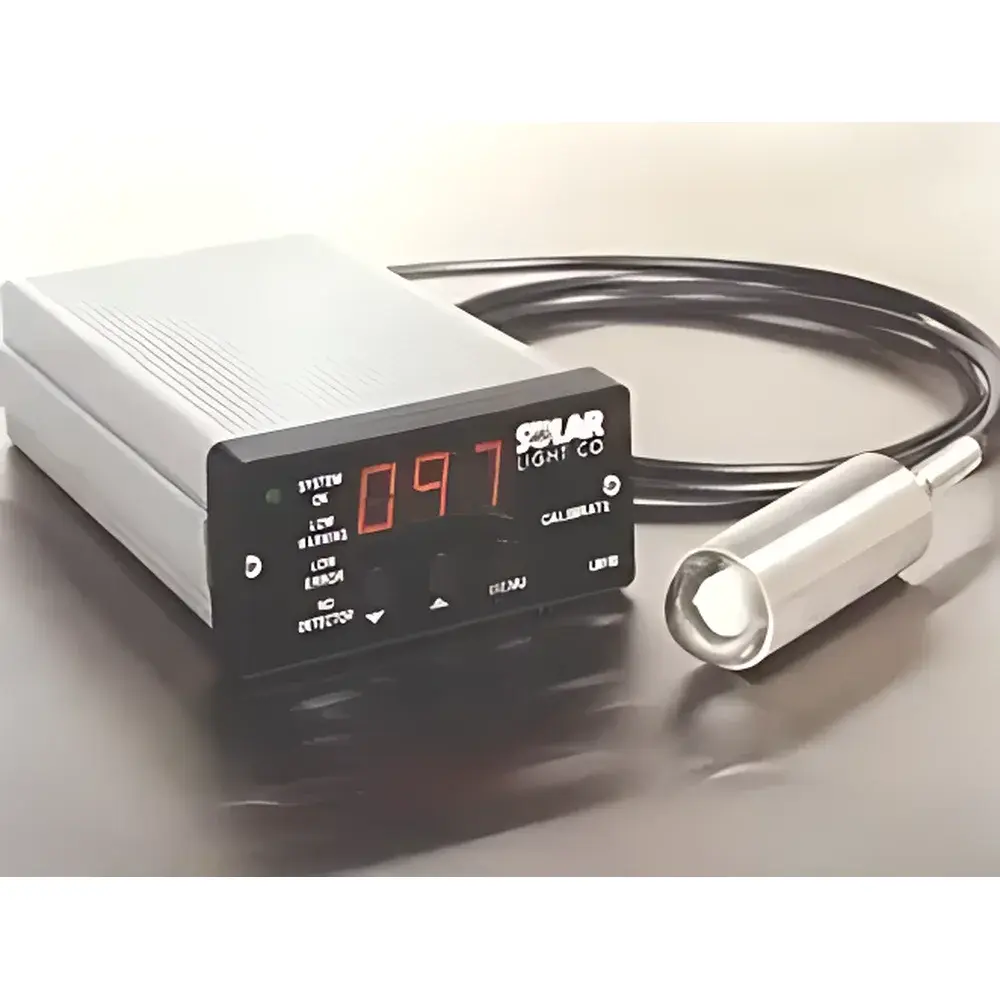
Solar Light GLM100 UV Germicidal Lamp Monitor
| Brand | Solar Light |
|---|---|
| Origin | USA |
| Model | GLM100 |
| Detector Type | Submersible UV-C Radiometer (253.7 nm peak) |
| Spectral Range | 210–380 nm |
| Output Signal Compatibility | 4–20 mA (two-wire), analog 0–100% display |
| Power Input | AC or DC |
| Calibration | Single-step, field-adjustable |
| Alarm Output | Relay-controlled external alarm |
| Display | 0.56" high-visibility LED, % intensity readout |
| Indicator | Multicolor status LEDs |
| Compliance | Designed for NSF/ANSI 55 Class A and EPA UV Disinfection Guidance compliant installations |
| Intended Use | Real-time monitoring of low-pressure mercury UV lamps in water disinfection systems |
Overview
The Solar Light GLM100 UV Germicidal Lamp Monitor is a dedicated, industrial-grade monitoring system engineered for continuous, real-time assessment of ultraviolet (UV-C) output from low-pressure mercury vapor lamps used in municipal and industrial water disinfection applications. It operates in conjunction with the UW-254 submersible UV-C radiometric sensor—optimized for the 253.7 nm germicidal emission line—which serves as the primary transducer in UV dose assurance protocols. The GLM100 processes analog signals from the UW-254 (or any compatible 4–20 mA UV sensor) to deliver a normalized, percentage-based intensity readout (0–100%), where 100% corresponds to the calibrated output of a clean, fully operational lamp under nominal operating conditions. Unlike broadband UV meters, the UW-254’s narrow spectral response (210–380 nm) ensures immunity to solar UV interference—even during submerged operation—making it suitable for open-channel, pipe-mounted, and reactor-integrated UV disinfection systems where ambient light exposure cannot be fully excluded.
Key Features
- Single-step field calibration: Enables rapid re-zeroing after lamp cleaning or replacement without requiring reference standards or external instrumentation.
- Dual power input flexibility: Accepts both AC and DC supply, supporting integration into existing control panels or standalone skid-mounted installations.
- Relay-based alarm interface: Provides dry-contact output for triggering external annunciators, SCADA inputs, or automatic lamp bank shutdown sequences when intensity falls below user-defined thresholds.
- High-contrast 0.56″ LED display: Delivers clear, at-a-glance visualization of relative UV intensity (0–100%) under variable lighting and wet-environment conditions.
- Multi-color status indicators: Green (normal operation), yellow (warning threshold approached), red (alarm condition or sensor fault) — enabling immediate visual diagnostics without display interpretation.
- Interchangeable sensor support: While optimized for Solar Light’s UW-254 submersible detector, the GLM100 accepts standard 4–20 mA two-wire inputs, facilitating compatibility with third-party UV-C sensors meeting IEC 60751 and NIST-traceable responsivity specifications.
Sample Compatibility & Compliance
The GLM100/UW-254 system is validated for use with low-pressure (LP) and amalgam low-pressure (LP-A) mercury UV lamps emitting predominantly at 253.7 nm. It is not intended for medium-pressure (MP) UV sources due to their broad spectral output and significant out-of-band irradiance. The UW-254 sensor housing is constructed from chemically resistant, UV-stable quartz and stainless steel (316L), rated for continuous submersion in potable water, wastewater effluent, and reclaimed water streams up to 40 °C. Its optical design eliminates cosine error across ±30° incident angles, ensuring accurate irradiance measurement regardless of flow-induced sensor orientation. The system supports compliance with key regulatory frameworks including NSF/ANSI 55 Class A (for point-of-use and point-of-entry systems), U.S. EPA Ultraviolet Disinfection Guidance Manual (2006), and ISO 15858:2016 (UV reactor validation requirements). Data logging and alarm events can be configured to meet GLP/GMP audit trail expectations when integrated with compliant SCADA or DCS platforms.
Software & Data Management
The GLM100 operates as a stand-alone analog monitor and does not include embedded firmware or network connectivity. However, its 4–20 mA output and relay alarm signal are fully compatible with industry-standard PLCs (e.g., Siemens S7, Allen-Bradley CompactLogix), DCS systems (e.g., Emerson DeltaV, Honeywell Experion), and cloud-enabled IIoT gateways. When paired with supervisory software such as Ignition SCADA or Inductive Automation, users can archive time-stamped intensity trends, generate maintenance logs, correlate lamp aging with flow rate and transmittance data, and trigger automated work orders upon sustained deviation from setpoints. All alarm states—including sensor disconnect, power loss, and out-of-range signal—are latched and visible via the front-panel LED indicators, satisfying basic functional safety requirements per IEC 61508 SIL 1 for non-critical monitoring functions.
Applications
- Real-time verification of UV lamp performance in municipal wastewater tertiary disinfection trains.
- Monitoring lamp output decay in drinking water treatment plants operating under UV dose-based regulatory compliance (e.g., U.S. Long Term 2 Enhanced Surface Water Treatment Rule).
- Preventive maintenance scheduling for UV reactor arrays in pharmaceutical water-for-injection (WFI) loop systems.
- Performance validation during UV reactor commissioning and periodic recalibration per ASTM D7096 and ISO/IEC 17025-accredited procedures.
- Integration into automated control logic for dynamic lamp staging or intensity modulation based on real-time UV transmittance (UVT) and flow rate inputs.
FAQ
Can the GLM100 be used with medium-pressure UV lamps?
No. The UW-254 detector’s spectral response is optimized for 253.7 nm and lacks sufficient sensitivity across the broader MP UV spectrum (200–400 nm); using it with MP lamps will result in inaccurate intensity reporting.
Is the UW-254 sensor suitable for installation in chlorinated water?
Yes. The quartz window and 316L stainless-steel body are resistant to chlorine concentrations typical in post-disinfection effluent (≤5 mg/L free chlorine), provided pH remains within 6.0–8.5.
Does the GLM100 support Modbus or other digital communication protocols?
No. It is an analog-only monitor. Digital integration requires external signal conversion via a compatible I/O module or gateway.
How often should the UW-254 sensor be cleaned?
Cleaning frequency depends on water quality; in wastewater applications, quarterly inspection and cleaning are recommended, while potable water systems may require only annual maintenance.
Can the 100% calibration point be adjusted for different lamp types or reactor geometries?
Yes. The single-step calibration allows field technicians to redefine “100%” at any time—e.g., after lamp replacement or reactor retrofit—to maintain traceability to current operational baselines.
Related Products







