
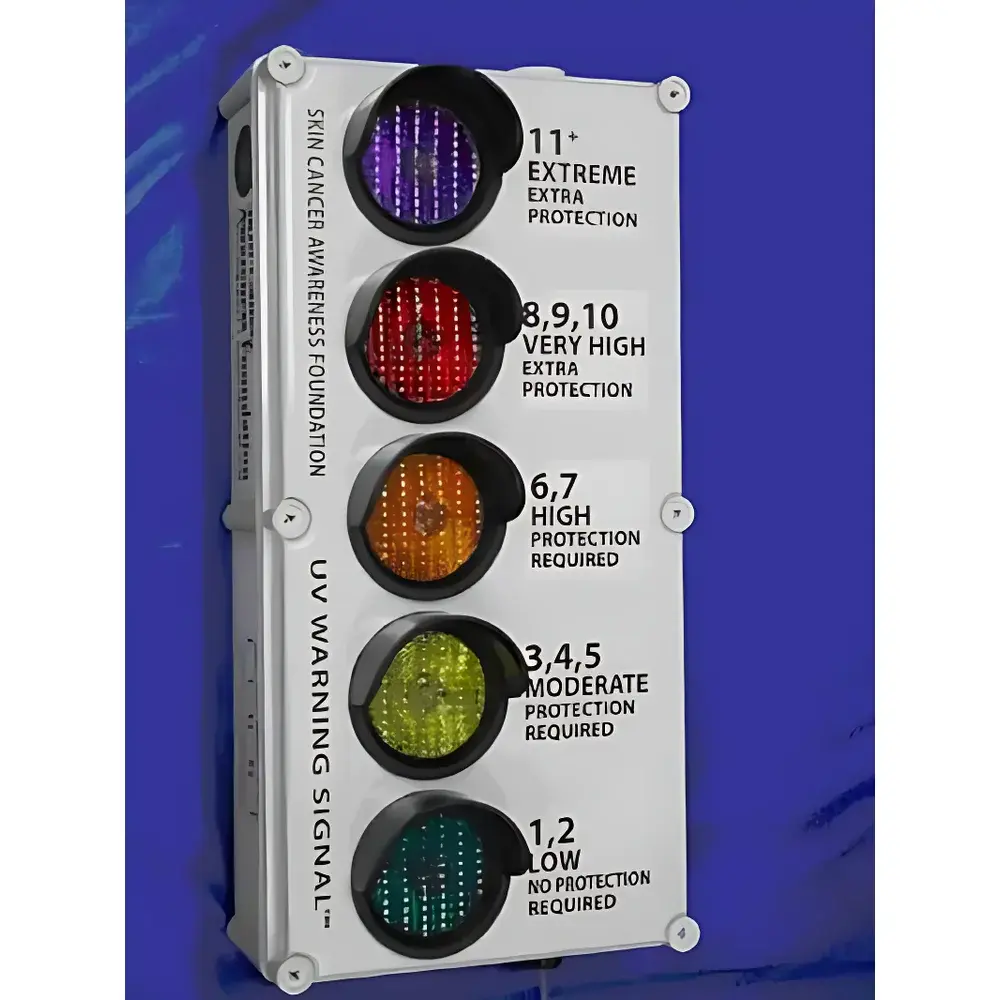
Solar Light Model 511 UV Index Signal Light
| Brand | Solar Light |
|---|---|
| Origin | USA |
| Manufacturer Type | Authorized Distributor |
| Product Origin | Imported |
| Model | Model 511 |
| Pricing | Upon Request |
| Spectral Range | 280–400 nm |
| Measurement Range | 0–16 UV Index |
| Angular Response | Within ±5% of ideal cosine response for incident angles < 70° |
| Operating Temperature | −30 to +55 °C |
| Environmental Rating | NEMA 4X |
| Display | Five-color LED array (Green → Red) |
| Sensor Type | Erythemally Weighted Photodiode |
| Calibration Interval | Every 24 months |
| Power Supply | 110 VAC, 60 Hz input |
| Sensor Cable Standard Length | 10 m (extendable) |
| Enclosure Dimensions | 61 cm H × 28 cm W × 18 cm D |
| Weight | 4.5 kg (10 lbs) |
| Power Cord Length | 30 m |
Overview
The Solar Light Model 511 UV Index Signal Light is a precision-engineered environmental monitoring device designed to provide real-time, visually intuitive indication of solar ultraviolet (UV) radiation intensity in accordance with the internationally standardized UV Index scale. Unlike laboratory-grade spectroradiometers or research-grade broadband radiometers, the Model 511 functions as a dedicated field-deployable indicator system—translating biologically weighted UV irradiance (280–400 nm) into a human-readable five-tier color-coded display aligned with WHO and U.S. EPA UV Index exposure categories. Its core sensor employs an erythemally weighted photodiode calibrated to the CIE standard action spectrum for skin erythema (ISO 17166:2019 / CIE S 007/E-1998), ensuring physiological relevance in sun safety communication. The instrument operates continuously under ambient outdoor conditions, delivering stable, maintenance-minimized performance across seasonal extremes—from sub-zero winter environments to high-irradiance summer conditions exceeding UV Index 10+. It is not intended for spectral analysis or quantitative dosimetry but serves as a robust, standards-compliant public health interface between solar UV exposure and behavioral risk mitigation.
Key Features
- NEMA 4X-rated enclosure: Fully sealed against windblown dust, rain, snow, and corrosion—validated for permanent outdoor installation in coastal, alpine, and high-humidity environments.
- Erythemally weighted optical sensing: Integrates Solar Light’s traceable, factory-calibrated broadband UV sensor with spectral responsivity closely matching the CIE erythema action curve (280–400 nm).
- High-luminance LED display: Five-color segmented indicator (green → yellow → orange → red → purple) visible at >50 m under direct sunlight; LEDs meet IEC 62471 photobiological safety requirements for Class 1 emission.
- Flexible sensor deployment architecture: Supports both co-located mounting (sensor integrated into signal housing) and remote sensor placement up to 100 m via optional extended cabling—ideal for shaded enclosures or multi-zone site monitoring.
- Low-voltage, safety-certified power system: 24 VAC isolated secondary supply eliminates need for GFCI or conduit in most municipal installations; transformer complies with UL 508 and CSA C22.2 No. 14.
- Traceable calibration & long-term stability: Factory calibration certified per ISO/IEC 17025; recommended recalibration interval of 24 months supports GLP-aligned operational continuity without downtime.
Sample Compatibility & Compliance
The Model 511 does not process biological or chemical samples. Instead, it monitors ambient solar UV irradiance in open-air environments—including school playgrounds, aquatic facilities, ski resorts, golf courses, and public recreation areas. Its measurement methodology adheres to the WHO Global Solar UV Index guidelines (2002 revision) and U.S. EPA UV Index Forecasting Protocol (EPA 402-F-05-001). The erythemal weighting function conforms to ISO 17166:2019 and CIE S 007/E-1998. Device construction meets NEMA 4X (IP66 equivalent) for ingress protection and ASTM D4329 for accelerated weathering resistance. It is not classified as medical equipment and carries no FDA 510(k) or CE medical device designation; however, its output aligns with public health signage requirements under ANSI Z535.2 for hazard communication.
Software & Data Management
The Model 511 is a standalone analog indicator system with no embedded microprocessor, network interface, or data logging capability. All signal processing is performed in hardware: the sensor output is conditioned, scaled, and mapped directly to discrete LED driver circuits. This architecture ensures zero firmware dependencies, immunity to cyber intrusion, and uninterrupted operation during grid fluctuations or network outages. For integration into broader environmental monitoring networks, optional analog voltage output (0–5 V DC proportional to UV Index) is available upon request—enabling connection to third-party SCADA systems, building management platforms, or custom data acquisition hardware compliant with IEEE 1451.2 transducer standards. No proprietary software, cloud service, or subscription model is required or supported.
Applications
- Public health infrastructure: Deployment at municipal swimming pools, state parks, and school districts to support sun-safety education and policy enforcement (e.g., mandatory shade breaks when UV Index ≥ 6).
- Sports facility operations: Real-time UV awareness for athletic trainers, lifeguards, and event coordinators managing outdoor competitions under variable sky conditions.
- Occupational safety: Supplemental monitoring for OSHA-regulated outdoor worksites (e.g., construction, agriculture, utility line maintenance) where UV exposure contributes to cumulative occupational dermatosis risk.
- Climate resilience planning: Long-term observational node in urban heat island studies or regional UV trend analysis when paired with time-stamped manual log sheets or external dataloggers.
- Architectural integration: Wall-mounted or pole-mounted installation on community centers, senior living campuses, and transit shelters to promote equitable access to environmental health information.
FAQ
Is the Model 511 suitable for scientific research requiring absolute UV irradiance values (W/m²)?
No. It reports only the dimensionless UV Index (scaled 0–16) derived from erythemally weighted irradiance. For quantitative radiometric measurements, Solar Light recommends the Model 501 UV-Biometer or Model 6.5 UV Spectroradiometer.
Can the sensor be installed separately from the display unit?
Yes. The standard configuration includes a 10 m shielded coaxial cable with IP67-rated connector; extension kits (up to 100 m) and mounting brackets for pole, wall, or roof installation are available.
Does the device require annual recalibration?
Solar Light specifies a 24-month calibration interval under normal operating conditions. Recalibration must be performed by an ISO/IEC 17025-accredited laboratory using NIST-traceable reference standards.
What electrical infrastructure is needed for installation?
A standard 110 VAC, 60 Hz outlet is required. The included transformer converts to 24 VAC; no hardwiring or licensed electrician is necessary for basic deployment.
Is the Model 511 compliant with ADA or local signage ordinances?
While not ADA-certified as tactile signage, its high-contrast color coding, large-format LEDs, and viewing distance (>50 m) meet functional accessibility criteria outlined in ICC A117.1-2017 Section 703.5 for visual alarms and environmental indicators.
Related Products





