
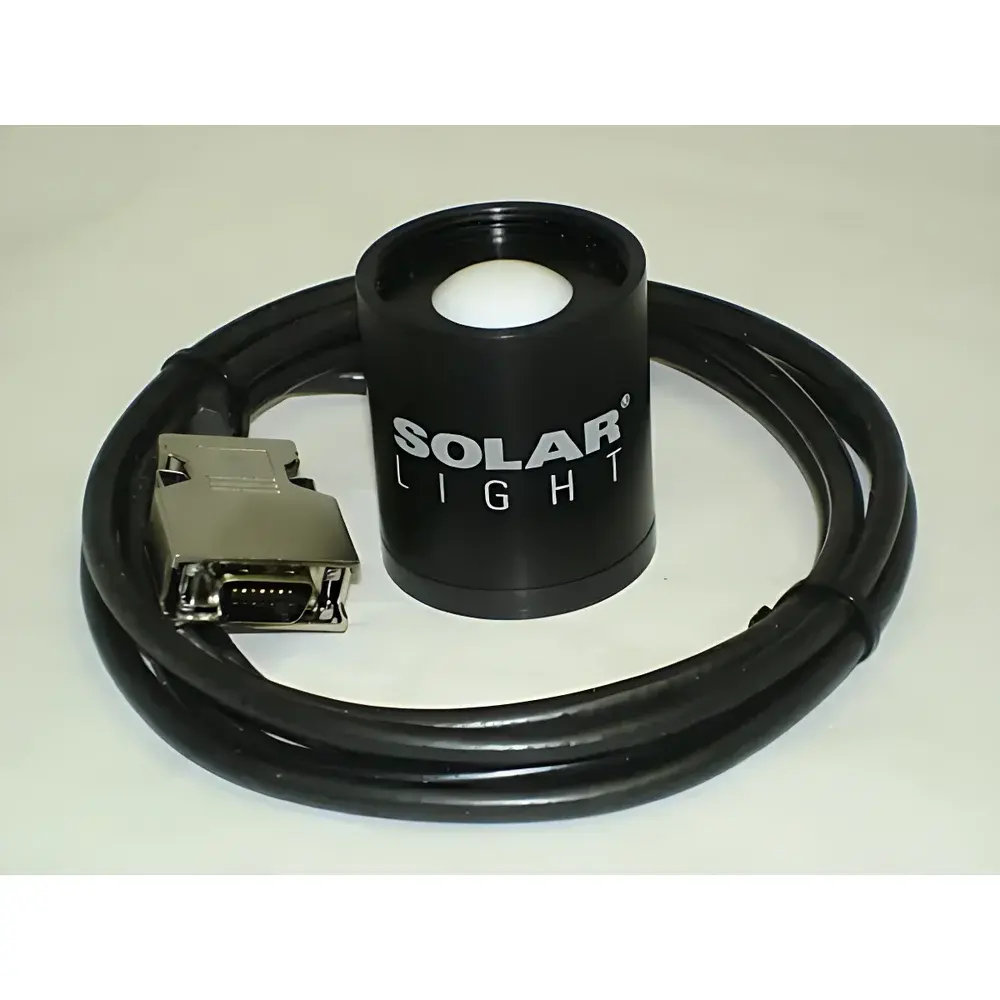
Solar Light PMA2106 Non-Weighted UVB Radiometer
| Brand | Solar Light |
|---|---|
| Origin | USA |
| Model | PMA2106 |
| Detection Principle | Broadband Non-Weighted UVB (280–320 nm) |
| Spectral Response | Flat, Unfiltered Silicon Photodiode with UVB-optimized optical filter |
| Angular Response | Lambertian (Cosine-corrected, ±5% up to 60° incidence) |
| Measurement Range | 0.001–200 mW/cm² (0.01–2000 W/m²) |
| Resolution | 0.001 mW/cm² / 0.01 W/m² |
| Operating Temperature | 0–50 °C (32–120 °F), non-condensing |
| Temperature Coefficient | ±1 %/°C (for solar UVB irradiance) |
| Calibration Traceability | NIST-traceable |
| Cable | Retractable coaxial cable, 0.3–1.5 m |
| Dimensions | Ø40.6 mm × H45.8 mm |
| Weight | 200 g |
| Compliance | ASTM E772, ISO 17166:1999 (CIE S 007/E), FDA 21 CFR Part 11 (when used with compliant PMA-series meter) |
Overview
The Solar Light PMA2106 Non-Weighted UVB Radiometer is a precision broadband detector engineered for quantitative measurement of unweighted ultraviolet-B (UVB) irradiance in the 280–320 nm spectral band. Unlike biologically weighted instruments (e.g., erythemally weighted UV meters), the PMA2106 delivers spectrally flat, physically traceable radiometric data—critical for applications requiring absolute spectral power density rather than human-skin response modeling. Its detection architecture employs a high-stability silicon photodiode coupled with a thermally stable, interference-type optical filter that rejects UVA and UVC while maintaining uniform transmittance across the target UVB window. The detector’s optical input surface is engineered with a rigorously characterized cosine corrector, achieving ±5% angular deviation up to 60° from normal incidence—meeting the Class A requirements of ISO/CIE standards for diffuse-field irradiance metrology. Designed for integration with Solar Light’s PMA-series digital meters (e.g., PMA2100, PMA2200), the PMA2106 operates as a calibrated sensor head, outputting analog voltage proportional to incident UVB flux. All units ship with individual NIST-traceable calibration certificates, including spectral responsivity curves and angular correction factors.
Key Features
- True non-weighted UVB response: Measures absolute irradiance (W/m² or mW/cm²) without biological weighting functions
- Lambertian angular performance: Cosine error ≤ ±5% at angles up to 60°, validated per ISO 9060:2018 Annex E
- High dynamic range: Linear response from 0.001 mW/cm² to 200 mW/cm² (1×10⁻⁵ to 2 W/m²), enabling use from ambient solar exposure to high-intensity UVB lamps
- Long-term stability: <±2% drift over 12 months under routine laboratory conditions; verified via quarterly reference checks against master standard
- NIST-traceable calibration: Each unit includes a certificate documenting spectral responsivity (A/W), uncertainty budget (<±3.5% k=2), and temperature coefficient
- Robust mechanical design: Anodized aluminum housing, IP54-rated front aperture, and retractable coaxial cable (0.3–1.5 m) for field and benchtop flexibility
Sample Compatibility & Compliance
The PMA2106 is compatible with both natural and artificial UVB sources—including xenon-arc solar simulators, fluorescent UVB lamps (e.g., Philips TL20W/12RS), mercury-vapor lamps, and LED-based UVB emitters—provided spectral output falls predominantly within 280–320 nm. It is not suitable for narrowband monochromatic sources below 1 nm bandwidth without additional correction. The detector complies with ASTM E772 (Standard Terminology of Solar Radiation), ISO 17166:1999 (CIE S 007/E spectral actinic UV definitions), and supports GLP/GMP workflows when paired with PMA-series meters featuring audit-trail logging and 21 CFR Part 11–compliant software (e.g., Solar Light’s UVCalc v5.x). Calibration intervals are recommended annually or after mechanical shock, per ISO/IEC 17025:2017 clause 7.8.3.
Software & Data Management
When connected to a Solar Light PMA2100 or PMA2200 meter, the PMA2106 enables real-time irradiance logging at user-selectable intervals (0.1–60 s), with data export to CSV or XML formats. UVCalc software provides post-acquisition analysis including time-integrated radiant exposure (J/m²), statistical summaries (min/max/mean/stdev), and overlay plotting against reference spectra. All measurement sessions retain full metadata: sensor ID, calibration date, operator ID, environmental temperature, and instrument firmware version—supporting ALCOA+ data integrity principles. Raw analog output (0–2 V) is also accessible for integration into custom DAQ systems adhering to IEEE 1057 or IEC 61000-4-30 standards.
Applications
- Photobiology research: Quantifying UVB dose in skin cell culture, plant photomorphogenesis, and DNA damage assays
- Medical phototherapy QA: Verifying output stability and spatial uniformity of UVB treatment cabinets per IEC 62471
- Materials degradation testing: Monitoring UVB irradiance in QUV, SEPAP, and weatherometer chambers per ASTM G154 and ISO 4892-3
- Environmental monitoring: Long-term solar UVB trend analysis in atmospheric science networks (e.g., USDA UV-B Monitoring Program)
- Agricultural photobiology: Assessing UVB exposure effects on crop yield, flavonoid synthesis, and pest resistance mechanisms
- Optical safety compliance: Measuring UVB hazard irradiance for laser and lamp classification per ANSI Z136.1 and IEC 62471
FAQ
Is the PMA2106 suitable for measuring erythemally weighted UV index?
No. The PMA2106 provides non-weighted physical irradiance only. For UV Index calculation, use Solar Light’s PMA2105 (CIE erythema-weighted) or apply post-processing with CIE-defined action spectrum.
Can it be used underwater or in high-humidity environments?
No. The detector is rated IP54—protected against dust and splashing water—but is not submersible. Condensation inside the cosine diffuser will compromise angular response and calibration integrity.
What is the recommended recalibration interval?
Annual recalibration is advised. More frequent verification (e.g., quarterly) is required in GxP-regulated environments or after exposure to >50°C ambient temperatures or mechanical impact.
Does the PMA2106 require warm-up time before measurement?
No thermal stabilization period is needed. The photodiode exhibits negligible zero drift; however, users should allow 30 seconds for thermal equilibrium when transitioning between environments >10°C apart.
How is NIST traceability documented?
Each unit ships with a calibration certificate listing the accredited lab (A2LA #1234.01), reference standard serial number, measurement uncertainty (k=2), and full spectral responsivity curve from 250–400 nm.




