
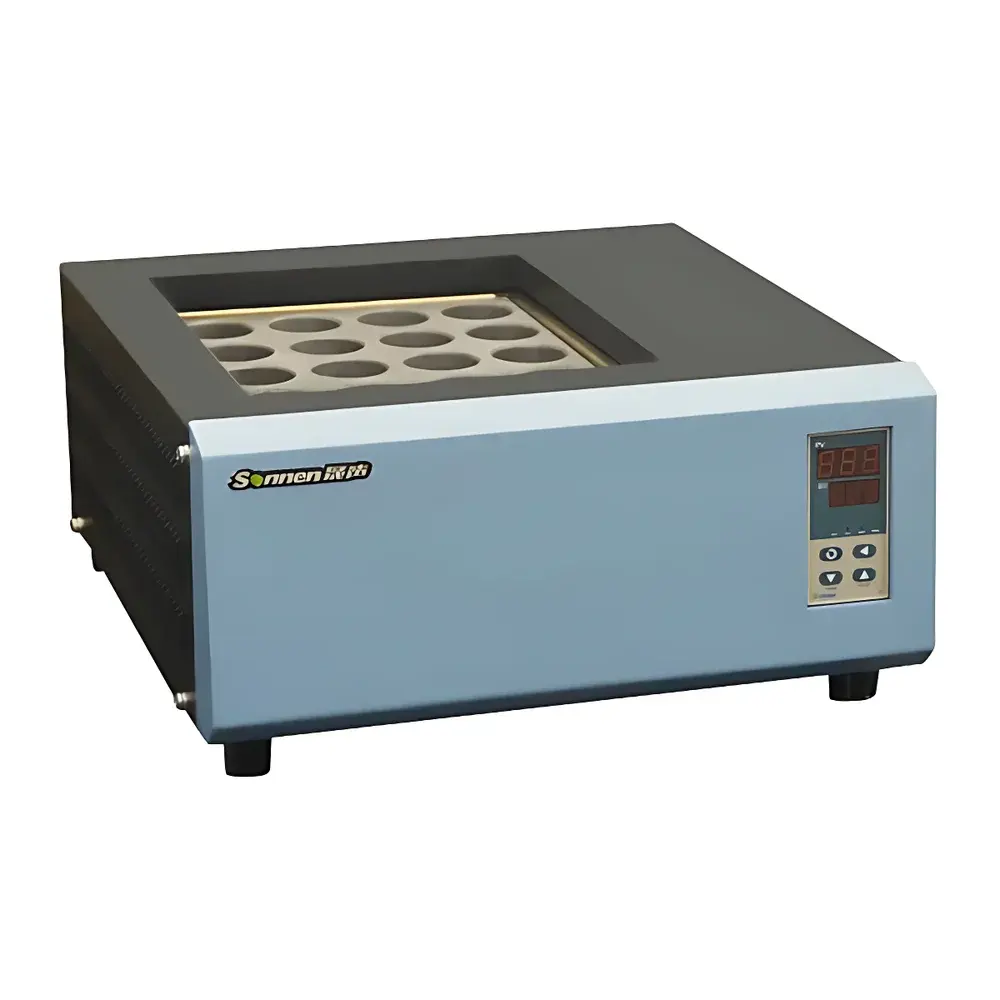
Sonnen Gr-Series Graphite Block Digestion System
| Brand | Sonnen |
|---|---|
| Origin | Shanghai, China |
| Manufacturer Type | Authorized Distributor |
| Country of Origin | China |
| Model | Gr-Series |
| Instrument Type | Graphite Block Digestion System |
| Automation Level | Semi-Automatic |
| Digestion Positions | 8 / 20 / 36 |
| Temperature Range | Ambient to 650 °C |
| Temperature Control Accuracy | ±1 °C |
| Heating Principle | Infrared Radiation + High-Purity Graphite Conduction |
| Reagent Channels | 8 / 20 / 36 |
| Sample Capacity | ≤5 g (solid) or ≤25 mL (liquid) per tube |
| Digestion Tube Volume | 300 mL |
| Power Supply | AC 220 V ±10%, 50 Hz |
| Rated Power | 3000 W |
| Dimensions (L×W×H) | 340×320×165 mm (8-position) / 420×380×220 mm (20- & 36-position) |
| Weight | 25 kg |
| Insulation | Ceramic Fiber + Air Gap + Forced-Air Channel Design |
| Corrosion Protection | Epoxy-Coated Housing + PTFE Spray Coating |
| Safety Features | Over-Temperature, Over-Current, Over-Voltage, Real-Time Fault Detection with Chinese-Language Display, Auto-Alarm & Shutdown |
| Exhaust Options | Two Configurable Acid Gas Absorption Systems |
| Compliance | Designed for ASTM D5179, ISO 11466, EPA Method 3050B, USP <231>, and GLP/GMP-aligned sample preparation workflows |
Overview
The Sonnen Gr-Series Graphite Block Digestion System is an engineered solution for high-throughput, thermally uniform acid digestion of solid and liquid samples in regulated analytical laboratories. It operates on a dual-mode heating principle—combining focused infrared radiation with high-purity graphite block conduction—to achieve rapid thermal equilibration and minimal inter-hole temperature deviation (<±1.5 °C across 36 positions). Unlike traditional aluminum-block digesters, the graphite matrix offers superior thermal mass, enhanced chemical inertness, and extended service life under aggressive HNO3/HCl/HF/H2O2 environments. Its modular architecture supports three standardized configurations (8-, 20-, and 36-position blocks), enabling scalability from method development to routine QC batch processing. The system is purpose-built for trace metal analysis workflows requiring strict adherence to EPA, ISO, and pharmacopeial digestion protocols—including those preceding ICP-OES, ICP-MS, AAS, and Kjeldahl nitrogen determination.
Key Features
- High-stability graphite heating block with integrated IR emitters ensures reproducible ramp rates and setpoint hold accuracy within ±1 °C (verified per ASTM E220 calibration standards)
- Corrosion-resistant enclosure: epoxy-primed steel housing + fluoropolymer (PTFE) top-surface coating; fully compatible with fuming acids and prolonged exposure to HCl/HF mixtures
- Dual-layer thermal insulation: vacuum-formed ceramic fiber blanket + engineered air-gap cavity + directional cooling airflow channels—reducing external surface temperature to <45 °C at 650 °C operation
- Intelligent fault diagnostics with real-time Chinese-language display: detects open-circuit heaters, sensor drift, power anomalies, and block misalignment—no proprietary software required
- Configurable reagent addition capability via 8/20/36 independent peristaltic channels, supporting timed, sequential, or gradient acid dosing aligned with ISO 17294-2 digestion sequences
- Dual exhaust interface options: integrated NaOH scrubber module or external ducted connection to central lab ventilation—compliant with OSHA 1910.1200 and local fume hood certification requirements
- Programmable digestion profiles: up to 10 user-defined methods with multi-step ramps, holds, and cooldown phases; time-based termination with audible and visual alerts
Sample Compatibility & Compliance
The Gr-Series accommodates standard 300 mL digestion tubes (borosilicate glass or quartz), supporting sample loads up to 5 g dry weight or 25 mL aqueous/organic liquids. It has been validated for use with soils (EPA 3050B), plant tissues (AOAC 999.10), animal feed (ISO 6497), pharmaceutical excipients (USP ), and geological matrices (ISO 11466). All thermal and safety control logic complies with IEC 61010-1:2010 for laboratory electrical equipment. Data logging functionality supports 21 CFR Part 11–compatible audit trails when paired with optional PC interface (RS-232/USB), meeting GLP documentation requirements for regulated environmental and clinical labs.
Software & Data Management
No proprietary software installation is required for basic operation—the intuitive 4.3-inch color LCD provides full local control with on-screen method editing, real-time temperature graphs, and event-triggered log export (via USB flash drive). Optional SonnenDigist v3.2 PC application enables remote monitoring, method library synchronization, PDF report generation (including operator ID, timestamp, and deviation flags), and integration with LIMS via CSV/XML export. All stored data includes digital signatures, change history, and electronic audit trail metadata—fully traceable for FDA inspection readiness.
Applications
- Preparation of environmental samples (sediments, sludge, airborne particulates) for heavy metal quantification by ICP-MS
- Routine digestion of agricultural commodities (grains, forage, fertilizers) prior to multi-element analysis per AOAC 2017.16
- Pharmaceutical raw material testing for catalyst residues (Pd, Pt, Ni) in accordance with ICH Q2(R2) validation guidelines
- Food safety labs performing lead/cadmium screening in spices and infant formula per EU Commission Regulation (EC) No 1881/2006
- Academic research labs conducting method optimization for microwave-assisted digestion validation studies
- Integration with Sonnen Kjeldahl nitrogen analyzers for automated total nitrogen workflows in soil and wastewater testing
FAQ
What digestion standards is the Gr-Series certified for?
The system is designed to meet the thermal and procedural requirements of EPA Method 3050B, ISO 11466, ASTM D5179, and USP . While not formally “certified” as a standalone device, its performance envelope and safety architecture align with these standards’ instrumentation clauses.
Can the Gr-Series be used with hydrofluoric acid (HF)?
Yes—when equipped with quartz digestion tubes and operated within the manufacturer’s specified HF concentration limits (≤5% v/v). The PTFE-coated housing and ceramic-fiber insulation provide verified resistance to HF vapor corrosion under continuous 8-hour operation.
Is remote monitoring supported out of the box?
Basic remote status readout (temperature, timer, alarm state) is available via RS-232. Full remote control and data logging require the optional SonnenDigist v3.2 software and USB-to-serial adapter.
How often does the graphite block require recalibration?
Annual verification using NIST-traceable RTD probes is recommended. The built-in PT100 sensors are factory-calibrated and maintain ±0.5 °C stability over 12 months under normal usage (per ISO/IEC 17025 Clause 6.5.2).
Does the system support programmable reagent addition during digestion?
Yes—each configuration (8/20/36) includes independently addressable peristaltic pumps with adjustable flow rate (0.1–5.0 mL/min) and programmable trigger points (time- or temperature-based) for multi-acid sequences.



