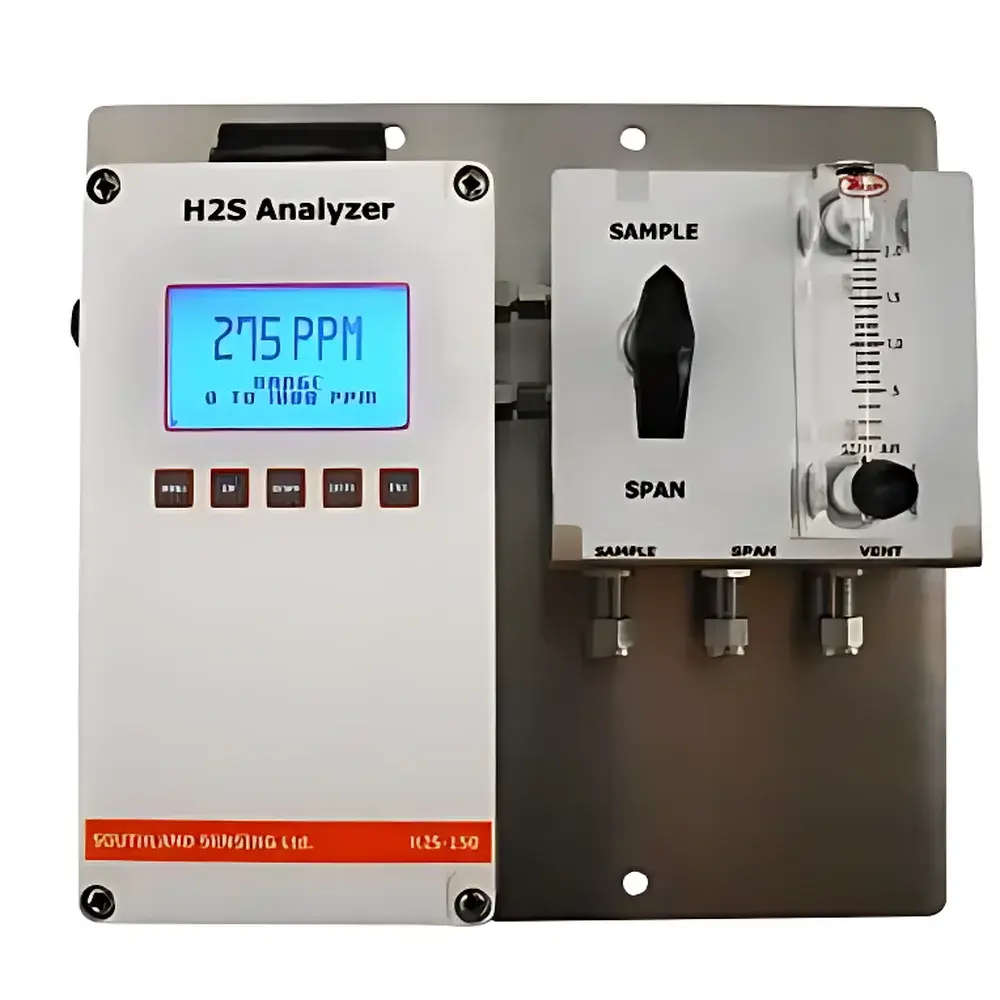
Southland H2S-150-NG Online Hydrogen Sulfide Analyzer
| Brand | Southland |
|---|---|
| Origin | USA |
| Model | H2S-150-NG |
| Measurement Principle | Electrochemical Fuel Cell Sensor |
| Range Options | 0–200 ppm (H2S-1X) or 0–2000 ppm (H2S-2X) |
| Accuracy | < ±2% of Full Scale |
| Response Time (T90) | 60 s |
| Operating Temperature | 0–50 °C |
| Sample Flow Rate | 0.5–2.0 SCFH |
| Inlet Pressure Range | 0.1–50 PSI |
| Output Signal | 4–20 mA or 1–5 VDC |
| Enclosure Rating | Class 1, Div 2, Groups C & D |
| Dimensions | 11.25 × 12.0 × 5.50 in |
| Weight | 12.5 lbs |
| Sensor Lifetime | 12 months |
| Calibration Interval | Every 1–3 months with certified span gas |
| Gas Connection | 1/4" compression fitting |
| Electrical Isolation | Galvanically isolated power and analog outputs |
| Optional | Dual-loop configuration, RS-485 Modbus RTU interface |
Overview
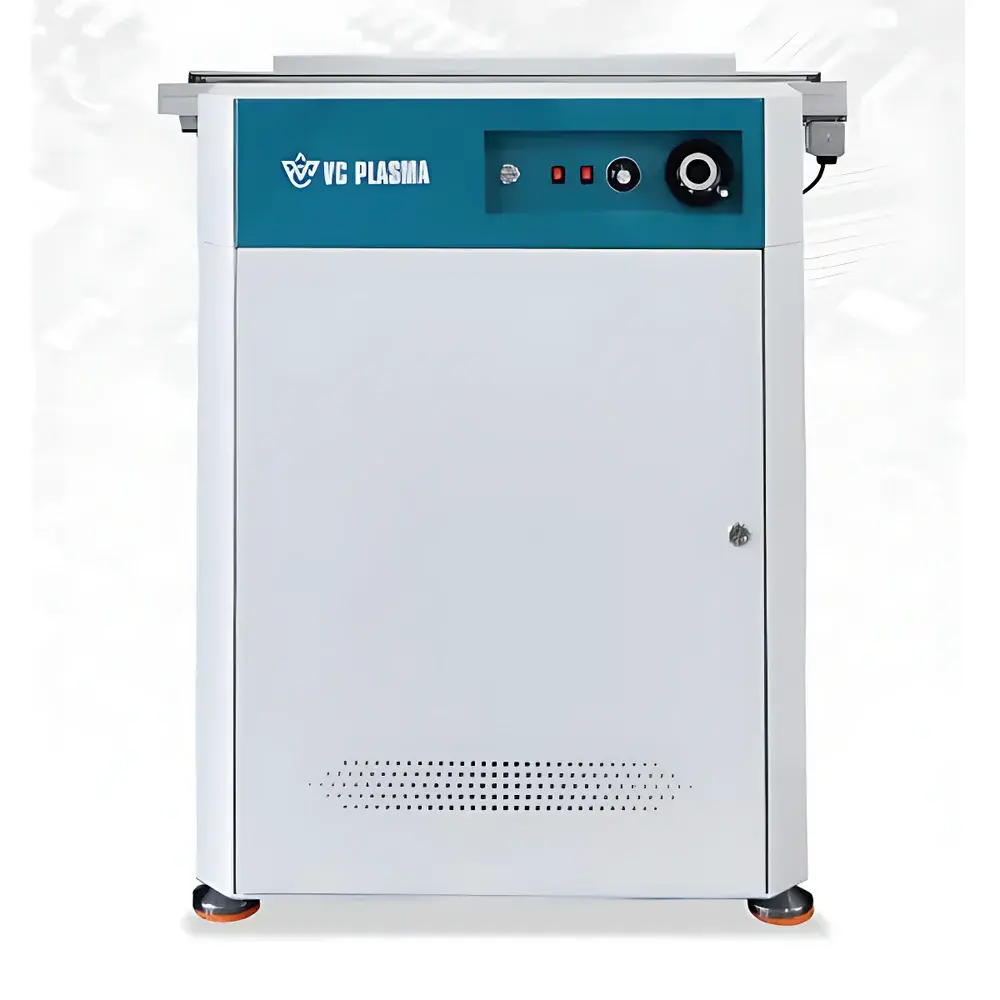
The Southland H2S-150-NG Online Hydrogen Sulfide Analyzer is an industrial-grade, continuously operating gas analyzer engineered for reliable, real-time quantification of hydrogen sulfide (H₂S) in natural gas, biogas, and process streams. It employs a proprietary electrochemical fuel cell sensor — a mature, field-proven transduction technology that delivers stable output without requiring electrolyte replenishment or electrode cleaning. Unlike optical or metal-oxide semiconductor methods, the fuel cell design provides high selectivity for H₂S in complex hydrocarbon matrices, minimizing cross-sensitivity to CO, SO₂, NOₓ, or total reduced sulfur (TRS) compounds. The analyzer is designed for permanent installation in hazardous locations classified under NEC Class 1, Division 2, Groups C and D, making it suitable for deployment directly at wellheads, pipeline metering stations, amine treaters, and biogas upgrading units. Its compact footprint, galvanically isolated analog outputs, and low-maintenance architecture support long-term unattended operation in remote or infrastructure-constrained environments.
Key Features
- Electrochemical fuel cell sensor with intrinsic selectivity for H₂S and no consumable electrolyte — eliminates routine maintenance associated with wet-cell or pumped-electrolyte designs
- Two calibrated range options: H2S-1X (0–200 ppm) and H2S-2X (0–2000 ppm), both traceable to NIST-certified calibration gases
- Galvanic isolation between power supply and 4–20 mA / 1–5 VDC output circuits ensures immunity from ground loops and EMI in electrically noisy industrial settings
- Integrated sample flow control with built-in rotameter and solenoid-actuated calibration valve for automated span verification without process interruption
- Robust aluminum enclosure rated for Class 1, Div 2, Groups C & D per UL 1203 and CSA C22.2 No. 30, compliant with IEC 60079-0 and -15
- Operating temperature range of 0–50 °C supports deployment in both temperate and hot ambient conditions typical of compressor stations and gas processing facilities
- Modular architecture allows optional integration of dual-loop redundancy or RS-485 Modbus RTU communication for SCADA-level data acquisition and remote diagnostics
Sample Compatibility & Compliance
The H2S-150-NG is validated for continuous analysis of dry or saturated natural gas (methane-rich), sour biogas (CH₄/CO₂/H₂S mixtures), and treated gas streams following amine scrubbing or iron sponge removal. It accommodates inlet pressures from 0.1 to 50 PSI and maintains measurement integrity across variable flow rates (0.5–2.0 SCFH). All wetted materials — including the 1/4″ stainless steel compression fittings and internal PTFE-lined sample path — are compatible with H₂S concentrations up to 2000 ppm and common pipeline contaminants such as water vapor, mercaptans, and elemental sulfur aerosols. The analyzer meets requirements for use in safety-critical applications governed by API RP 14C, ISA-84.00.01 (IEC 61511), and OSHA 1910.120 for H₂S exposure monitoring. Its calibration traceability aligns with ISO/IEC 17025-accredited laboratories, and documentation supports GLP-compliant validation protocols.
Software & Data Management
While the H2S-150-NG operates as a standalone analog transmitter, its optional RS-485 interface enables bidirectional communication via Modbus RTU protocol. This permits integration into distributed control systems (DCS), programmable logic controllers (PLCs), or cloud-based asset monitoring platforms. Configuration parameters — including zero/span values, damping time, alarm thresholds, and linearization coefficients — can be adjusted remotely using standard Modbus function codes (e.g., FC03, FC06). All calibration events, sensor health diagnostics, and output deviations are timestamped and logged internally, supporting audit trails required under FDA 21 CFR Part 11 when deployed in regulated biogas-to-RNG facilities. No proprietary software is required; third-party SCADA tools (e.g., Ignition, Siemens Desigo, Honeywell Experion) natively support its register map.
Applications
- Natural gas production: Real-time H₂S monitoring upstream of dehydration units and downstream of sweetening towers to ensure pipeline specification compliance (e.g., GPA 2261, ASTM D1835)
- Biogas upgrading: Continuous verification of H₂S removal efficiency post-iron oxide filtration or biological desulfurization, enabling dynamic adjustment of air dosing or media replacement schedules
- Landfill gas conditioning: Monitoring residual H₂S after activated carbon polishing to prevent catalyst poisoning in internal combustion engines or fuel cells
- Refinery flare gas recovery: Quantifying H₂S content in acid gas bypass streams to optimize Claus plant feed composition
- Wastewater treatment off-gas: Ensuring odor control system performance by tracking H₂S breakthrough in biofilters or chemical scrubbers
FAQ
What calibration gases are recommended for routine span verification?
Certified H₂S/N₂ standard gases at 50% and 100% of full scale, with uncertainty ≤ ±1% (k=2), traceable to NIST SRM 1941b or equivalent.
Is the sensor replaceable in the field without specialized tools?
Yes — the electrochemical cell is a user-serviceable module secured with two captive screws; replacement requires only a Torx T10 driver and takes under five minutes.
Can the analyzer operate in high-humidity or condensing environments?
It is rated for operation up to 95% RH non-condensing; for saturated streams, a heated sample line or inline coalescing filter is recommended upstream of the analyzer inlet.
Does the device support intrinsic safety (IS) certification for Class 1, Div 1 areas?
No — the H2S-150-NG is certified for Class 1, Div 2 only; for Div 1 applications, a barrier-isolated configuration with an approved safety barrier (e.g., Pepperl+Fuchs KFD2-STC4-EX1) must be implemented.
How is sensor drift compensated during extended operation?
Drift is mitigated through scheduled zero/span adjustments using certified gases; the instrument’s linear output and stable baseline eliminate the need for algorithmic compensation or auto-zero cycles.