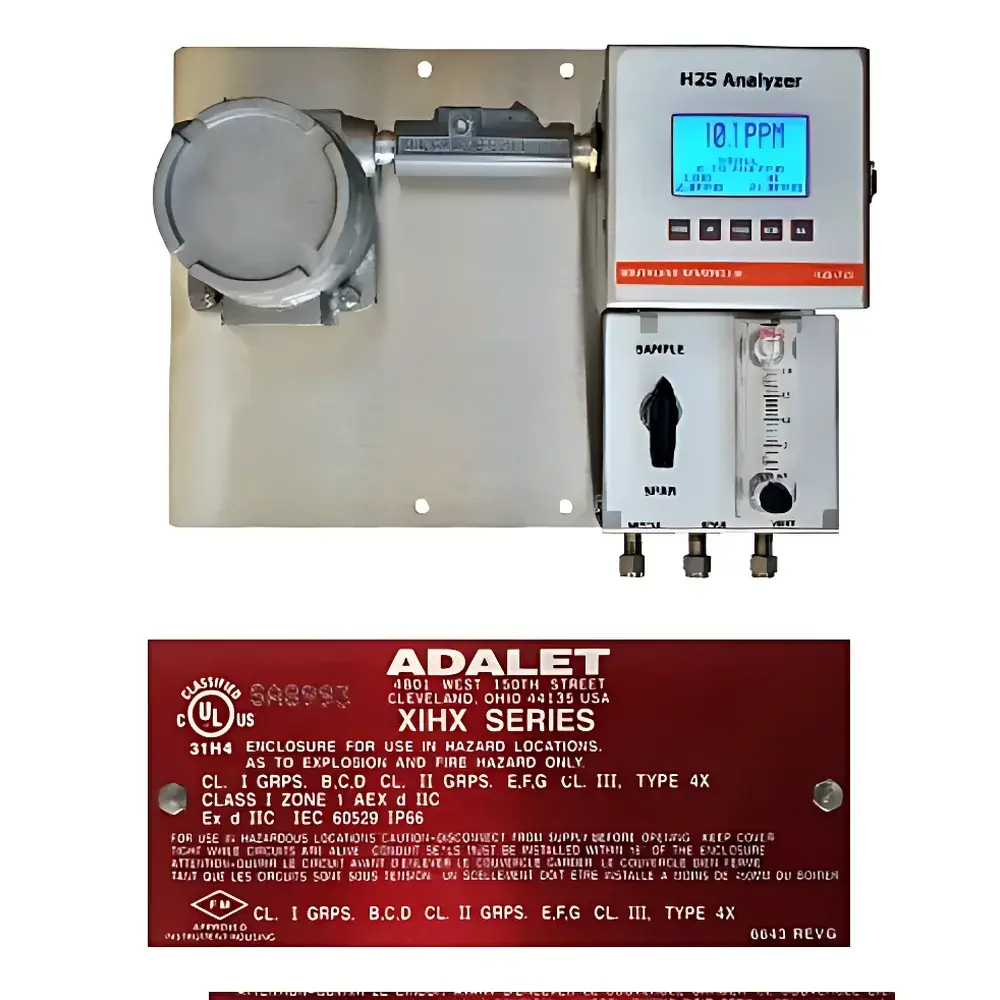
Southland Sensing H2S-725M Electrochemical Hydrogen Sulfide Analyzer
| Origin | USA |
|---|---|
| Manufacturer Type | Authorized Distributor |
| Product Origin | Imported |
| Model | H2S-725M |
| Measurement Ranges | 0–10, 0–50, 0–100, 0–200, 0–500, 0–1000, 0–2000 ppm (user-selectable or auto-ranging) |
| Accuracy | < ±2% FS |
| Certifications | CE, UL Class I, Div 1, Groups B, C, D |
| Dimensions | 241 × 165 × 96 mm |
| Operating Temperature | –10 to +50 °C |
| Temperature Compensation | Built-in |
| Sensor Type | Micro-fuel-cell electrochemical H₂S sensor |
| Power Supply | 12–24 VDC |
| Current Draw | 25 mA |
| Output Signals | 4–20 mA, 0–10 VDC, MODBUS RTU over RS-485 (ASCII bi-directional) |
| Sample Flow Rate | 230–2500 mL/min (with integrated 4-way sampling valve, bypass valve, needle valve, and flowmeter) |
| Warranty | 12 months |
| Application Media | Natural gas streams, biogas, sour gas, desulfurized process gas |
Overview
The Southland Sensing H2S-725M is a precision-engineered electrochemical hydrogen sulfide (H₂S) analyzer designed for continuous, real-time monitoring in demanding industrial process environments. Utilizing a proprietary micro-fuel-cell electrochemical sensing principle, the instrument delivers stable, low-drift detection of H₂S at trace to high-concentration levels across multiple user-selectable ranges—from 0–10 ppm up to 0–2000 ppm. Its core transduction mechanism relies on the selective oxidation of H₂S at the working electrode, generating a current linearly proportional to analyte concentration—ensuring high specificity, minimal cross-sensitivity to CO, SO₂, or hydrocarbons, and long-term baseline stability. Engineered for hazardous area deployment, the H2S-725M meets UL Class I, Division 1, Groups B, C, and D requirements—making it suitable for installation directly in Zone 1 classified locations without external purging or explosion-proof enclosures. The unit operates on a wide 12–24 VDC supply with low power consumption (25 mA), enabling integration into distributed control systems (DCS), programmable logic controllers (PLC), or standalone safety shutdown loops.
Key Features
- Micro-fuel-cell electrochemical sensor with inherent zero drift suppression and >2-year typical service life under continuous operation
- Seven factory-configurable measurement ranges (0–10, 0–50, 0–100, 0–200, 0–500, 0–1000, 0–2000 ppm), supporting both manual range selection and automatic range switching based on signal threshold
- Integrated temperature compensation circuitry ensuring measurement stability across –10 to +50 °C ambient operating conditions
- Dual analog outputs (4–20 mA and 0–10 VDC) plus MODBUS RTU over RS-485 for bidirectional communication—fully compatible with industry-standard SCADA and asset management platforms
- Backlit LCD display with intuitive menu navigation, real-time concentration readout, status indicators, and configurable high/low alarm relays
- Robust sample handling system including a 4-way sampling manifold, calibrated bypass valve, fine-adjustment needle valve, and inline flowmeter (230–2500 mL/min)
- CE-marked and certified to UL 61010-1 and UL 1203 for electrical safety and intrinsic safety compliance in hazardous locations
Sample Compatibility & Compliance
The H2S-725M is validated for use in natural gas transmission pipelines, amine-treated sour gas streams, landfill biogas, Claus plant feed and tail gas, and refinery fuel gas networks. It maintains accuracy and sensor integrity in non-condensing gas matrices containing up to 95% methane, <5% CO₂, <1% H₂O vapor (dew point ≤ –20 °C), and trace hydrocarbons. The analyzer complies with ISO 8573-1:2010 (Class 4 particulate, Class 3 moisture, Class 2 oil) when used with recommended particulate and coalescing filtration upstream. For regulatory reporting contexts, its <±2% full-scale accuracy meets ASTM D6299-22 requirements for precision verification of fixed-gas analyzers in process control applications. The device supports GLP/GMP-aligned data integrity through MODBUS register logging of calibration timestamps, alarm events, and sensor health diagnostics—facilitating audit-ready records per FDA 21 CFR Part 11 when paired with compliant host software.
Software & Data Management
While the H2S-725M operates autonomously without embedded firmware updates or PC-based configuration tools, its MODBUS RTU interface enables seamless integration into third-party supervisory systems. All critical operational parameters—including span/gain coefficients, alarm setpoints, relay hysteresis, and range selection—are accessible via standard MODBUS function codes (03h, 06h, 10h). Host systems can poll sensor health status (e.g., electrolyte depletion flag, temperature error, signal saturation), initiate zero/span verification routines, and log timestamped concentration values at user-defined intervals (1–300 seconds). ASCII protocol support allows direct ASCII command parsing from legacy PLCs or custom Python/C# applications. No proprietary drivers or cloud dependencies are required; all data exchange occurs over deterministic serial communication, ensuring deterministic latency and cyber-resilient operation in air-gapped facilities.
Applications
- Natural gas custody transfer and pipeline integrity monitoring—detecting breakthrough H₂S post-amine scrubbers or membrane separation units
- Biogas upgrading plants—verifying H₂S removal efficiency before compression and injection into municipal gas grids
- Refinery sulfur recovery units—measuring H₂S concentration in acid gas feed to Claus furnaces and tail gas to SCOT units
- Landfill gas-to-energy facilities—ensuring compliance with EPA 40 CFR Part 60 Subpart WWW emission limits during combustion or flaring
- Chemical manufacturing off-gas streams—monitoring H₂S in vent headers prior to thermal oxidizers or wet scrubbers
- Research laboratories conducting catalyst poisoning studies or corrosion testing under controlled H₂S partial pressures
FAQ
What is the expected service life of the electrochemical sensor?
The micro-fuel-cell sensor is rated for ≥24 months of continuous operation under typical natural gas matrix conditions (non-condensing, <10 ppm H₂O, no heavy hydrocarbon fouling). Sensor replacement is field-serviceable and requires no recalibration of the electronics module.
Can the H2S-725M be installed in an outdoor, unheated shelter?
Yes—provided ambient temperature remains within –10 to +50 °C and relative humidity stays below 90% non-condensing. For sub-zero environments, optional thermostatically controlled heater kits are available through authorized distributors.
Does the analyzer require periodic calibration gas exposure?
Zero and span calibration is recommended every 3–6 months depending on exposure history and regulatory requirements. A single-point span check using certified 50 ppm H₂S/N₂ standard gas is sufficient for routine verification.
Is the MODBUS implementation compatible with common DCS platforms?
Yes—the device implements standard MODBUS RTU slave functionality (slave ID 1–247) with registers mapped per Southland Sensing’s publicly available MODBUS map (v3.2), tested with Emerson DeltaV, Honeywell Experion, Siemens PCS7, and Yokogawa CENTUM VP.
How is sample conditioning handled for high-moisture or particulate-laden streams?
The H2S-725M must be installed downstream of a certified sample conditioning system—including particulate filtration (≤0.3 µm), moisture removal (chiller or permeation dryer), and pressure regulation—to prevent sensor contamination or electrolyte dilution. Southland Sensing provides application engineering support for complete system design.
Related Products