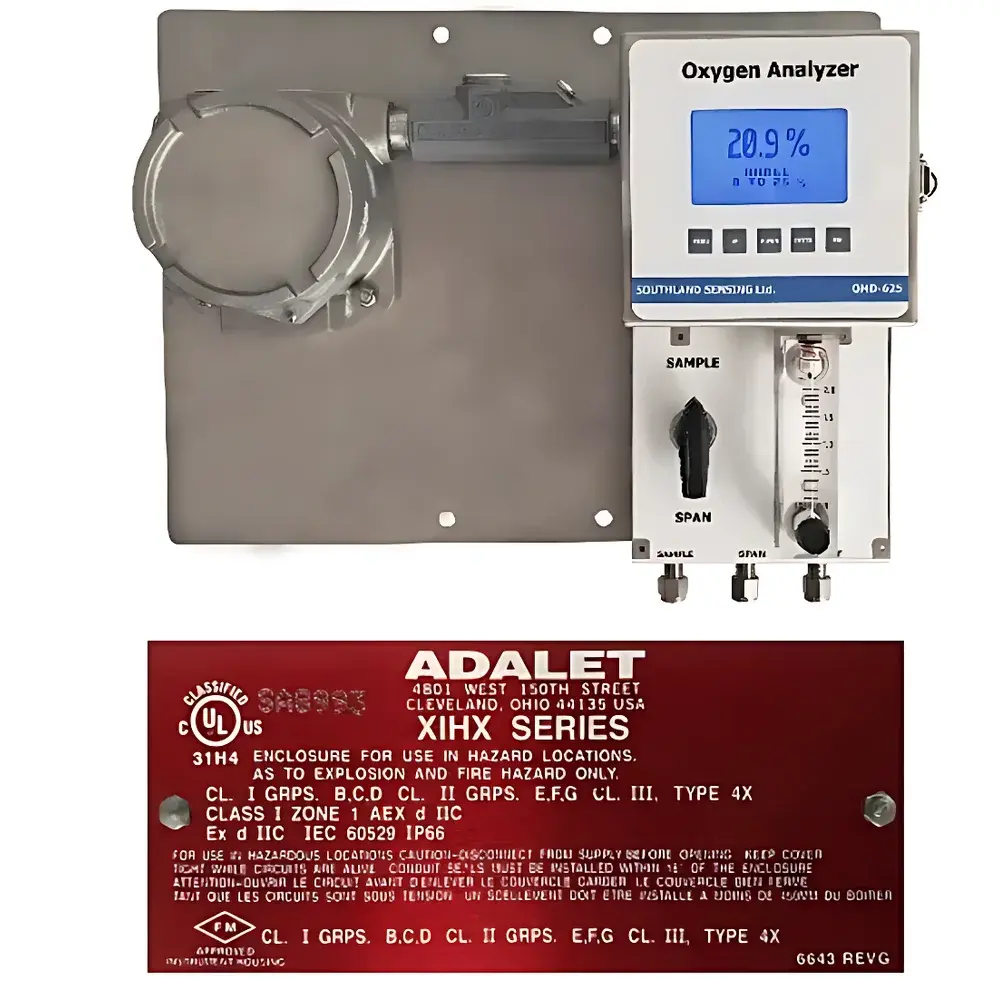
Southland Sensing OMD-625 Fuel Cell-Based Oxygen Analyzer for Natural Gas Applications
| Origin | USA |
|---|---|
| Manufacturer Type | Authorized Distributor |
| Origin Category | Imported |
| Model | OMD-625 |
| Price Range | USD 4,200 – 7,000 (FOB) |
| Certifications | CE, ATEX/IECEx Class I, Div 2, Groups B, C, D Compliant |
| Measurement Ranges | 0–10 ppm / 0–100 ppm / 0–1,000 ppm / 0–1% / 0–25% O₂ |
| Accuracy | < ±1% FS |
| Sensor Type | Electrochemical Fuel Cell (Micro-Fuel Cell) |
| Operating Temperature | −10 to +50 °C |
| Temperature Compensation | Integrated |
| Power Supply | 12–24 VDC |
| Current Draw | 25 mA |
| Output Signals | 4–20 mA, 0–10 VDC, MODBUS RTU over RS485 (ASCII bi-directional) |
| Sample Flow Rate | 230–2500 mL/min |
| Enclosure Dimensions | 241 × 165 × 96 mm |
| Sensor Lifetime | >24 months typical (dependent on exposure profile) |
| Warranty | 12 months |
| Compatible Gases | N₂, Ar, He, H₂, CH₄, CO₂ (with acid-resistant sensor option), natural gas streams, syngas, inert/reducing atmospheres |
| Optional Acid-Resistant Sensor | Available for H₂S, SO₂, and CO₂-laden streams |
| Calibration | Zero & span via external gas ports or digital interface |
Overview
The Southland Sensing OMD-625 is a precision electrochemical oxygen analyzer engineered for continuous, real-time measurement of trace to percent-level oxygen concentrations in demanding natural gas processing, pipeline monitoring, and industrial inerting applications. Utilizing a proprietary micro-fuel cell sensor architecture, the OMD-625 operates on the principle of galvanic oxygen reduction: O₂ diffuses through a selective membrane into an aqueous electrolyte, where it undergoes catalytic reduction at the cathode, generating a linear current proportional to partial pressure—directly correlating to concentration across five selectable ranges (0–10 ppm to 0–25% O₂). Unlike paramagnetic or zirconia-based analyzers, the fuel cell design delivers inherently stable zero baselines, minimal drift (<0.5% FS/month), and immunity to background gas interference from hydrocarbons, CO₂, or H₂—critical for integrity assurance in natural gas transmission systems compliant with API RP 1173 and ISO 8502-3 standards.
Key Features
- Fuel cell sensor with >24-month operational life under typical natural gas service conditions (subject to H₂S/acid gas exposure profile)
- Class I, Division 2, Groups B, C, D hazardous area certification per UL 1604 and IEC 60079-0/15 — suitable for installation adjacent to gas compressors, metering stations, and dehydration units
- Integrated temperature compensation and auto-zero stabilization circuitry ensuring <±1% full-scale accuracy across −10 to +50 °C ambient operating range
- Dual analog outputs (4–20 mA and 0–10 VDC) plus MODBUS RTU over RS485 for seamless integration into DCS, SCADA, and PLC-based process control architectures
- Modular sensor head design enabling field-replaceable acid-resistant variants for streams containing H₂S, SO₂, or high-CO₂ sour gas fractions
- Low power consumption (25 mA @ 24 VDC) supports solar/battery-powered remote pipeline monitoring deployments
- Robust aluminum enclosure (IP65 rated) with NEMA 4X compatibility for outdoor mounting in refinery, LNG terminal, and offshore platform environments
Sample Compatibility & Compliance
The OMD-625 is validated for use with non-corrosive and mildly acidic process gases common in upstream and midstream operations, including purified natural gas (methane-rich), nitrogen blanketing streams, hydrogen reformate, CO₂ injection lines, and inerted glovebox atmospheres. When equipped with the optional acid-resistant sensor variant, it maintains metrological integrity in streams containing up to 500 ppm H₂S or 10% CO₂—meeting ASTM D1946 requirements for hydrocarbon gas analysis. All units ship with CE marking and documentation supporting compliance with EU Machinery Directive 2006/42/EC and Electromagnetic Compatibility Directive 2014/30/EU. For regulated environments (e.g., FDA-regulated biogas upgrading facilities or GMP-compliant specialty gas production), the device supports audit-ready calibration logs via MODBUS register access, aligning with 21 CFR Part 11 data integrity expectations when paired with validated host software.
Software & Data Management
Configuration, diagnostics, and calibration are performed via ASCII command protocol over RS485, enabling integration with custom HMI platforms or third-party asset management systems (e.g., Emerson DeltaV, Honeywell Experion, Siemens Desigo). The analyzer stores internal event logs—including power cycles, calibration timestamps, and sensor health metrics—for retrieval via serial query. While no proprietary PC software is bundled, Southland provides full MODBUS register maps and ASCII command tables in the user manual (Rev. 4.2), facilitating automation of periodic zero/span verification and trend-based predictive maintenance. Raw output signals are compatible with standard 4–20 mA data acquisition modules; digital outputs support time-stamped data streaming at configurable intervals (1–60 s), suitable for cloud-based IIoT platforms such as AWS IoT Core or Azure Industrial IoT.
Applications
- Natural gas pipeline quality monitoring pre- and post-dehydration to verify O₂ < 10 ppm (per GPA 2261 and ISO 8502-3)
- Inert gas blanketing control in LNG storage tanks and vapor recovery units
- Leak detection and integrity verification in nitrogen-purged instrumentation manifolds and valve actuator enclosures
- Process gas purity assurance in hydrogen production (PSA tail gas), syngas conditioning, and ammonia synthesis loops
- Atmospheric monitoring in semiconductor fab nitrogen supply networks and aerospace propulsion test stands
- Real-time O₂ ingress detection in carbon capture and storage (CCS) transport pipelines carrying supercritical CO₂
FAQ
What sensor technology does the OMD-625 employ, and how does it differ from zirconia or paramagnetic analyzers?
It uses a galvanic fuel cell sensor—self-powered, no reference gas required, and highly selective for O₂ without cross-sensitivity to CO₂, CH₄, or H₂. Zirconia sensors require elevated temperatures and reference air; paramagnetic units are bulkier and sensitive to vibration and flow fluctuations.
Can the OMD-625 measure oxygen in raw natural gas containing H₂S?
Yes—but only when specified with the acid-resistant sensor option. Standard fuel cells degrade rapidly in H₂S >10 ppm; the acid-resistant variant extends service life in sour gas environments up to 500 ppm H₂S.
Is the unit suitable for installation in Zone 1 hazardous areas?
No—it is certified for Class I, Div 2 only (equivalent to Zone 2). For Zone 1, an intrinsically safe barrier system must be used in conjunction with the analyzer’s 4–20 mA output.
Does the OMD-625 support automatic zero calibration?
It does not perform automatic zero calibration; however, its fuel cell design exhibits exceptional zero stability (<0.1 ppm drift/month), and zero adjustment is achievable manually using certified zero gas or digitally via MODBUS command.
What is the recommended calibration frequency for pipeline monitoring applications?
Southland recommends quarterly span calibration using certified O₂-in-N₂ standard gas (traceability to NIST SRM 2623a), with zero verification prior to each calibration. In critical safety applications, monthly checks are advised per ISA-84.00.01.
Related Products