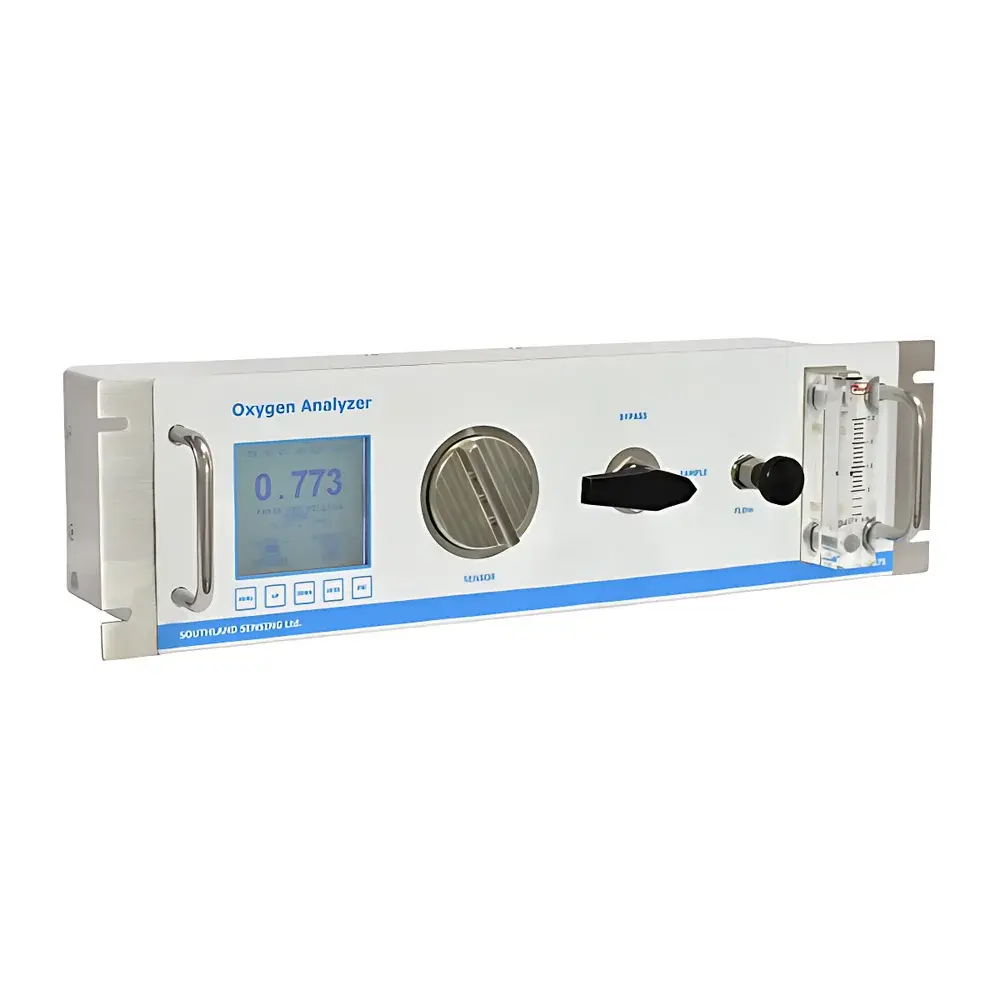
Southland Sensing OMD-675-1 Trace Oxygen Analyzer
| Origin | USA |
|---|---|
| Manufacturer Type | Distributor |
| Origin Category | Imported |
| Model | OMD-675-1 |
| Price Range | USD 4,200 – 7,000 |
Overview
The Southland Sensing OMD-675-1 Trace Oxygen Analyzer is a high-stability electrochemical analyzer engineered for continuous, real-time measurement of ultra-low oxygen concentrations in inert and reducing process gas streams. It employs a proprietary miniature fuel cell sensor — a galvanic, self-powered electrochemical transducer — that generates a current proportional to the partial pressure of molecular oxygen (O₂) diffusing across a selective membrane. Unlike paramagnetic or zirconia-based analyzers, this sensor operates without external bias voltage or consumable electrolytes, delivering inherently stable zero and span characteristics over extended service intervals. Designed specifically for purity-critical environments — including nitrogen blanketing systems, semiconductor purge lines, hydrogen reforming off-gas monitoring, and high-purity argon distribution networks — the OMD-675-1 provides reliable detection down to 0–1 ppm O₂ with full-scale accuracy better than ±1% FS. Its compact 241 × 165 × 96 mm chassis supports panel-mount or benchtop integration into Class 1 Div 2 or ATEX Zone 2-compliant enclosures when deployed in hazardous area applications.
Key Features
- Miniature fuel cell oxygen sensor with intrinsic long-term stability and no warm-up time required
- Five selectable measurement ranges: 0–1 ppm, 0–10 ppm, 0–100 ppm, 0–1000 ppm, and 0–25% O₂ (switchable via DIP switch or software configuration)
- Integrated temperature compensation circuitry ensuring consistent performance across –10°C to +50°C ambient operating conditions
- Low-power design: 12–24 VDC input, typical current draw ≤25 mA — suitable for remote or battery-backed installations
- Standard analog outputs: isolated 4–20 mA and 0–10 VDC, both configurable for linear or square-root scaling per user requirement
- Rugged aluminum housing with IP65-rated front panel; field-replaceable sensor cartridge enabling <5-minute maintenance downtime
- Compliance with CE marking directives for electromagnetic compatibility (EMC) and low-voltage safety (LVD)
Sample Compatibility & Compliance
The OMD-675-1 is validated for use with non-corrosive, dry process gases including nitrogen, argon, helium, hydrogen, and hydrocarbon mixtures. For applications involving trace H₂S, SO₂, CO₂, or other acidic contaminants, Southland Sensing recommends specifying the optional acid-resistant sensor variant — which incorporates a chemically stabilized cathode and enhanced membrane barrier to prevent electrode poisoning. The analyzer conforms to ISO 8573-1:2010 Class 2 particulate and dew point specifications when used with an inline coalescing filter and desiccant dryer upstream. While not certified for FDA 21 CFR Part 11 compliance out-of-the-box, its analog output architecture supports integration into validated PLC/DCS systems meeting GMP/GLP data integrity requirements when paired with audit-trail-enabled controllers.
Software & Data Management
The OMD-675-1 operates as a standalone transmitter with no embedded firmware update capability; however, its analog outputs interface seamlessly with industry-standard SCADA platforms (e.g., Siemens Desigo, Honeywell Experion, Rockwell FactoryTalk) and data historians (OSIsoft PI, Emerson DeltaV). Optional third-party signal conditioners or smart I/O modules can provide digital communication (Modbus RTU over RS-485), local display logging, and alarm relay triggering. All calibration procedures — zero and span adjustments — are performed using physical potentiometers accessible through the rear panel, eliminating dependency on proprietary software or USB interfaces. Calibration frequency is typically recommended every 6–12 months depending on sample gas cleanliness and exposure history.
Applications
- Monitoring residual O₂ in glovebox atmospheres during lithium-ion battery electrode manufacturing
- Verifying nitrogen purity in pharmaceutical fluidized-bed dryers and solvent recovery systems
- Tracking oxygen ingress in cryogenic air separation plant product streams (LN₂, LH₂, LAr)
- In-line verification of inerting efficiency in chemical reactor purge cycles and catalyst regeneration vents
- O₂ leak detection in high-pressure hydrogen transport pipelines and refueling station buffer tanks
- Quality assurance of electronic-grade specialty gases supplied to semiconductor wafer fabrication facilities
FAQ
What is the expected service life of the fuel cell sensor under typical operating conditions?
Under continuous operation with clean, dry, non-acidic sample gas, the sensor demonstrates a functional lifespan exceeding 24 months with minimal drift — verified by routine quarterly bump tests.
Can the OMD-675-1 be used for wet gas sampling?
No. Condensation or liquid water ingress will permanently damage the fuel cell. A dedicated chilled mirror dew point monitor and coalescing filter must be installed upstream if sample dew point exceeds –20°C.
Is NIST-traceable calibration documentation available?
Yes. Southland Sensing provides factory calibration certificates with NIST-traceable reference standards upon request at time of order — valid for initial commissioning only.
Does the unit support HART or Foundation Fieldbus protocols?
No. The OMD-675-1 is analog-output-only. Digital protocol support requires external signal converters compatible with Modbus RTU or Profibus PA.
What is the minimum required sample flow rate for accurate measurement?
230 mL/min is the lower limit for stable diffusion-limited response; optimal performance is achieved at 500–1000 mL/min with laminar flow and minimal pressure fluctuation.
Related Products