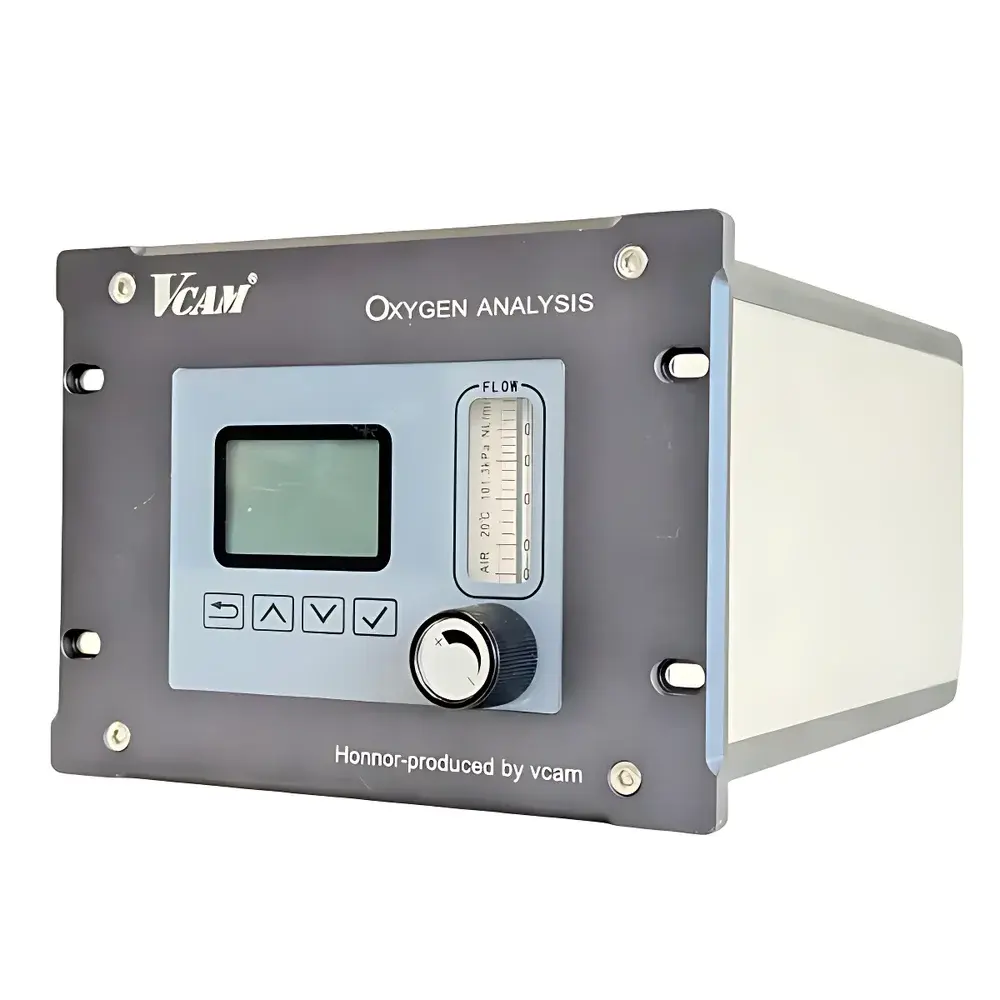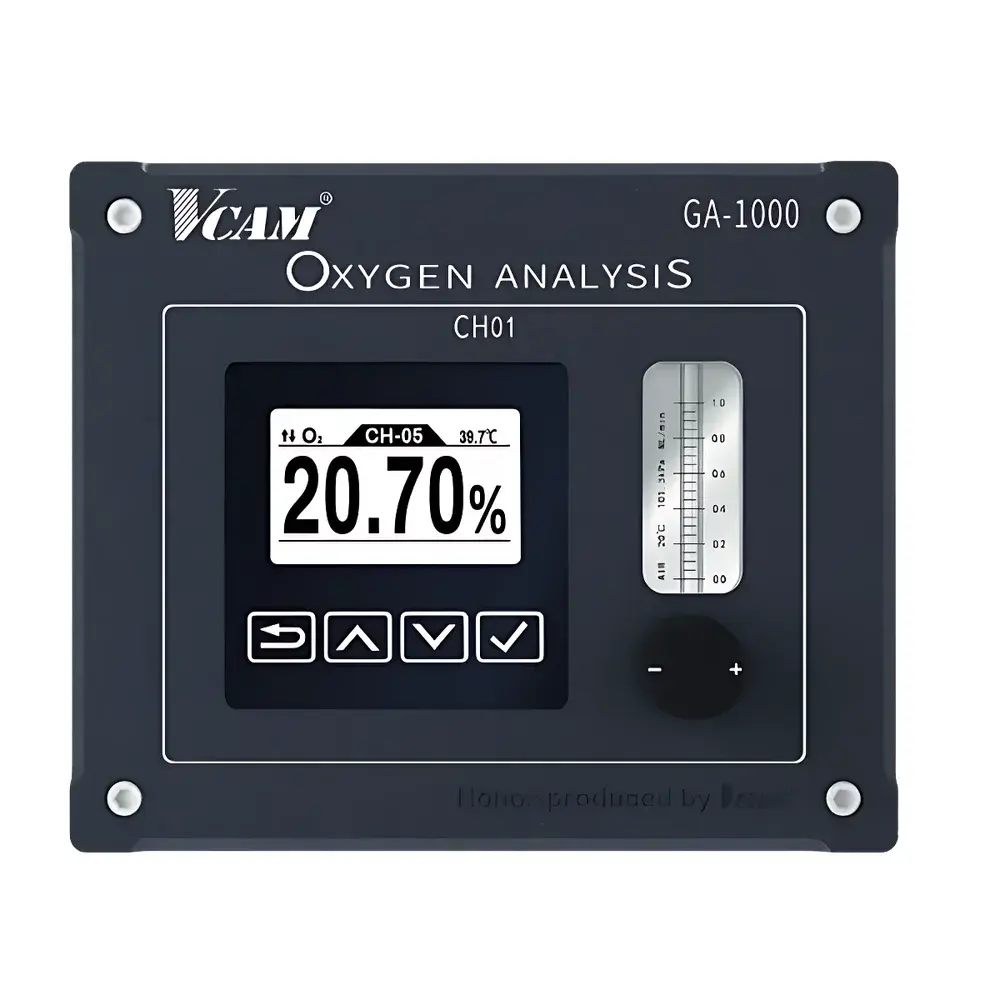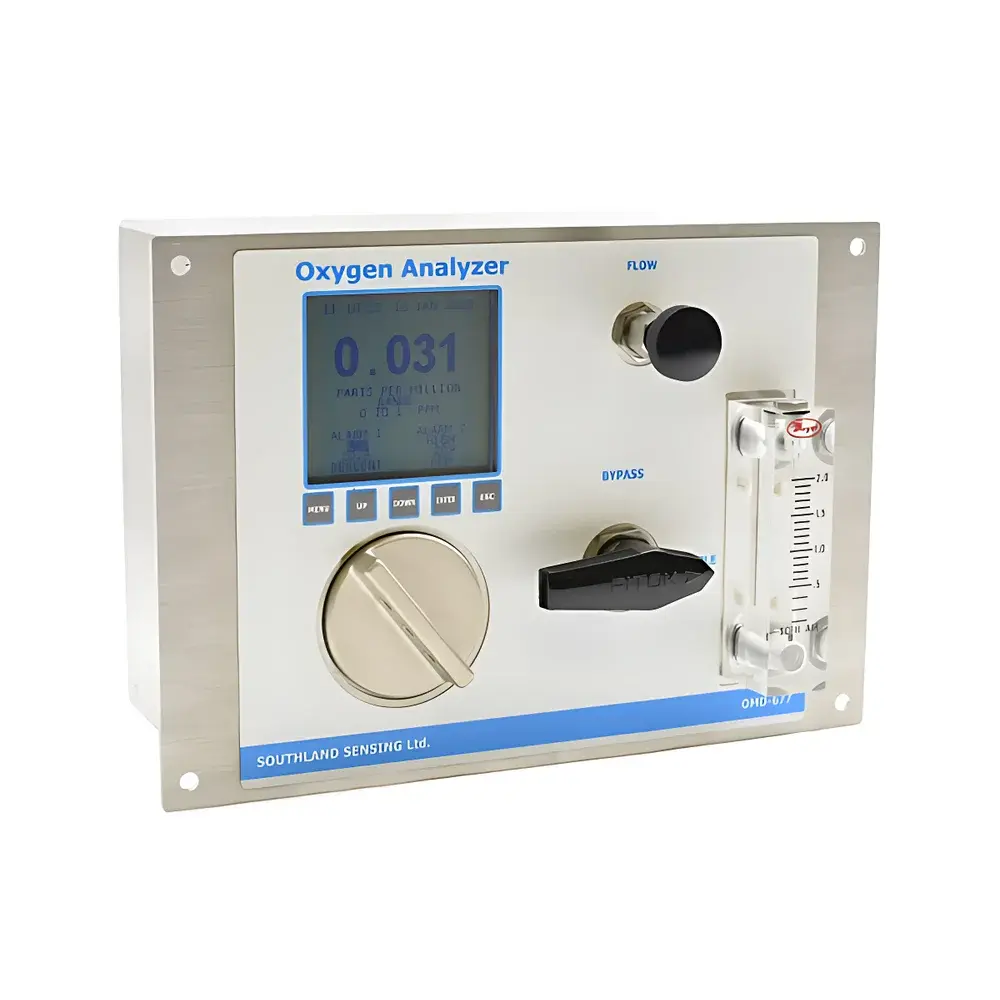
Southland Sensing OMD-677-1 Embedded Electrochemical Oxygen Analyzer
| Origin | USA |
|---|---|
| Manufacturer Type | Authorized Distributor |
| Origin Category | Imported |
| Model | OMD-677-1 |
| Price Range | USD 4,200 – 7,000 |
| Measurement Ranges | 0–10 ppm / 0–100 ppm / 0–1,000 ppm / 0–1% / 0–25% O₂ |
| Accuracy | < ±1% FS |
| Sensor Type | Miniature Fuel Cell (Electrochemical) |
| Operating Temperature | −10 to +50 °C |
| Sample Flow Rate | 230–2,500 mL/min |
| Output Signals | 4–20 mA, 0–10 VDC, MODBUS RTU over RS485 (ASCII bi-directional) |
| Power Supply | 12–24 VDC |
| Current Consumption | 25 mA |
| Enclosure Dimensions | 241 × 165 × 96 mm |
| Certifications | CE |
| Temperature Compensation | Built-in |
| Optional Sensor Variant | Acid-Gas Resistant (for CO₂, H₂S, SO₂ environments) |
| Warranty | 12 months |
| Compatible Media | N₂, Ar, He, H₂, hydrocarbon streams, and other inert or reducing gases |
Overview
The Southland Sensing OMD-677-1 is an embedded electrochemical oxygen analyzer engineered for continuous, high-stability measurement of trace to percent-level oxygen concentrations in industrial process and inert gas systems. Utilizing a miniature, galvanic fuel cell sensor, the instrument operates on the principle of electrochemical oxygen reduction—where O₂ diffuses through a selective membrane and undergoes a stoichiometric redox reaction at the cathode, generating a current linearly proportional to partial pressure. This zero-power-consumption sensing mechanism ensures intrinsic safety, long-term baseline stability, and immunity to flow rate fluctuations within specified sample delivery conditions. Designed for integration into OEM gas cabinets, nitrogen generators, glovebox control systems, and pipeline monitoring skids, the OMD-677-1 delivers reliable performance in demanding environments—including semiconductor cleanrooms, hydrogen production units, and high-purity inert gas distribution networks—without requiring calibration gases or frequent maintenance.
Key Features
- Multi-range electrochemical sensing architecture supporting five selectable full-scale spans: 0–10 ppm, 0–100 ppm, 0–1,000 ppm, 0–1% (10,000 ppm), and 0–25% O₂—configured via DIP switches or software command
- Integrated temperature compensation circuitry ensuring measurement consistency across −10 to +50 °C ambient operating conditions
- Dual programmable alarm relays with configurable setpoints and hysteresis, suitable for safety interlocks or purge cycle control
- Backlit LCD display with real-time concentration readout, range indication, and status icons for sensor health and power integrity
- Robust aluminum enclosure (241 × 165 × 96 mm) rated for industrial panel mounting; IP65 front-panel rating when installed with gasketed bezel
- Standard analog outputs (4–20 mA and 0–10 VDC) plus MODBUS RTU over RS485 for seamless integration into PLCs, DCS, and SCADA platforms
- Optional acid-gas-resistant sensor variant available for applications involving CO₂, H₂S, or SO₂—featuring chemically stabilized electrolyte and corrosion-resistant electrode materials
Sample Compatibility & Compliance
The OMD-677-1 is validated for use with non-corrosive, non-condensing process streams including nitrogen, argon, helium, hydrogen, methane, ethane, and other saturated hydrocarbons. It is explicitly not recommended for direct measurement in chlorine, ammonia, or halogenated solvent vapors without prior consultation. When deployed in glovebox or inert-atmosphere furnaces, the analyzer maintains accuracy under low-flow conditions (230–2,500 mL/min), provided sample conditioning—such as particulate filtration and moisture removal—is implemented upstream. The device complies with CE marking requirements per Directive 2014/30/EU (EMC) and 2014/35/EU (LVD). While not intrinsically safe certified, its low-voltage DC operation (12–24 VDC, 25 mA) and absence of internal ignition sources support Class I, Division 2 hazard area deployment when installed per NEC Article 500 guidelines. Data logging and audit trail functionality are supported via external MODBUS master devices compliant with FDA 21 CFR Part 11 when paired with validated software infrastructure.
Software & Data Management
Configuration and diagnostics are performed via ASCII command protocol over RS485, enabling remote parameter adjustment—including zero/span offset, alarm thresholds, output scaling, and relay logic modes—using standard terminal emulation or custom HMI interfaces. No proprietary software is required; all commands follow documented register mapping and response syntax. Analog outputs are factory-calibrated to NIST-traceable standards and retain linearity within ±0.5% of span over 12 months under stable thermal conditions. For GLP/GMP environments, third-party data acquisition systems can capture timestamped readings, relay state changes, and sensor diagnostic flags (e.g., low voltage, open-circuit detection) to meet ALCOA+ data integrity principles. Firmware updates are delivered via serial interface and require physical access—no over-the-air capability is implemented.
Applications
- On-line purity verification in membrane- and PSA-based nitrogen generators (ISO 8573-1 Class 1–3 compressed air/gas quality compliance)
- Oxygen ingress monitoring in semiconductor fab gloveboxes (target ≤1 ppm O₂ in N₂/Ar atmospheres)
- Leak detection and purge validation in aerospace propulsion test stands using inert blanket gases
- Process endpoint control in thermal annealing furnaces where residual O₂ affects oxide layer formation
- Quality assurance in hydrogen production systems (PEM and alkaline electrolyzers), ensuring <5 ppm O₂ in product gas per ISO 8573-8
- Continuous surveillance of transformer insulating oil headspace gas in substation SCADA networks
FAQ
What is the expected service life of the fuel cell sensor under typical operating conditions?
Fuel cell sensors in the OMD-677-1 typically deliver 18–24 months of stable operation in clean, dry, low-oxygen environments (e.g., 70% RH, or trace acidic contaminants unless the acid-resistant variant is specified.
Can the OMD-677-1 be used in hydrogen-rich gas streams without sensor poisoning?
Yes—the standard fuel cell design is compatible with H₂ matrices up to 100% concentration, provided no catalytic poisons (e.g., siloxanes, phosphines) or sulfur compounds are present. For H₂ streams containing >1 ppm H₂S, the optional acid-resistant sensor must be selected.
Is field calibration possible without specialized equipment?
Zero calibration may be performed using certified nitrogen (99.999% purity); span calibration requires certified O₂-in-N₂ standard gas at a concentration matching the selected range. No internal potentiometers or manual adjustments exist—calibration is executed exclusively via MODBUS or ASCII command sequence.
Does the analyzer support HART communication protocol?
No—HART is not implemented. Communication is limited to MODBUS RTU (RS485) and analog signals (4–20 mA / 0–10 VDC).
What mechanical mounting options are available?
The unit is designed for front-panel flush mounting using the included metal bracket and rubber gasket. DIN rail adapters and surface-mount kits are available as accessories but not supplied standard.