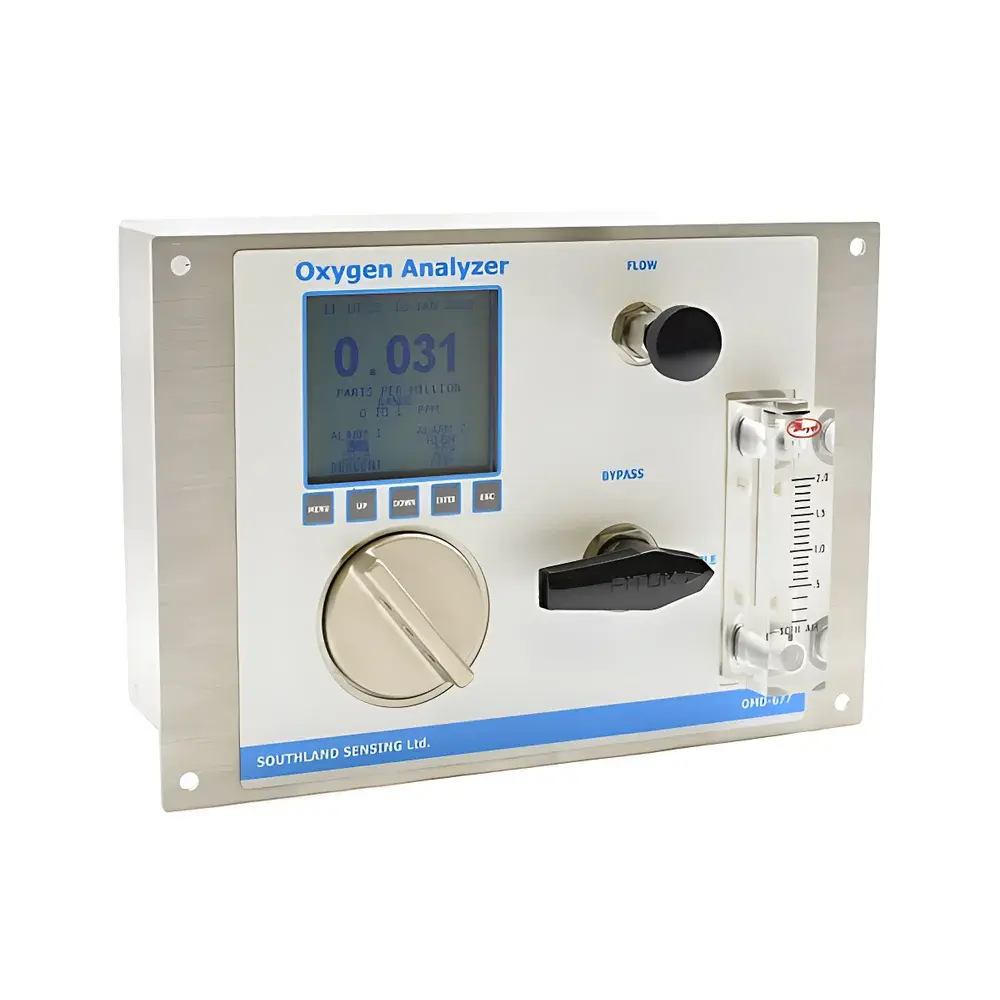
Southland Sensing OMD-677-10 Trace Oxygen Analyzer
| Origin | USA |
|---|---|
| Manufacturer Type | Authorized Distributor |
| Origin Category | Imported |
| Model | OMD-677-10 |
| Measurement Ranges | 0–10 ppm, 0–100 ppm, 0–1000 ppm, 0–1%, 0–25% O₂ |
| Accuracy | <1% FS |
| Sensor Type | Micro-fuel-cell (electrochemical) |
| Operating Temperature | –10 to 50 °C |
| Enclosure Dimensions | 241 × 165 × 96 mm |
| Power Supply | 12–24 VDC, 25 mA |
| Output Signals | 4–20 mA, 0–10 VDC, MODBUS RTU over RS485 (ASCII bi-directional) |
| Sample Flow Rate | 230–2500 mL/min |
| Temperature Compensation | Built-in |
| Certifications | CE |
| Warranty | 12 months |
| Compatible Gases | N₂, Ar, He, H₂, hydrocarbons |
Overview
The Southland Sensing OMD-677-10 Trace Oxygen Analyzer is a high-stability, electrochemical gas analyzer engineered for continuous, real-time measurement of trace to percent-level oxygen concentrations in inert, reducing, and process gases. At its core, the instrument employs a proprietary micro-fuel-cell oxygen sensor — a galvanic cell technology that generates an electrical current proportional to the partial pressure of O₂ diffusing across a selective membrane. Unlike paramagnetic or zirconia-based analyzers, this sensor operates at ambient temperature, requires no external heating or reference gas, and delivers inherently stable zero and span performance over extended intervals. The OMD-677-10 is specifically designed for integration into nitrogen generation systems, glovebox atmospheres, semiconductor purge lines, hydrogen production units, and natural gas transmission monitoring — where detection limits as low as 0.01 ppm (with appropriate range selection) and long-term baseline drift <0.5% FS/year are critical for process integrity and safety compliance.
Key Features
- Multi-range capability: Field-selectable full-scale ranges include 0–10 ppm, 0–100 ppm, 0–1000 ppm, 0–1%, and 0–25% O₂ — enabling one instrument platform to serve ultra-trace purity verification and bulk gas quality control.
- True maintenance-free operation: The fuel-cell sensor consumes no internal reagents and exhibits >24-month typical service life under standard conditions; no periodic electrolyte refills or electrode replacements required.
- Intelligent auto-ranging and auto-zero: Microcontroller-driven signal conditioning dynamically adjusts gain and offset to maintain optimal signal-to-noise ratio across range transitions without manual intervention.
- Dual programmable alarm relays: Configurable for high/low concentration thresholds, fault conditions (e.g., flow loss, sensor timeout), or maintenance alerts — each with dry-contact SPDT outputs rated for 2 A @ 240 VAC.
- Backlit graphical LCD display: High-contrast 128×64 pixel screen shows real-time O₂ value, selected range, status icons, and diagnostic codes — readable under low-light or gloved-hand operation.
- Robust environmental adaptation: Integrated temperature compensation algorithm corrects for thermal effects across –10 to 50 °C ambient; IP54-rated enclosure suitable for controlled industrial environments.
Sample Compatibility & Compliance
The OMD-677-10 is validated for use with non-corrosive, non-condensing gas matrices including nitrogen, argon, helium, hydrogen, methane, ethane, and other saturated hydrocarbons. For applications involving acidic contaminants — such as CO₂, H₂S, or SO₂ — an optional acid-resistant sensor variant is available, featuring chemically stabilized electrodes and fluoropolymer membranes to prevent catalytic poisoning and electrolyte degradation. The analyzer meets CE marking requirements per EU Directive 2014/30/EU (EMC) and 2014/35/EU (LVD). While not intrinsically safe certified, it is routinely deployed in Class 1 Div 2 / Zone 2 areas when installed downstream of approved gas conditioning systems. All firmware and hardware revisions comply with ISO 9001:2015 design control protocols; calibration records and factory test reports are provided with each unit to support GLP and internal QA documentation.
Software & Data Management
Data acquisition and configuration are supported via MODBUS RTU protocol over RS485 — enabling seamless integration into DCS, SCADA, and PLC networks using standard ASCII command sets. The bidirectional interface supports remote readout of live O₂ values, range status, sensor health flags, and alarm states, as well as write access to setpoints, relay logic, and analog output scaling. Analog outputs (4–20 mA and 0–10 VDC) are independently configurable for any selected range and include loop-powered isolation. No proprietary software is required; configuration can be performed using generic terminal emulators or industry-standard MODBUS master tools. Audit trails are maintained internally for all parameter changes, with timestamps synchronized to device uptime — supporting basic 21 CFR Part 11 readiness when paired with compliant host systems.
Applications
- Nitrogen generator outlet monitoring for pharmaceutical-grade (<1 ppm O₂) and electronics-grade (<10 ppm O₂) purity verification.
- Glovebox atmosphere control in battery R&D labs, nuclear material handling, and air-sensitive synthesis — interfaced with purge controllers for closed-loop O₂ suppression.
- Hydrogen production and purification skids, where residual O₂ must remain below explosive limit thresholds (e.g., <4% v/v in H₂).
- Semiconductor fab tool purges, CVD chamber backfilling, and annealing furnace atmospheres requiring sub-ppm oxygen control.
- Natural gas pipeline injection points, verifying inerting prior to commissioning or after maintenance interventions.
- Research furnace exhaust analysis for oxidation kinetics studies in metallurgy and ceramic sintering processes.
FAQ
What sample gas conditioning is required prior to analysis?
A particulate filter (0.1 µm) and moisture trap are strongly recommended upstream of the analyzer inlet. Liquid water, oil aerosols, or solid particulates will permanently damage the fuel-cell membrane. For high-humidity streams, a Nafion® dryer or chilled mirror condenser is advised.
Can the OMD-677-10 measure oxygen in chlorine or ozone-rich environments?
No. Strong oxidizers such as Cl₂, O₃, or NO₂ will irreversibly degrade the fuel-cell electrolyte and electrode catalyst. This instrument is strictly limited to inert, reducing, and neutral gas matrices.
Is field calibration possible, and what standards are recommended?
Yes. Calibration is performed using certified zero gas (high-purity N₂ or Ar) and span gas traceable to NIST standards. For sub-100 ppm ranges, certified 10 ppm O₂ in N₂ is recommended; for 1% FS, 1% O₂ in N₂ is appropriate. Calibration interval depends on application severity but is typically every 3–6 months.
How does sensor lifetime vary with operating range and gas composition?
At 25 °C and 1 atm, typical fuel-cell lifespan exceeds 24 months when measuring 1% O₂ continuously reduces expected life to ~12–18 months. Presence of H₂S >1 ppm without the acid-resistant option accelerates failure within weeks.