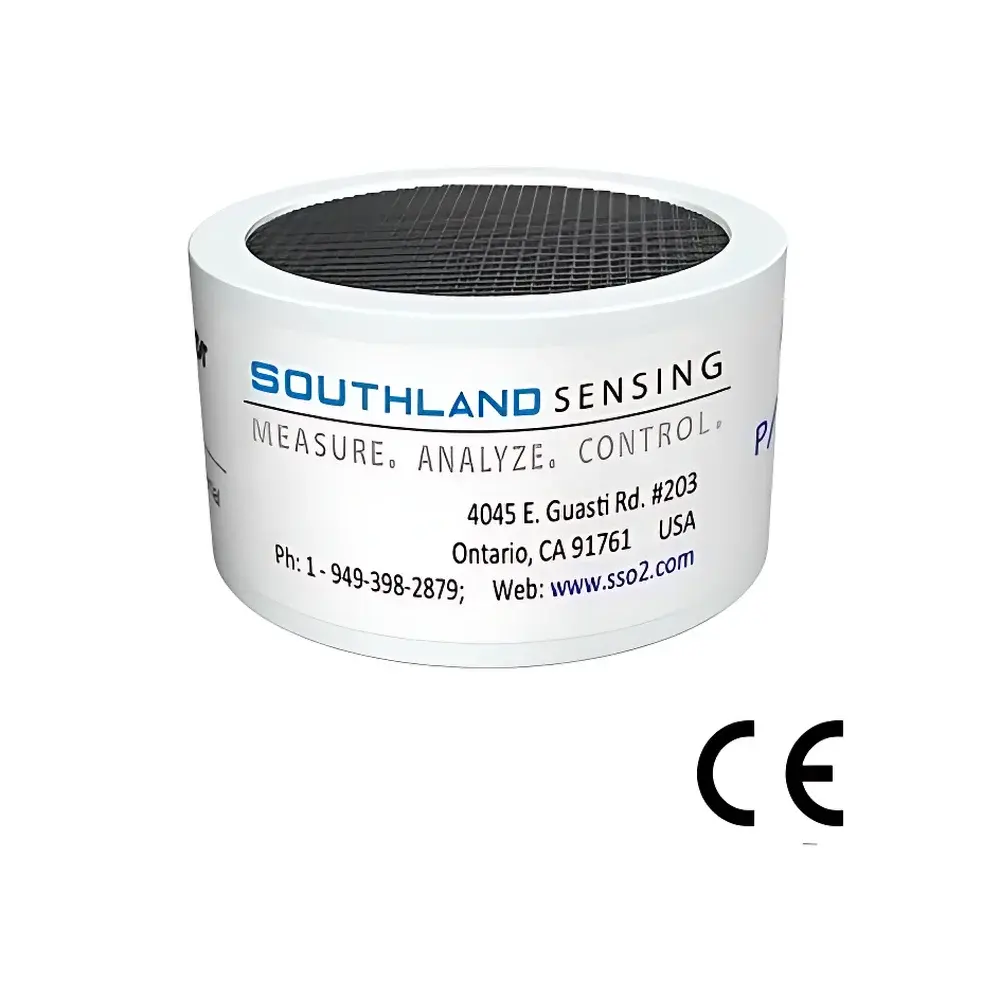
Southland Sensing TO2-1T-xL PPM-Level Electrochemical Oxygen Sensor
| Origin | USA |
|---|---|
| Manufacturer Type | Authorized Distributor |
| Origin Category | Imported |
| Model | TO2-1T-xL |
| Price Range | USD 1–9,999 |
Overview
The Southland Sensing TO2-1T-xL is a high-stability, electrochemical fuel cell-based oxygen sensor engineered for trace-level (ppm) and percent-range oxygen measurement in demanding industrial process environments. Unlike optical or zirconia-based analyzers, this sensor operates on galvanic fuel cell principles—where oxygen diffuses through a selective membrane and undergoes a controlled electrochemical reduction at the cathode, generating a linear current output (285–590 µA) proportional to O₂ partial pressure. Its design eliminates the need for external power to drive the sensing reaction, ensuring intrinsic safety, low power consumption, and long-term zero stability. The TO2-1T-xL is specifically calibrated for continuous in-line monitoring of inert gas streams (e.g., N₂, Ar, He), hydrogen-rich atmospheres, and hydrocarbon process gases—common in semiconductor purge loops, nitrogen generator outlets, and high-purity gas distribution systems. With an operational range spanning 0–1 ppm to 0–25% O₂ (configurable via range-selectable electronics), it delivers reliable detection where conventional paramagnetic or laser-based methods face interference from background gas composition or particulate loading.
Key Features
- Fuel cell technology with self-powered operation—no excitation voltage required, enabling Class I Div 1/Zone 1 compatibility in hazardous areas when properly housed
- Multi-range capability: factory-configurable spans include 0–1 ppm, 0–10 ppm, 0–100 ppm, 0–1000 ppm, 0–1%, and 0–25% O₂
- Fast T₉₀ response time of ≤13 seconds across all ranges, validated per ISO 14644-1 cleanroom commissioning protocols
- Full-scale accuracy of ±1% FS and repeatability of ±0.5% FS under stable temperature and flow conditions
- Temperature compensation algorithm integrated into signal conditioning circuitry, with a specified temperature coefficient of 2.54%/°C
- Two user-configurable relay outputs for high/low alarm thresholds—programmable via front-panel interface or host software
- Backlit LCD display with auto-ranging functionality and real-time concentration readout in ppm or % units
- Robust PCB-mount construction with center-foil cathode (negative) and outer-foil anode (positive), optimized for OEM integration into gas analyzers and panel-mounted transmitters
Sample Compatibility & Compliance
The TO2-1T-xL exhibits broad compatibility with non-corrosive, non-condensing process gases including nitrogen, argon, helium, hydrogen, methane, ethylene, and synthetic air. It is not recommended for use in strongly oxidizing environments (e.g., >50% O₂), chlorine-containing streams, or gases with >10 ppm SO₂, H₂S, or NOₓ due to potential catalyst poisoning. The sensor complies with CE marking requirements for electromagnetic compatibility (EN 61326-1) and meets RoHS Directive 2011/65/EU material restrictions. While the sensor itself does not carry ATEX or IECEx certification, it is routinely deployed in certified analyzer enclosures meeting ATEX II 2G Ex d IIB T4 Gb or IECEx Ex db IIB T4 Gb standards when integrated by qualified system integrators. For regulated pharmaceutical or food-grade applications, its performance supports adherence to USP and ISO 8573-1:2010 Class 1 compressed gas purity specifications.
Software & Data Management
The TO2-1T-xL is a 4–20 mA or 0–10 V analog-output sensor and does not embed firmware or onboard data logging. However, when interfaced with Southland’s compatible transmitter modules (e.g., TOX-200 series) or third-party PLCs/DCS systems, it supports full audit-trail functionality compliant with FDA 21 CFR Part 11 when paired with validated SCADA platforms. Configuration, calibration history, and alarm event logs are managed externally via Modbus RTU/ASCII over RS-485 or HART 7 protocol. Firmware updates and calibration certificate generation occur at the transmitter level—not at the sensor—and are traceable to NIST-traceable O₂ standards. All calibration records maintain GLP/GMP-compliant metadata including operator ID, date/time stamp, standard gas lot number, and environmental conditions during verification.
Applications
- On-line purity verification in PSA and membrane-based nitrogen generators (ISO 8573-1 Class 1–2 compliance)
- Oxygen ingress monitoring in semiconductor wafer fabrication tool purge lines and load-lock chambers
- Leak detection and blanketing gas quality control in aerospace propulsion test stands and cryogenic storage systems
- Process safety interlocks in hydrogen production facilities (PEM electrolyzer off-gas monitoring)
- Residual oxygen quantification in vacuum furnace backfill cycles and heat-treating atmospheres
- Quality assurance in medical gas manufacturing (USP and EN ISO 8573-7:2003)
- Research-grade measurements in catalysis laboratories and plasma chemistry reactors
FAQ
What is the expected service life under continuous operation?
Typical functional lifespan is 20–25 months when operated within specified temperature (0–50°C), humidity (0–100% RH, non-condensing), and flow (0.5–5 SCFH) limits. Storage beyond six months prior to installation may reduce initial stability and requires reconditioning per manufacturer guidelines.
Can the sensor be recalibrated in the field?
Yes—zero and span calibration can be performed using certified zero gas (N₂ or Ar) and traceable span standards (e.g., 10 ppm O₂ in N₂). Calibration frequency depends on application criticality; quarterly verification is recommended for GMP environments.
Is condensation tolerance specified?
No—condensation must be strictly avoided. Installation requires upstream coalescing filtration and dew point control to maintain gas stream temperature ≥5°C above ambient dew point.
Does the sensor require periodic electrolyte replenishment?
No—the TO2-1T-xL uses a sealed, maintenance-free fuel cell with immobilized alkaline electrolyte; no user-serviceable parts exist.
How does temperature variation affect measurement accuracy?
The sensor incorporates passive thermal compensation; however, uncontrolled ambient fluctuations >±2°C/hour may introduce transient drift. For highest accuracy, housing temperature should be stabilized within ±1°C using thermostatically controlled enclosures.
Related Products