
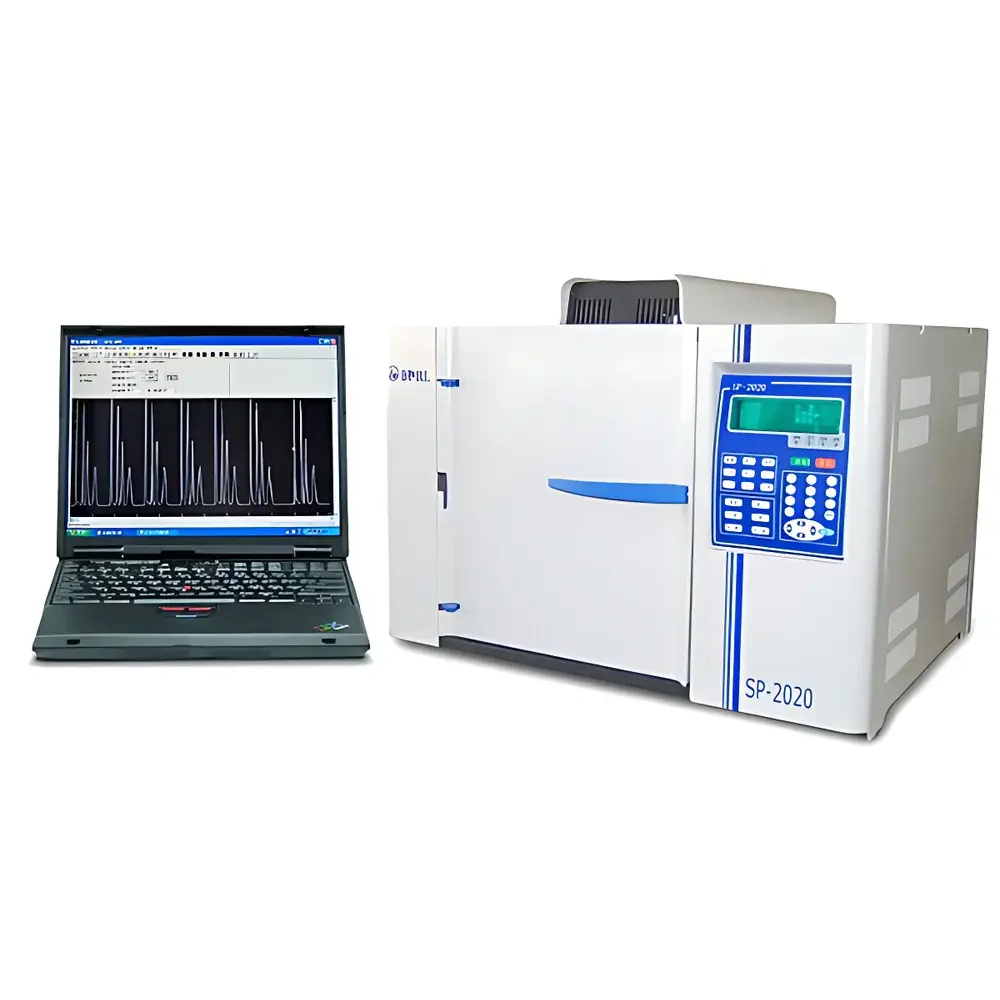
SP-2020 Online Laboratory Gas Chromatograph
| Brand | Beifen Sanpu |
|---|---|
| Origin | Beijing, China |
| Manufacturer Type | Direct Manufacturer |
| Origin Category | Domestic (China) |
| Model | SP-2020 |
| Instrument Type | Online Gas Chromatograph |
| Application Scope | General-Purpose |
| Oven Temperature Range | Up to 400 °C |
| Temperature Ramp Rate | 0.1–50 °C/min |
| Oven Cooling Rate | 0.1–50 °C/min |
| Carrier Gas Flow Control Range | 0–600 kPa |
| Carrier Gas Pressure Control Range | 0–600 kPa |
| Injector Maximum Operating Temperature | 400 °C |
| Injector Pressure Setting Range | 0–600 kPa |
| Injector Total Flow Setting Range | 0–100 / 200 / 500 mL/min (selectable) |
Overview
The SP-2020 Online Laboratory Gas Chromatograph is a benchtop analytical instrument engineered for continuous or semi-continuous monitoring of volatile and semi-volatile organic compounds in laboratory and light industrial environments. It operates on the fundamental principle of gas chromatography—separating complex mixtures based on differential partitioning between a mobile gaseous phase (carrier gas) and a stationary liquid or polymer phase coated inside a capillary or packed column. Separated analytes elute at characteristic retention times and are quantified by one of five interchangeable detectors (FID, TCD, ECD, FPD, or TSD), enabling trace-level analysis across diverse sample matrices. Designed with full microprocessor-based reverse control and Ethernet-enabled remote operation, the SP-2020 integrates modern electronic pressure and flow control (EPC) architecture to ensure method reproducibility, retention time stability, and compliance-ready data integrity.
Key Features
- Full digital EPC system with independent pressure and flow regulation for carrier gas, makeup gas, and detector gases—supporting precise method transfer and robust retention time locking.
- Programmable oven temperature control up to 400 °C with ±0.1 °C accuracy and ramp rates adjustable in 0.1 °C/min increments (0.1–50 °C/min); cooling rate similarly tunable for rapid cycle turnaround.
- Dual injector configuration options: packed column inlet or split/splitless capillary inlet—both rated to 400 °C maximum operating temperature and supporting pressure programming.
- Three standard communication interfaces: RS-232, USB 2.0, and 10/100 Mbps Ethernet—enabling seamless integration into LIMS, SCADA, or centralized lab networks.
- Digitally encoded analog outputs for temperature, pressure, flow, and detector signals—compatible with third-party DAQ systems and regulatory audit trails.
- Modular detector design with hot-swappable detector modules; all detectors feature digitally stabilized baselines and real-time signal diagnostics.
Sample Compatibility & Compliance
The SP-2020 accommodates a broad range of sample types—including environmental air, refinery gases, pharmaceutical solvents, food flavor volatiles, and polymer outgassing profiles—when coupled with appropriate sampling interfaces (e.g., gas-tight syringes, purge-and-trap, thermal desorption units, or direct gas loop injection). Its hardware and firmware architecture supports GLP-compliant workflows: audit-trail-enabled method storage, user-access logging, electronic signature-capable reporting, and data export formats compliant with ASTM D3612, ISO 10156, USP , and EPA Method 8260/8021. While not pre-certified for FDA 21 CFR Part 11, the system’s secure user authentication, immutable raw data storage, and configurable electronic signature settings provide a validated foundation for regulated laboratories undergoing internal or external GMP/GLP audits.
Software & Data Management
The SP-2020 is operated via a dedicated chromatography data system (CDS) that runs on Windows OS platforms. The software provides full instrument control—including oven, injector, detector, and EPC parameter configuration—as well as automated sequence execution, peak integration with customizable baseline algorithms, calibration curve generation (linear, quadratic, or multi-point non-linear), and report templating per ISO/IEC 17025 requirements. Raw data files (.spc or .cdf format) are stored with embedded metadata (method ID, operator, timestamp, instrument serial number, and detector response parameters). Export options include CSV, PDF, XML, and vendor-neutral ANDI/NetCDF formats for cross-platform interoperability. Remote access is supported via HTTPS-secured web interface or VNC-based desktop sharing—subject to network firewall policy and role-based permission settings.
Applications
- Environmental monitoring: VOC analysis in ambient air, soil headspace, and wastewater effluent per EPA TO-17 and ISO 16017-1.
- Petrochemical QA/QC: Hydrocarbon speciation in LPG, natural gas, and reformulated gasoline using ASTM D1945 and D6667.
- Pharmaceutical residual solvent testing: Quantification of Class 2 and 3 solvents in APIs and excipients per ICH Q3C guidelines.
- Food & flavor analysis: Identification and quantification of esters, aldehydes, terpenes, and sulfur compounds in beverages and essential oils.
- Materials science: Outgassing profiling of adhesives, coatings, and composite resins under thermal stress conditions.
FAQ
Is the SP-2020 certified for use in regulated pharmaceutical environments?
The instrument meets foundational hardware and software requirements for GxP environments (e.g., user access controls, audit trail capability, electronic signatures), but formal validation documentation (IQ/OQ/PQ protocols) must be executed by the end-user or qualified third party in accordance with local regulatory expectations.
Can the SP-2020 operate unattended for extended periods?
Yes—when configured with autosampler compatibility (optional), method sequences with up to 999 injections, and scheduled shutdown/restart logic, the system supports 72+ hour unattended operation under stable environmental conditions (±2 °C, <60% RH).
What carrier gases are supported, and how is gas purity managed?
Helium, hydrogen, and nitrogen are fully supported; optimal performance requires Grade 5.0 (99.999%) purity or better. Optional integrated gas purifiers (oxygen/moisture traps) and pressure-swing adsorption (PSA) generators may be added to ensure consistent supply quality.
Does the system support method transfer from legacy GC platforms?
Yes—retention time locking (RTL) mode, combined with EPC-driven flow compensation and digital oven ramp calibration, enables high-fidelity method migration from Agilent, Shimadzu, or Thermo platforms with minimal re-optimization.
Related Products





