
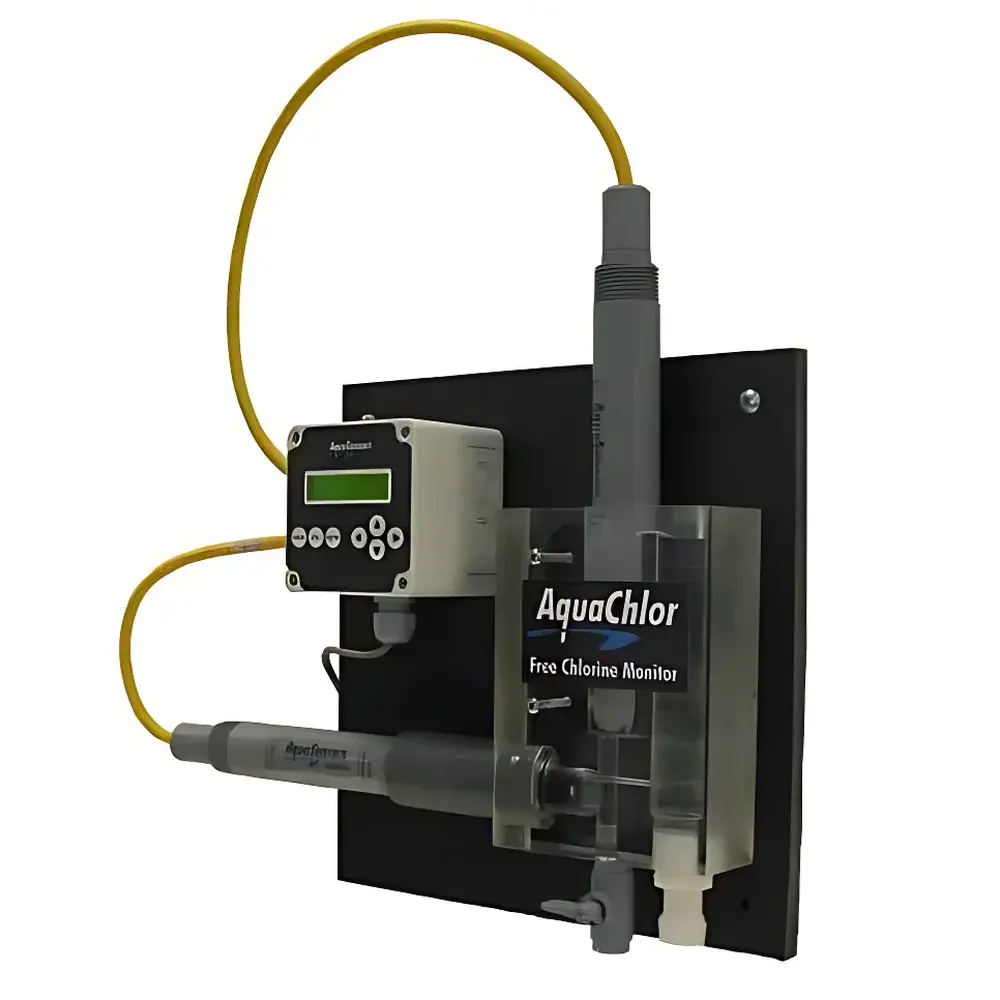
Thermo Fisher AquaChlor Residual Chlorine Analyzer
| Brand | Thermo Fisher |
|---|---|
| Origin | USA |
| Manufacturer | Thermo Fisher Scientific |
| Product Type | Imported Instrument |
| Model | AquaChlor |
| Pricing | Upon Request |
| Measurement Principle | Amperometric Electrode (Gold Cathode / Silver Anode with Teflon Membrane) |
| Range | 0–5 ppm and 0–20 ppm |
| Resolution | 0.005 ppm |
| Accuracy | ±2% of reading or ±10 ppb, whichever is greater |
| Response Time (t₉₀) | 90 seconds |
| Units | ppm (Cl₂), °C / °F |
| Calibration | Single-point air calibration |
| Compensation | Automatic temperature compensation |
| Operating Temperature | 0–45 °C |
| Max Pressure | 15 PSIG (1.03 bar) at 40 °C |
| Flow Rate | 200–250 mL/min |
| Housing Material | Noryl |
| Electrode Materials | Gold cathode, silver anode |
| Selective Membrane | PTFE (Teflon®) |
| Communication Protocols | Modbus RTU, DeviceNet, USB, RS-232, CANopen |
| Data Interface | AV38 Local Display Unit or DataStick Network-Ready Module |
Overview
The Thermo Fisher AquaChlor Residual Chlorine Analyzer is a robust, amperometric electrochemical instrument engineered for continuous, real-time monitoring of free chlorine concentration in potable water, distribution systems, cooling towers, and wastewater effluent streams. It operates on the principle of diffusion-controlled amperometric detection: dissolved chlorine diffuses through a hydrophobic PTFE (Teflon®) membrane into an electrolyte-filled chamber, where it undergoes reduction at a gold cathode while silver is oxidized at the counter anode—generating a current linearly proportional to residual Cl₂ concentration. This membrane-based electrode architecture eliminates reagent consumption, avoids optical interferences (e.g., turbidity, color), and delivers high specificity with a lower detection limit of 5 ppb—critical for compliance with stringent regulatory thresholds such as EPA Method 334.1 and WHO Guidelines for Drinking-water Quality. The system is designed for wall-mounted panel integration (12″ × 12″ footprint) and features a precision flow-through cell with an integrated overflow weir to maintain stable hydraulic head and consistent sample residence time—ensuring measurement repeatability across variable inlet pressures up to 15 PSIG.
Key Features
- Amperometric sensor with gold cathode and silver anode, housed in chemically inert Noryl polymer body for long-term stability in chlorinated environments
- Pre-assembled, factory-calibrated electrode module with integrated PTFE selective membrane—enabling true plug-and-play deployment without field recalibration
- Two selectable measurement ranges (0–5 ppm and 0–20 ppm) optimized for both low-dose disinfection control and high-chlorine process monitoring
- Automatic temperature compensation (ATC) using integrated Pt1000 RTD; optional pH compensation via co-installed pH sensor connected to AV38 display or DataStick interface
- Full diagnostic capability accessible via any supported communication port—no dedicated controller or analyzer required for configuration, calibration verification, or fault logging
- Modular maintenance design: membrane replacement and electrolyte refill performed in under 5 minutes without disassembling the flow cell or breaking process piping
Sample Compatibility & Compliance
The AquaChlor is validated for use with municipal drinking water, filtered surface water, membrane-treated effluent, and recirculating industrial cooling water. It meets material compatibility requirements per NSF/ANSI Standard 61 for components in contact with potable water. Its measurement performance aligns with EPA-approved methods for residual chlorine quantification (e.g., EPA 334.1) and supports data integrity protocols required under 21 CFR Part 11 when deployed with AV38 units configured for audit-trail-enabled operation. All firmware and calibration records are timestamped and user-attributed—facilitating GLP/GMP-compliant documentation during third-party audits or regulatory inspections.
Software & Data Management
Data acquisition and system management are supported through two interoperable hardware platforms: the AV38 local display unit—providing real-time concentration readouts, relay-driven alarms, analog outputs (4–20 mA), and on-device report generation—or the DataStick network module, which enables direct Ethernet/IP or Modbus TCP connectivity to SCADA, DCS, or cloud-based asset monitoring platforms. Configuration is performed via intuitive web interface (DataStick) or keypad-driven menu (AV38), with all settings stored in non-volatile memory. Firmware updates are delivered via secure HTTPS download and support rollback functionality. Event logs—including calibration events, sensor drift alerts, and communication timeouts—are retained for ≥30 days and exportable as CSV files for trend analysis.
Applications
- Real-time monitoring of chlorine residual at water treatment plant clearwells and distribution system entry points
- Automated dosing control feedback for sodium hypochlorite or chlorine gas feed systems
- Verification of disinfection efficacy in hospital sterile processing departments and pharmaceutical water loops
- Compliance tracking for state-level Total Coliform Rule (TCR) and Stage 2 Disinfectants and Disinfection Byproducts Rule (DBPR)
- Performance validation of point-of-use (POU) and point-of-entry (POE) chlorine removal systems
FAQ
Does the AquaChlor require daily reagent addition or chemical standards?
No. It is a reagent-free, amperometric system relying solely on electrochemical reaction kinetics and membrane diffusion—eliminating consumables, waste generation, and associated handling hazards.
Can the sensor be calibrated offline and then installed without field adjustment?
Yes. Electrode modules are pre-calibrated in controlled laboratory conditions and shipped with NIST-traceable calibration certificates. Once installed, no further calibration is needed unless sensor performance drift exceeds predefined tolerance bands.
Is pH compensation mandatory for accurate readings?
Not universally—but highly recommended for samples with pH 8.5, where hypochlorous acid/hypochlorite speciation shifts significantly. The system supports either automatic pH-linked compensation (when paired with a compatible pH sensor) or fixed-offset manual correction.
What is the expected service life of the sensor under continuous operation?
With routine membrane replacement every 6–12 months (depending on water quality and flow conditions), the electrode assembly maintains metrological integrity for ≥24 months. Annual verification against certified standard solutions is advised per ISO/IEC 17025 quality management requirements.
Related Products







