
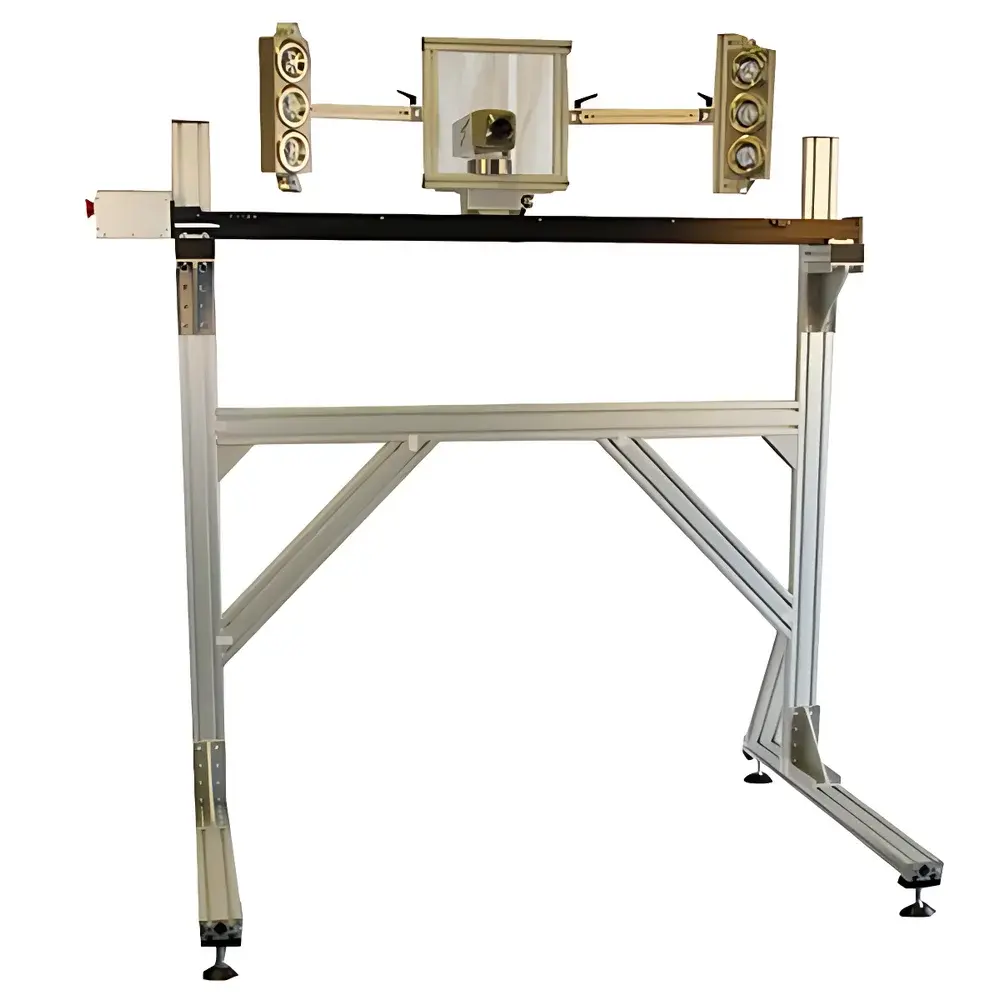
SPECIM ArtScanner Art Conservation Hyperspectral Imaging System
| Brand | SPECIM |
|---|---|
| Origin | Finland |
| Model | ArtScanner |
| Spectral Ranges | VNIR (400–1000 nm), NIR (900–1700 nm), SWIR (1000–2500 nm) |
| Maximum Scan Length | 190 cm |
| Illumination Source | Broadband Halogen Lamp (400–2500 nm) |
| Camera Mounting | Easy-Lock Modular Interface |
| Compatible Platform | Fully Interoperable with SisuCHEMA Hyperspectral Data Acquisition Suite |
Overview
The SPECIM ArtScanner is a purpose-built, non-invasive hyperspectral imaging platform engineered for scientific analysis and documentation of cultural heritage objects. Operating on the principle of push-broom scanning, it acquires spatially registered spectral data cubes (x, y, λ) across defined wavelength ranges—VNIR, NIR, or SWIR—without requiring physical contact or sample relocation. Unlike conventional RGB or multispectral systems, the ArtScanner captures continuous reflectance spectra at each pixel, enabling material identification, pigment mapping, underdrawing revelation, and stratigraphic layer analysis based on spectral absorption features, scattering behavior, and chemical fingerprinting. Its fixed optical geometry—where the hyperspectral camera and calibrated broadband illumination source move synchronously along a precision linear stage—ensures consistent illumination uniformity and radiometric stability across the entire field of view. Designed for integration into conservation laboratories, museum imaging studios, and academic research facilities, the system adheres to best practices in preventive conservation and conforms to international guidelines for non-destructive analytical methodologies.
Key Features
- Precision linear motor-driven scanning stage with 190 cm maximum travel length, accommodating large-format paintings, tapestries, manuscripts, and three-dimensional artifacts.
- Modular, tool-free camera mounting via SPECIM’s Easy-Lock interface—enabling rapid interchange between VNIR, NIR, and SWIR sensors without realignment or recalibration.
- Integrated low-thermal-radiation halogen illumination covering 400–2500 nm; spectrally stable output eliminates need for source swapping when changing spectral bands.
- Bi-directional sensor orientation capability (horizontal or vertical), supporting wall-mounted canvases, vertically displayed scrolls, or bench-top archaeological specimens.
- Optical path optimized for minimal stray light and high signal-to-noise ratio (SNR), critical for detecting subtle spectral variations in aged, faded, or overpainted surfaces.
- Fully compatible with SPECIM’s SisuCHEMA software ecosystem, allowing synchronized acquisition, real-time preview, and cross-platform data fusion with complementary techniques (e.g., XRF, FTIR, macro-XRF).
Sample Compatibility & Compliance
The ArtScanner supports direct imaging of fragile, irreplaceable, and dimensionally constrained cultural objects—including oil paintings on canvas or panel, watercolor and tempera manuscripts, illuminated codices, polychrome sculptures, ceramics, textiles, and lacquerware. No vacuum chambers, sample preparation, or surface coating is required. The system complies with ASTM E2847–22 (“Standard Guide for Hyperspectral Imaging in Forensic and Cultural Heritage Applications”) and aligns with ICOM-CC (International Council of Museums – Committee for Conservation) recommendations for non-invasive diagnostic protocols. All raw spectral data are stored in ENVI-compatible .hdr/.bil format, ensuring long-term archival integrity and interoperability with FAIR (Findable, Accessible, Interoperable, Reusable) data principles. For institutions operating under GLP or ISO/IEC 17025 frameworks, metadata logging—including lamp intensity, scan velocity, integration time, and environmental temperature—is automatically embedded in image headers.
Software & Data Management
Acquisition and processing are managed through SPECIM’s SisuCHEMA platform, which provides full control over exposure parameters, spectral binning, spatial resampling, and geometric correction. The software supports batch processing of multi-scan datasets, spectral library matching (using reference pigment databases such as the FORS Pigment Database or the Smithsonian Museum Conservation Institute spectral repository), and supervised/unsupervised classification (e.g., SAM, SID, K-means). Export options include false-color composites, spectral angle maps, constituent abundance maps, and ASCII-exported spectra for external chemometric analysis (e.g., PCA, PLS-DA in MATLAB or Python). Audit trails—including user login timestamps, parameter changes, and processing history—are retained per dataset to satisfy FDA 21 CFR Part 11 and EU Annex 11 requirements where applicable in regulated conservation workflows.
Applications
- Revealing obscured signatures, inscriptions, and pentimenti beneath overpaint layers using NIR/SWIR transparency effects.
- Differentiating historically authentic pigments (e.g., vermilion vs. cadmium red, azurite vs. synthetic ultramarine) via spectral unmixing.
- Mapping retouching areas and identifying modern restoration materials in conservation condition reports.
- Documenting degradation patterns—including varnish yellowing, binder oxidation, and pigment fading—through time-series spectral monitoring.
- Supporting provenance research by correlating material composition with documented historical recipes and regional manufacturing practices.
- Enabling multimodal correlation with X-ray fluorescence (XRF), Raman spectroscopy, and infrared reflectography (IRR) within shared coordinate frameworks.
FAQ
Can the ArtScanner be used for in situ analysis of wall paintings or murals?
Yes—the vertical mounting configuration and extended scan range allow direct imaging of immovable frescoes and architectural surfaces without disassembly or sampling.
Does the system require darkroom conditions for optimal performance?
Ambient light rejection is achieved via synchronized mechanical shuttering and narrow-band spectral filtering; however, controlled lighting environments are recommended for highest radiometric fidelity.
Is spectral calibration traceable to NIST standards?
Factory calibration includes reflectance standard validation using certified Spectralon® panels (99% reflectance, NIST-traceable), with optional annual recalibration services available through SPECIM’s European service centers.
How is data security and version control managed for long-term conservation projects?
SisuCHEMA supports project-level encryption, role-based access control, and integration with institutional DAM (Digital Asset Management) systems via API; all processed outputs include embedded EXIF-like metadata compliant with PREMIS preservation standards.
What training and technical support options are provided?
SPECIM offers on-site installation verification, operator certification workshops, and remote diagnostics; application-specific protocol development is supported by their Conservation Science Application Team based in Oulu, Finland.
Related Products




