
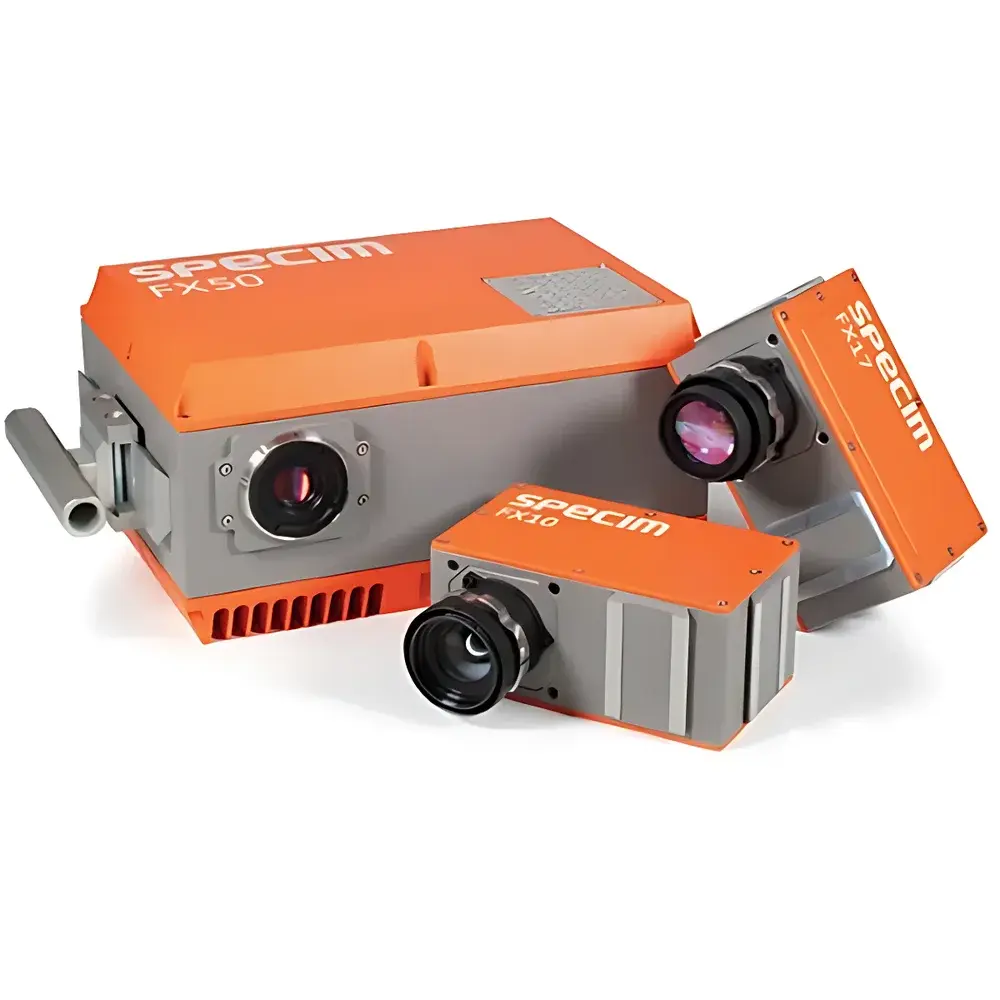
Specim FX Series Portable Hyperspectral Imaging Camera
| Brand | Konica Minolta |
|---|---|
| Origin | Japan |
| Manufacturer Type | Authorized Distributor |
| Product Origin | Imported |
| Model | Specim FX Series |
| Pricing | Upon Request |
| Operating Principle | Push-broom Scanning |
| Deployment Mode | Ground-based & Airborne Compatible |
| Spectral Range | 400–1000 nm |
| Spectral Resolution | 5.5 nm |
| Spatial Resolution | 1024 pixels |
Overview
The Specim FX Series Portable Hyperspectral Imaging Camera is a precision-engineered push-broom scanning instrument designed for quantitative spectral analysis in both laboratory and field-deployable environments. Operating on the principle of spatial-spectral separation via linear array detection and precise motion synchronization, the FX Series captures contiguous, high-fidelity spectral data cubes (x, y, λ) across defined wavelength domains. Each model is optimized for a specific spectral region—VNIR (FX10/FX10+/FX17), SWIR (FX50), or LWIR (FX120)—enabling material identification, compositional mapping, and physicochemical property inference based on characteristic absorption features. Engineered for industrial robustness and metrological consistency, the FX Series complies with fundamental optical calibration traceability requirements and supports NIST-traceable radiometric and spectral calibration protocols.
Key Features
- Modular platform architecture supporting interchangeable optics, filter wheels, and interface options (GigE Vision, Camera Link, CoaXPress)
- Real-time onboard processing capabilities for spectral normalization, dark current correction, and basic index computation (e.g., NDVI, PRI)
- Integrated temperature stabilization for detector and optical path, ensuring spectral fidelity across ambient fluctuations (±0.1 nm wavelength stability over 8 h at 25°C)
- Ruggedized aluminum housing rated IP52 for dust resistance and limited moisture exposure—suitable for factory-floor deployment and UAV-integrated payloads
- Factory-calibrated radiometric response with documented uncertainty budgets per ISO/IEC 17025-accredited procedures
- Support for synchronized external triggering and encoder-based motion compensation to maintain pixel-to-wavelength registration during variable-speed scanning
Sample Compatibility & Compliance
The FX Series accommodates diverse sample geometries and acquisition modalities—including static benchtop imaging, conveyor-based inline inspection, drone-mounted surveying, and handheld point-and-shoot operation. All models meet CE marking requirements for electromagnetic compatibility (EN 61326-1) and safety (EN 61010-1). Data acquisition workflows align with GLP and GMP documentation standards when paired with Specim’s calibrated reference panels (e.g., Spectralon® 99% reflectance tiles) and validated calibration routines. For regulated applications—including food safety (FDA FSMA), pharmaceutical raw material verification (USP ), and environmental monitoring (EPA Method 3050B spectral correlation)—the system supports audit-trail-enabled metadata logging compliant with 21 CFR Part 11 when used with Specim’s INSIGHT software suite.
Software & Data Management
Specim INSIGHT serves as the primary acquisition, preprocessing, and analysis environment—providing spectral library matching (using ENVI-compatible .sli format), multivariate regression (PLS, PCA), and pixel-wise classification (SVM, Random Forest). Raw data are stored in HDF5 format with embedded EXIF-like metadata (exposure time, integration time, GPS timestamp, IMU orientation). Batch processing pipelines support automated calibration application, geometric rectification, and orthorectification when integrated with third-party photogrammetry tools (e.g., Agisoft Metashape, Pix4Dmapper). Export options include GeoTIFF with spectral band stacking, CSV spectral profiles, and MATLAB-compatible .mat files. All software modules undergo annual functional verification per ISO/IEC 17025 Annex A.3 guidelines.
Applications
- Agricultural phenotyping: Quantitative chlorophyll, carotenoid, and water content mapping via VNIR spectral indices (e.g., MCARI, WI)
- Food quality assurance: Detection of bruising, mold, foreign bodies, and compositional heterogeneity in fruits, grains, and processed meats
- Industrial sorting: Real-time NIR/SWIR discrimination of polymer types (PET, PP, PE), mineral grades (quartz vs. feldspar), and metal surface contaminants (oil films, oxides)
- Print & display metrology: Spectral colorimetric validation of OLED/LCD emissivity, ink density uniformity, and metamerism assessment
- Geoscientific core logging: LWIR-based mineralogical identification (e.g., clays, carbonates, sulfates) in drill core scanning workflows with SisuRock integration
- Recycling stream analytics: Automated NIR-based separation of post-consumer plastics by resin type and additive composition
FAQ
What spectral calibration standards are supported?
The FX Series supports factory-applied NIST-traceable spectral calibration using mercury-argon lamp lines and radiometric calibration via certified integrating sphere sources. Users may perform field recalibration using portable calibration targets (e.g., Spectralon® panels) with documented uncertainty propagation.
Is the system compatible with third-party UAV platforms?
Yes—mechanical mounting interfaces, power requirements (12–24 V DC), and synchronization signals (TTL trigger, PPS, encoder input) conform to common UAV integration standards (e.g., DJI SkyPort, Pixhawk MAVLink). Weight and footprint specifications are provided in the Technical Integration Manual.
Can raw hyperspectral data be exported without proprietary software?
Yes—raw sensor output is accessible via GenICam-compliant drivers. Binary frame buffers and header metadata are structured according to IEEE 1789-2020 hyperspectral data interchange conventions, enabling direct ingestion into Python (hyperspy, scikit-image), R (hyperSpec), or MATLAB environments.
Does the FX120 require cryogenic cooling?
No—the FX120 utilizes a thermoelectrically cooled microbolometer array operating at stabilized temperatures between –10°C and +40°C ambient, eliminating the need for liquid nitrogen or Stirling coolers while maintaining NETD <40 mK.
How is spatial resolution maintained across varying scan speeds?
Encoder-coupled motion control ensures fixed ground sampling distance (GSD) by dynamically adjusting line rate and integration time. Firmware-level interpolation and sub-pixel resampling preserve spatial fidelity within ±0.5 pixel RMS error across operational velocity ranges (0.1–5 m/s).




