
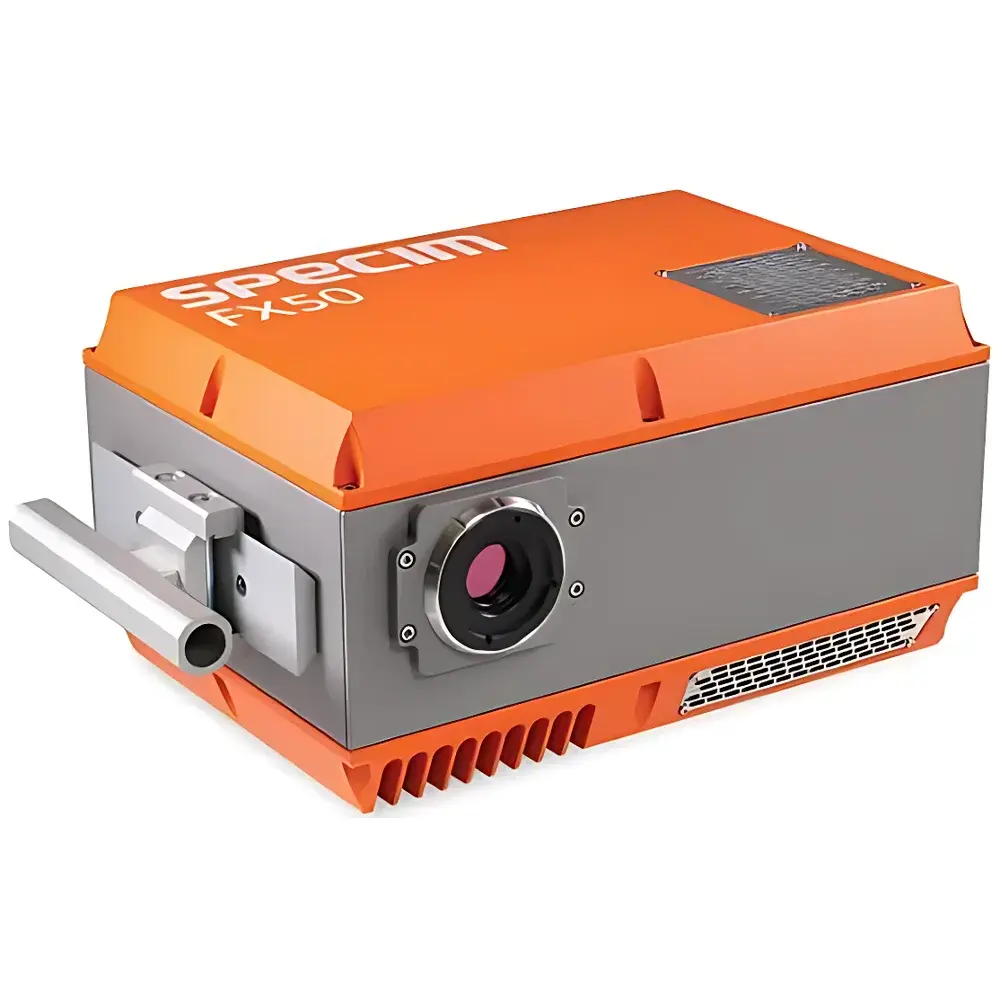
Specim FX50 Mid-Wave Infrared Hyperspectral Imaging Camera
| Brand | SPECIM |
|---|---|
| Origin | Finland |
| Model | FX50 |
| Spectral Range | 2.7–5.3 µm |
| Spatial Resolution | Up to 640 × 512 pixels |
| Spectral Bands | 150 configurable bands |
| Interface | GigE Vision compliant |
| Cooling | Integrated Stirling cooler |
| Lens Options | Three interchangeable MWIR lenses (focal lengths optimized for FOV and working distance) |
| Integration Support | Specim SDK, ASCII command protocol, third-party machine vision software compatibility (e.g., HALCON, OpenCV, Common Vision Blox) |
| Illumination Compatibility | Dedicated MWIR broadband光源 available |
Overview
The Specim FX50 is a purpose-engineered mid-wave infrared (MWIR) hyperspectral imaging camera designed for industrial machine vision applications requiring material identification and compositional analysis beyond the capabilities of visible or short-wave infrared (SWIR) systems. Operating across a calibrated spectral range of 2.7–5.3 µm, the FX50 leverages strong fundamental molecular absorption features—particularly C–H, O–H, and Si–O vibrational overtones and combinations—that are absent or attenuated in shorter wavelengths. This enables unambiguous discrimination of carbon-based polymers (including black ABS and PP), hydrocarbons, oxides, sulfides, and silicates in real time. Unlike conventional RGB or multispectral sensors, the FX50 captures full spectral signatures at every pixel, generating datacubes (x, y, λ) suitable for quantitative chemometric modeling, spectral library matching, and automated classification algorithms. Its compact, ruggedized housing—designed for continuous operation in factory-floor environments—integrates active Stirling cooling to stabilize detector response and ensure radiometric consistency across temperature fluctuations.
Key Features
- Optimized MWIR spectral coverage (2.7–5.3 µm) for detection of fundamental molecular vibrations in organic and inorganic materials
- 150 programmable spectral bands with user-defined band selection and binning, enabling application-specific spectral resolution tuning
- GigE Vision-compliant interface for deterministic frame transmission, low-latency synchronization, and seamless integration into existing industrial vision architectures
- Three interchangeable MWIR-optimized lenses (12 mm, 25 mm, and 50 mm focal lengths) supporting working distances from 150 mm to >1 m and field-of-view configurations from narrow-line to wide-area scanning
- High quantum efficiency InSb focal plane array (640 × 512 pixels) with <150 mK noise-equivalent temperature difference (NETD) at 1 ms integration time
- Built-in radiometric calibration engine with non-uniformity correction (NUC) and shutterless operation enabled by stabilized thermal management
- Full software control via ASCII command protocol and native support for Specim’s SDK (C++, Python, .NET bindings)
Sample Compatibility & Compliance
The FX50 excels in analyzing optically challenging samples that exhibit low reflectance or near-zero contrast in visible/SWIR domains—including black plastics, soot-coated surfaces, oxidized metals, and dark geological specimens. Its spectral sensitivity enables detection of trace contaminants (e.g., silicone residues on aluminum substrates, hydrocarbon films on stainless steel) at sub-0.1% surface coverage levels. The system complies with CE marking requirements for electromagnetic compatibility (EMC Directive 2014/30/EU) and low-voltage safety (LVD Directive 2014/35/EU). Data acquisition workflows support audit-ready metadata embedding (wavelength calibration, integration time, lens ID, NUC timestamp) required under ISO/IEC 17025-accredited laboratory practices. When deployed in regulated manufacturing environments, raw data output and processing logs can be configured to meet FDA 21 CFR Part 11 electronic record and signature requirements through validated third-party middleware.
Software & Data Management
Specim provides the FX50 with a modular software ecosystem: the Specim INSIGHT suite offers real-time visualization, spectral library creation (with ENVI-compatible .hdr/.sli export), and supervised classification (SVM, PLS-DA, Random Forest). All processing modules generate FAIR-compliant (Findable, Accessible, Interoperable, Reusable) outputs adhering to HDF5 and GeoTIFF standards. For production line deployment, the ASCII control protocol allows deterministic triggering, exposure control, and region-of-interest (ROI) readout without dependency on proprietary GUI layers. Integration with HALCON 22.11+, Common Vision Blox 14.0+, and OpenCV 4.8+ is validated and documented. Raw data streams are compatible with MATLAB-based chemometric toolboxes (e.g., PLS Toolbox, Unscrambler X) and Python libraries (scikit-learn, hylite, pysptools) for custom model development and edge inference deployment.
Applications
- Plastics sorting in recycling facilities: Discrimination of black ABS, PS, PP, and PET based on C–H stretching and bending modes at 3.4–3.5 µm and 4.6–4.7 µm
- Mineralogical mapping in core scanning and ore grade estimation: Identification of kaolinite, illite, smectite, and carbonate species via OH and CO₃²⁻ absorption features between 2.8–3.0 µm and 4.9–5.1 µm
- Hydrocarbon leak detection and composition analysis in upstream oil & gas: Quantification of methane, ethane, propane, and benzene vapor plumes using tunable band-ratio algorithms
- Surface contamination inspection in automotive and aerospace manufacturing: Detection of lubricant residues, release agents, and cleaning solvent traces on painted or anodized metal surfaces
- Pharmaceutical tablet coating uniformity assessment: Mapping of polymer film thickness and API distribution through MWIR absorption depth profiling
FAQ
What spectral calibration accuracy does the FX50 maintain over extended operation?
The FX50 performs automatic non-uniformity correction (NUC) every 30 minutes or on-demand, with wavelength calibration traceable to NIST-traceable blackbody sources. Spectral drift remains within ±0.5 nm over 8-hour continuous operation at ambient temperatures up to 40 °C.
Can the FX50 operate in reflective or transmissive mode?
The standard configuration is reflectance-mode imaging; transmissive measurements require external beam-splitting optics and collimated MWIR illumination—support is available via Specim’s Application Engineering team for custom optical path design.
Is real-time onboard processing supported?
The FX50 outputs raw hyperspectral data only; real-time classification requires external GPU-accelerated inference (e.g., NVIDIA Jetson AGX Orin or industrial PCs with CUDA-enabled GPUs) running models trained offline in Specim INSIGHT or Python environments.
Does the system include radiometric calibration certificates?
Yes—each unit ships with a factory-issued radiometric calibration report (including responsivity curves, NUC coefficients, and spectral bandpass characterization), valid for 12 months under normal operating conditions.
How is thermal stability managed during prolonged acquisition?
The integrated Stirling cooler maintains the InSb detector at −196 °C ± 0.3 °C, while dual-stage thermal isolation minimizes conductive heat load from the housing. Ambient temperature compensation algorithms adjust gain and offset parameters dynamically to preserve signal linearity across 15–40 °C ambient ranges.




