
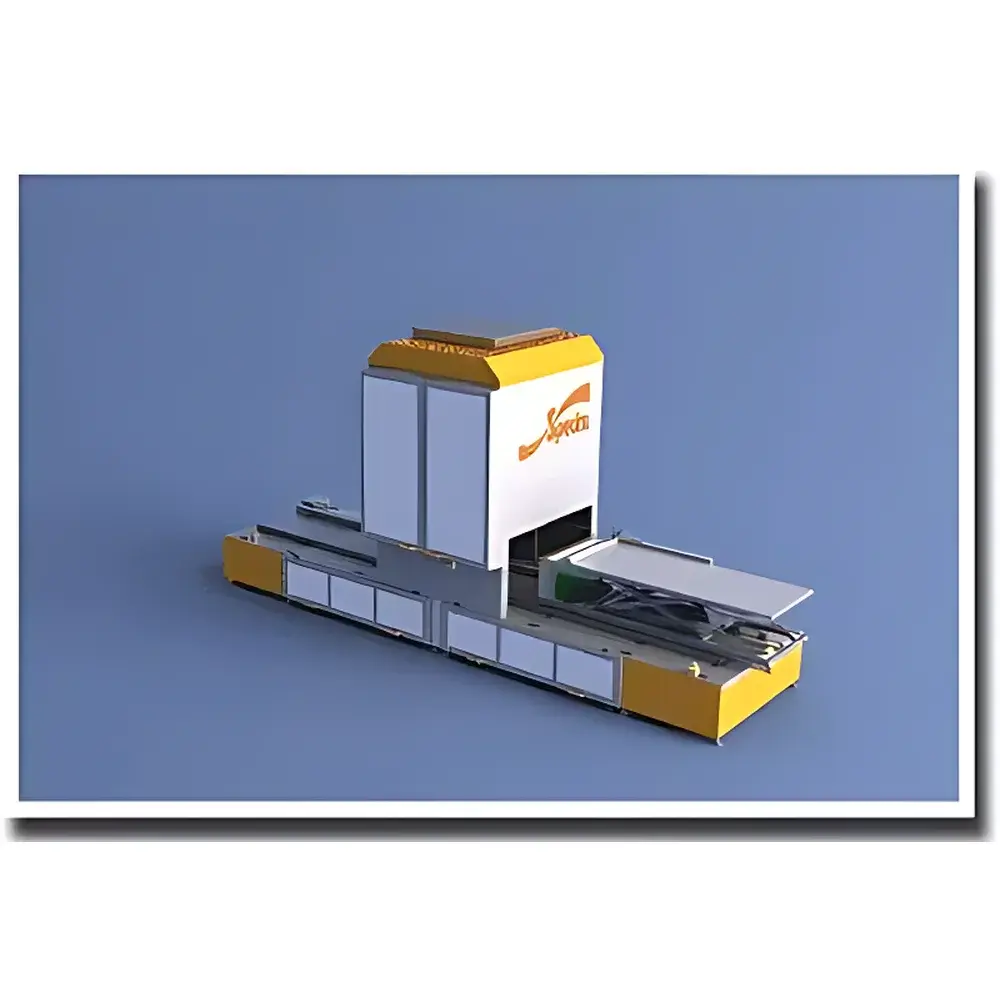
SPECIM SisuROCK Hyperspectral Core Imaging Workstation
| Brand | SPECIM |
|---|---|
| Origin | Finland |
| Model | SisuROCK |
| Imaging Principle | Push-broom |
| Imaging Type | Dispersive |
| Operational Mode | Ground-based |
| Spectral Range | 100–1000 nm (VNIR), 1000–2500 nm (SWIR), 3–5 µm (MWIR), 8–12 µm (LWIR) |
| Spectral Resolution | ≥1 nm |
| Spatial Resolution | 1024 × 1024 or 2048 × 2048 pixels |
| Field of View (TFOV) | 23° or 32° |
| Instantaneous Field of View (IFOV) | Height-dependent |
| Frame Rate | >1000 fps |
Overview
The SPECIM SisuROCK Hyperspectral Core Imaging Workstation is an industrial-grade, automated push-broom hyperspectral imaging system engineered for high-throughput mineralogical characterization of geological core samples. Based on dispersive spectroscopy and calibrated line-scan acquisition, the SisuROCK captures contiguous spectral data cubes (x, y, λ) across VNIR, SWIR, MWIR, and LWIR bands—enabling non-destructive, label-free identification and spatial mapping of mineral assemblages at sub-millimeter resolution. Its ground-based architecture integrates precision motion control, radiometrically calibrated optics, and synchronized illumination to ensure measurement repeatability under laboratory or field-deployable conditions. Designed explicitly for geoscience workflows, the SisuROCK meets the metrological demands of exploration geochemistry, resource estimation, and process optimization in mining operations—supporting traceable, standards-aligned data generation per ISO/IEC 17025 and ASTM D7996 (Standard Guide for Hyperspectral Imaging in Geological Applications).
Key Features
- Modular spectral configuration: Interchangeable camera modules for VNIR (100–1000 nm), SWIR (1000–2500 nm), MWIR (3–5 µm), and LWIR (8–12 µm) enable optimal band selection based on target mineral absorption features.
- Ultra-high-speed scanning: Full-core tray acquisition completed in ≤15 seconds; throughput of up to 1200 meters of core per day at 2 mm spatial sampling.
- Automated dual-mode operation: Switches seamlessly between high-resolution single-core imaging and rapid batch scanning of standard core trays (e.g., 1.5 m × 0.3 m).
- Radiometric calibration traceable to NIST-traceable standards; includes built-in white reference and dark current correction for quantitative reflectance/emissivity computation.
- Robust mechanical design with vibration-damped linear stage, integrated LED or halogen illumination, and environmental shielding for stable operation in controlled lab environments.
Sample Compatibility & Compliance
The SisuROCK accommodates cylindrical rock cores (diameters 30–150 mm), split core halves, drill cuttings, polished thin sections, and bulk ore samples mounted on standardized trays. Sample handling complies with industry-standard core logging protocols (e.g., ASX-1, IUGS Core Description Handbook). All spectral data products are structured in ENVI-compatible BIL/BIP format and include embedded metadata compliant with ISO 19115-2 for geospatial lineage tracking. System validation documentation supports GLP-compliant workflows and satisfies audit requirements under ISO 9001 and mining-specific QA/QC frameworks. Optional integration with LIMS enables direct ingestion of hyperspectral-derived mineral indices into resource modeling platforms (e.g., Leapfrog Geo, Vulcan).
Software & Data Management
The workstation ships with SPECIM’s proprietary SisuCHEMA software suite, which provides end-to-end processing from raw cube calibration to mineral classification and spectral unmixing. Key capabilities include atmospheric correction (for SWIR/LWIR emissivity retrieval), spectral library matching against USGS, JPL, and CSIRO mineral databases, and supervised/unsupervised classification (e.g., SAM, MAF, PCA). All processing steps generate immutable audit trails compliant with FDA 21 CFR Part 11 requirements—including user authentication, electronic signatures, and version-controlled parameter logs. Export options include GeoTIFF with embedded georeferencing, CSV spectral profiles, and interactive HTML reports for collaborative review.
Applications
- Mineral identification and lithological mapping of drill core in exploration campaigns—enabling real-time decision support during drilling programs.
- Quantitative estimation of alteration zones (e.g., phyllosilicate vs. carbonate assemblages) for porphyry Cu-Au targeting.
- Grade control and waste-rock discrimination in open-pit and underground operations via automated thresholding of diagnostic absorption features (e.g., Al–OH at 2200 nm, Fe³⁺ at 860 nm).
- Geotechnical assessment through clay mineral ratio analysis (e.g., illite/smectite ratios correlating with swelling potential).
- Archival digital core libraries supporting long-term reprocessing as new spectral libraries or AI models become available.
FAQ
What spectral bands are recommended for identifying hematite and goethite?
Hematite exhibits strong absorption features near 540 nm and 860 nm in the VNIR range, while goethite shows diagnostic bands at 480 nm and 920 nm—making VNIR instrumentation optimal for their discrimination.
Can the SisuROCK be integrated with existing core scanning infrastructure?
Yes—the system supports RS-232, Ethernet/IP, and OPC UA interfaces for synchronization with conveyor systems, barcode readers, and enterprise MES platforms.
Is spectral calibration required before each scan session?
A daily radiometric calibration using the integrated white reference panel is recommended; full NIST-traceable recalibration is advised every 12 months or after optical module replacement.
Does the system support real-time mineral classification during scanning?
Yes—onboard GPU-accelerated processing enables live spectral clustering and false-color mineral maps displayed synchronously with acquisition.
How is spatial resolution affected by sample height above the sensor?
Instantaneous field of view (IFOV) scales linearly with working distance; precise IFOV values are calculated per installation using the provided geometric calibration matrix and recorded Z-height metadata.



