
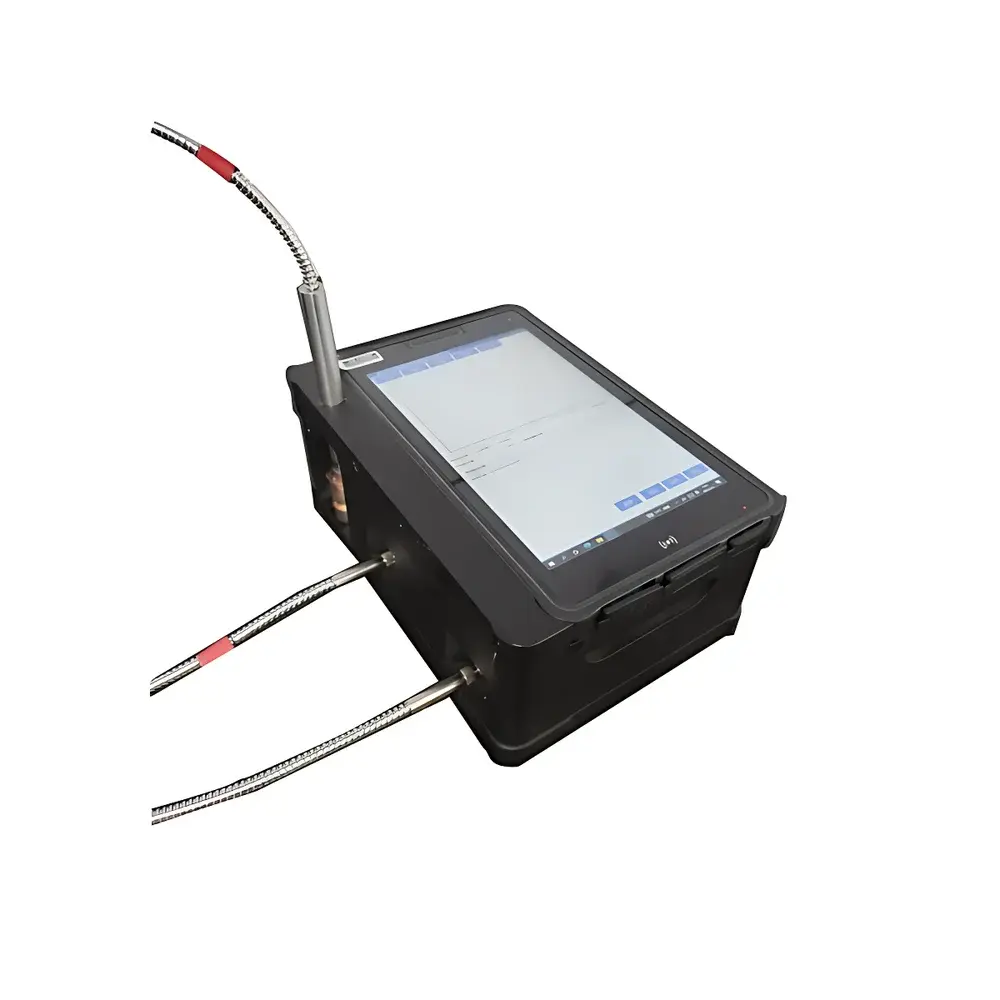
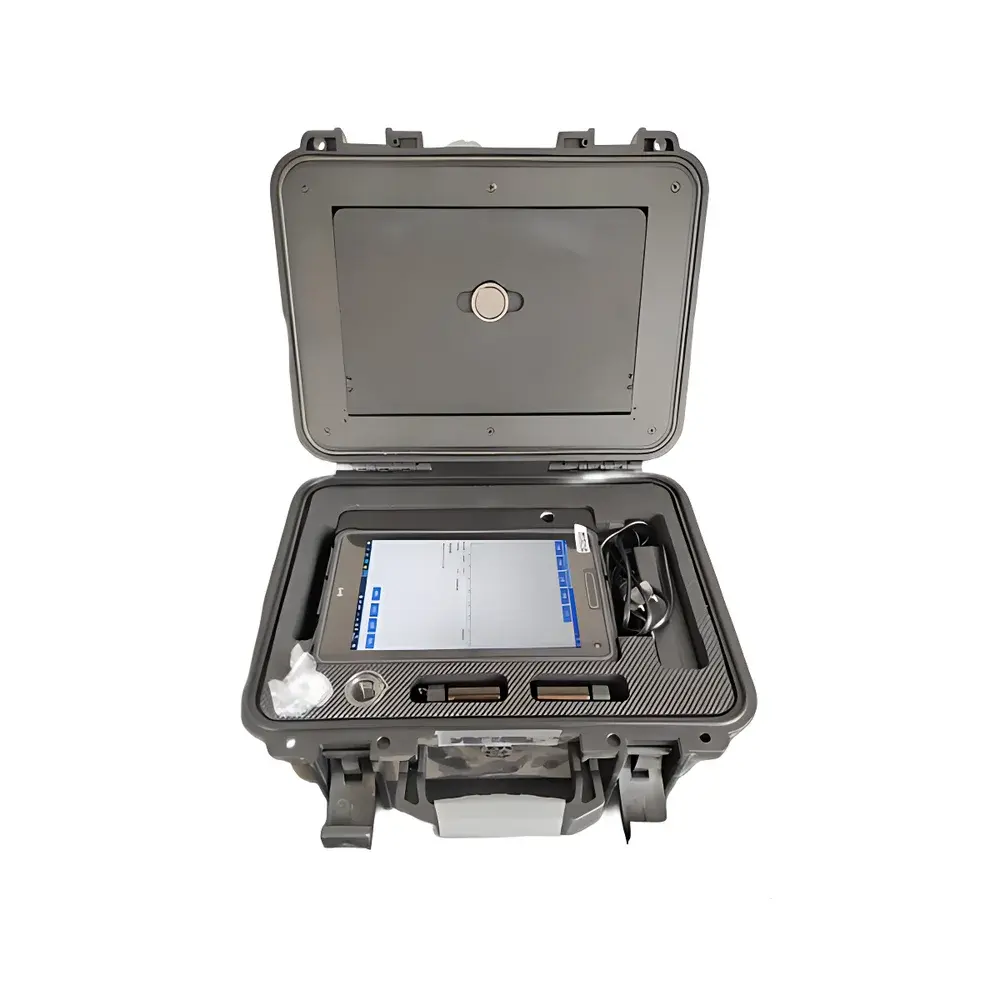
SPECTRA INVENT HX-920A Portable NIR Fuel Analyzer (Probe-Type)
| Brand | SPECTRA INVENT |
|---|---|
| Origin | Beijing, China |
| Manufacturer Type | Authorized Distributor |
| Country of Manufacture | China |
| Model | HX-920A |
| Pricing | Upon Request |
Overview
The SPECTRA INVENT HX-920A Portable NIR Fuel Analyzer (Probe-Type) is a field-deployable, non-destructive analytical instrument engineered for rapid, on-site quantitative determination of key quality parameters in aviation turbine fuels (e.g., Jet A-1, JP-5, JP-8), diesel, and marine distillate fuels. It operates on the principle of near-infrared (NIR) spectroscopy in the 1100–2500 nm wavelength range, utilizing fiber-optic probe-based transmission or reflectance measurement to acquire spectral signatures directly from bulk liquid samples in tanks, drums, or fueling hoses—without sample extraction or reagent consumption. The system employs chemometric modeling (primarily Partial Least Squares Regression, PLS-R) calibrated against reference ASTM D4052 (density), D4057 (sampling), D93 (flash point), D287 (API gravity), D2430 (freezing point), D5191 (vapor pressure), and D6536 (distillation) test data. This enables real-time prediction of critical specifications including density, kinematic viscosity, flash point, freezing point, distillation endpoints (T10, T50, T90), and aromatic content—within seconds per measurement.
Key Features
- Integrated probe-based optical interface with sapphire window and stainless-steel housing (IP65 rated), enabling direct immersion or contact measurement in operational fuel systems.
- Portable configuration: lightweight main unit (< 3.2 kg), rechargeable Li-ion battery (≥ 6 h continuous operation), and ruggedized carry case compliant with MIL-STD-810G shock/vibration requirements.
- Onboard calibration validation via built-in NIST-traceable ceramic reference standard; automated drift correction using internal wavelength and intensity references.
- Dual-mode spectral acquisition: configurable for either transmittance (via dip-probe geometry) or diffuse reflectance (for opaque or highly scattering fuels).
- Real-time spectral preprocessing: automatic baseline correction, Savitzky-Golay smoothing (1st derivative, 15-point window), and multiplicative scatter correction (MSC) applied prior to model inference.
- Embedded thermal stabilization: Peltier-controlled detector (InGaAs array) maintains ±0.1 °C stability across ambient temperatures from –10 °C to +50 °C.
Sample Compatibility & Compliance
The HX-920A is validated for use with hydrocarbon-based liquid fuels meeting military and civil aviation specifications, including but not limited to JP-5, JP-8, Jet A-1, F-34, and ULSD. It supports measurements in clear, mildly turbid, and low-water-content (< 50 ppm) samples; high particulate load or free water requires pre-filtration per ASTM D2709. All chemometric models are developed and verified in accordance with ASTM E1655 (Standard Practices for Infrared Multivariate Quantitative Analysis) and ISO 12099 (Animal feeding stuffs, cereals and milled cereal products — Guidelines for the application of near infrared spectroscopy). Instrument performance verification adheres to GJB 6154–2008 (Naval Vessel Fuel Testing Kit Specification) and GJB 6663–2009 (Aviation Fuel Testing Kit Specification), with prediction errors statistically bounded relative to reference methods per GB/T 265 (viscosity), GB/T 1884 (density), GB/T 261 (flash point), GB/T 2430 (freezing point), GB/T 510 (pour point), and GB/T 6536 (distillation).
Software & Data Management
The analyzer is operated via SpectraChem v4.2 software installed on the included Windows 10 IoT Enterprise tablet. The software provides full audit trail functionality compliant with FDA 21 CFR Part 11 requirements—including electronic signatures, user role-based access control (admin/operator/technician), and immutable measurement logs with timestamp, GPS coordinates (optional external module), operator ID, and raw spectral metadata. Calibration models are stored in encrypted .cal format with version control and change history. Data export supports CSV, XML, and ASTM E2713-compliant LIMS-ready formats. Remote firmware updates and model library synchronization are supported over secure TLS 1.2 connections.
Applications
- Field verification of fuel conformity prior to aircraft refueling or naval vessel bunkering operations.
- Rapid screening of fuel batches at depots, terminals, and forward operating bases without laboratory turnaround delay.
- In-process monitoring during fuel blending or additive dosing to ensure specification compliance in real time.
- Forensic analysis of fuel contamination incidents (e.g., diesel/jet fuel misidentification, glycol adulteration, hydrocarbon solvent ingress).
- Supporting GLP/GMP-aligned quality assurance workflows where traceability, method validation, and instrument qualification (IQ/OQ/PQ) documentation are required.
FAQ
What reference standards are required for initial calibration setup?
Primary calibrations require laboratory-measured reference datasets generated per ASTM D4057 sampling protocols and analyzed using primary methods (e.g., ASTM D93 for flash point). SPECTRA INVENT provides certified calibration transfer sets for routine verification.
Can the HX-920A be used for biofuel blends (e.g., HEFA-SPK)?
Yes—provided the chemometric model is specifically developed and validated for the target blend ratio and feedstock origin; custom model development services are available under NDA.
Is the fiber-optic probe compatible with pressurized fuel lines?
The standard probe is rated for static immersion up to 10 bar; for inline pressurized applications, a DIN 259/2999 threaded process adapter kit must be specified at order.
How often does the instrument require recalibration?
Model validity is assessed daily via reference standard checks; full recalibration is recommended every 90 days or after 500 measurements, whichever occurs first, per GJB 6663–2009 Section 5.4.2.
Does the system support multi-language UI beyond English?
The software interface supports English, Simplified Chinese, and Arabic; additional languages may be enabled via localized resource packs upon request.
Related Products





