
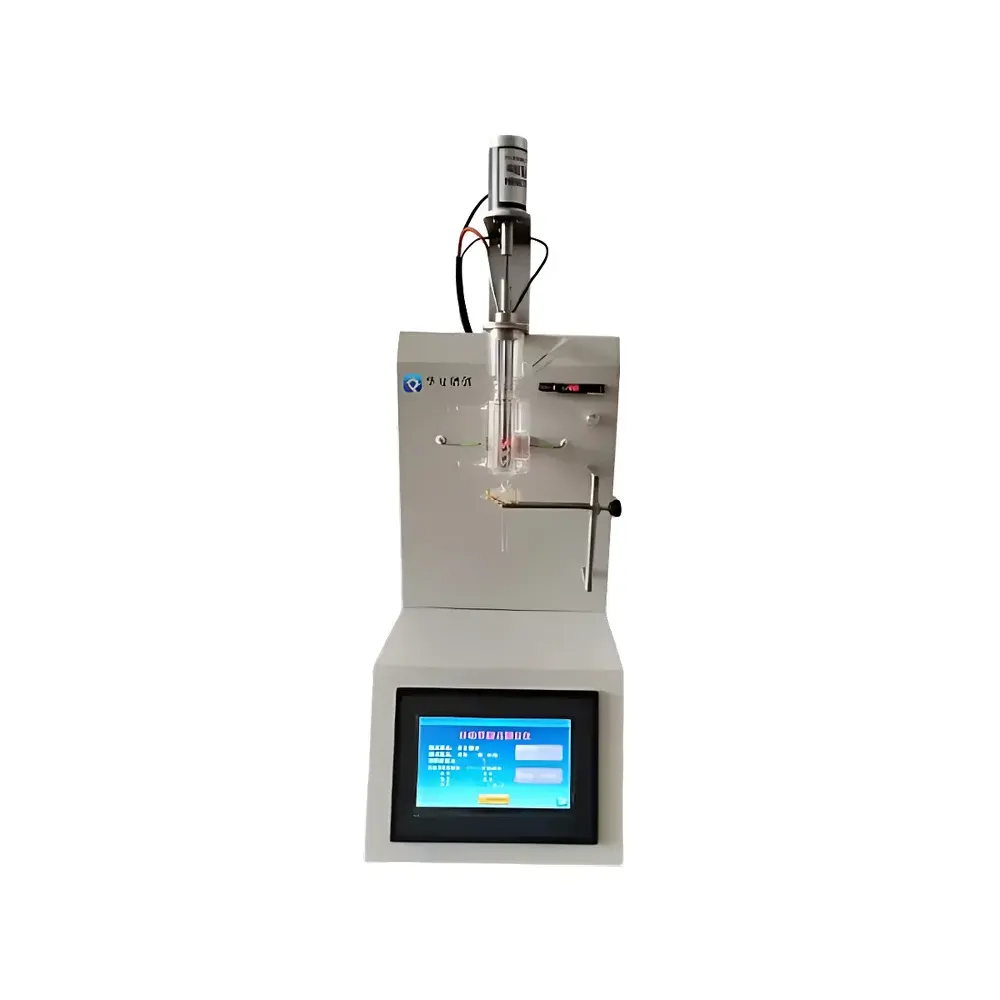
Spectra Invent HX-AP1890A Fully Automated Aniline Point Tester
| Brand | Spectra Invent |
|---|---|
| Origin | Beijing, China |
| Manufacturer Type | Authorized Distributor |
| Country of Origin | China |
| Model | HX-AP1890A |
| Price Range | USD 1,400 – 14,000 |
| Detection Principle | Optical Turbidity Transition Monitoring |
| Temperature Control Range | 20–170 °C ±0.1 °C |
| Temperature Resolution | 0.1 °C |
| Heating Power | 160 W |
| Sample Volume | 20 mL (10 mL oil + 10 mL aniline) |
| Stirring Speed | 0–1000 rpm (adjustable via touchscreen) |
| Detection Sensor | Imported Infrared Photoelectric Sensor with Fiber-Optic Coupling |
| Display | 7-inch Color TFT Touchscreen (Chinese UI) |
| Compliance | GB/T 262, ASTM D611, ISO 6977 |
| Power Supply | AC 220 V ±10%, 50 Hz |
Overview
The Spectra Invent HX-AP1890A Fully Automated Aniline Point Tester is an engineered analytical instrument designed for precise determination of the aniline point—the lowest temperature at which equal volumes of aniline and a petroleum product become completely miscible. This thermodynamic parameter serves as a critical indicator of aromatic content, solvent power, and hydrocarbon composition in crude oils, lubricants, diesel fuels, and related hydrocarbon streams. The HX-AP1890A implements the turbidity-based detection principle defined in GB/T 262 (Method B), where optical transmission through the heated oil-aniline mixture is continuously monitored via an imported infrared photoelectric sensor coupled with fiber-optic detection optics. As temperature increases, the solution transitions from turbid (two-phase) to clear (single-phase); the inflection point of this optical transition is identified algorithmically by the embedded microprocessor as the aniline point. Unlike manual or semi-automated systems, the HX-AP1890A eliminates operator subjectivity, ensures consistent heating profiles, and supports both light and dark-colored samples—including those unsuitable for Method A (visual observation) per GB/T 262.
Key Features
- Fully automated test sequence: Initiate analysis with single-button operation—no manual intervention required during heating, stirring, or endpoint recognition.
- High-stability temperature control system featuring imported PID-controlled heating modules, enabling ramp rates ≤1.0 °C/min and thermal uniformity within ±0.1 °C across the 20–170 °C operating range.
- Real-time optical monitoring using a calibrated infrared photodiode sensor with fiber-optic probe, delivering high signal-to-noise ratio and immunity to ambient light interference.
- Intuitive 7-inch color TFT touchscreen interface with native Chinese language support, offering guided workflow navigation, real-time temperature/stir speed graphs, and on-screen result validation.
- Programmable mechanical stirring subsystem with digitally controlled DC motor (0–1000 rpm, adjustable in 1 rpm increments), ensuring reproducible mixing kinetics across sample matrices.
- Integrated data handling: Results—including measured aniline point, date/time stamp, sample ID, and thermal profile metadata—are automatically stored in non-volatile memory and exportable via USB or printed via built-in thermal printer.
Sample Compatibility & Compliance
The HX-AP1890A accommodates a broad spectrum of petroleum-derived liquids, including naphthas, kerosenes, gas oils, base oils, and residual fuels. Its optical detection architecture enables reliable endpoint identification even in highly colored or opaque samples that preclude visual assessment under GB/T 262 Method A. Instrument performance adheres strictly to the precision requirements outlined in GB/T 262 (repeatability ≤1.0 °C, reproducibility ≤2.0 °C), and has been verified against reference materials traceable to NIM (National Institute of Metrology, China). The system is also validated for conformance with ASTM D611 (Standard Test Method for Aniline Point of Petroleum Products) and ISO 6977 (Petroleum products — Determination of aniline point), supporting international laboratory reporting and cross-laboratory data comparability. While not inherently 21 CFR Part 11 compliant, audit trails, user access logs, and electronic signature readiness can be implemented via optional software upgrades aligned with GLP/GMP documentation frameworks.
Software & Data Management
The onboard firmware supports secure data retention for up to 1,000 test records, each containing full thermographic history (temperature vs. time), optical transmittance curve, and final aniline point calculation. Data export is supported in CSV format via USB mass storage mode, facilitating integration into LIMS environments or statistical process control (SPC) platforms. Optional PC-based companion software provides advanced features including calibration certificate management, multi-instrument fleet monitoring, trend analysis across batches, and customizable report templates compliant with internal QA documentation standards. All stored results include immutable timestamps and operator ID fields (when login authentication is enabled), satisfying basic traceability requirements for ISO/IEC 17025-accredited laboratories.
Applications
- Quality assurance of refinery intermediates and finished fuels, correlating aniline point with aromatic saturation levels and cetane number estimation.
- Formulation development for industrial solvents and cleaning agents, where miscibility behavior informs blending compatibility.
- Crude assay support: Rapid screening of crude fractions to estimate polycyclic aromatic hydrocarbon (PAH) concentration prior to detailed GC×GC analysis.
- Regulatory compliance testing for diesel fuel specifications (e.g., EN 590, ASTM D975), where aniline point is a mandatory parameter for cold flow improver compatibility assessment.
- Research applications in petroleum chemistry, including structure–property relationship studies between hydrocarbon distribution and phase behavior.
FAQ
What standards does the HX-AP1890A fully support?
The instrument is designed and verified for GB/T 262 (Methods A and B), ASTM D611, and ISO 6977. It meets repeatability and reproducibility criteria specified in these methods.
Can it analyze highly viscous or asphaltene-rich samples?
Yes—provided the sample is pre-heated to ensure homogeneity before loading, and the 20 mL total volume (10 mL oil + 10 mL aniline) remains within the defined geometry of the reaction cell. Viscosity itself does not impede optical detection.
Is external calibration required?
The unit includes factory calibration using NIST-traceable reference oils. Users may perform periodic verification using certified aniline point standards; no routine recalibration is necessary under normal operating conditions.
Does the system support multi-language interfaces beyond Chinese?
The standard configuration features Chinese-only UI. English-language firmware and documentation are available upon request for export markets, subject to regional regulatory validation.
What maintenance is recommended for long-term reliability?
Routine cleaning of the optical path window and reaction cell after each batch, annual verification of temperature sensor drift, and biannual inspection of stir shaft seal integrity constitute the core preventive maintenance protocol.






