
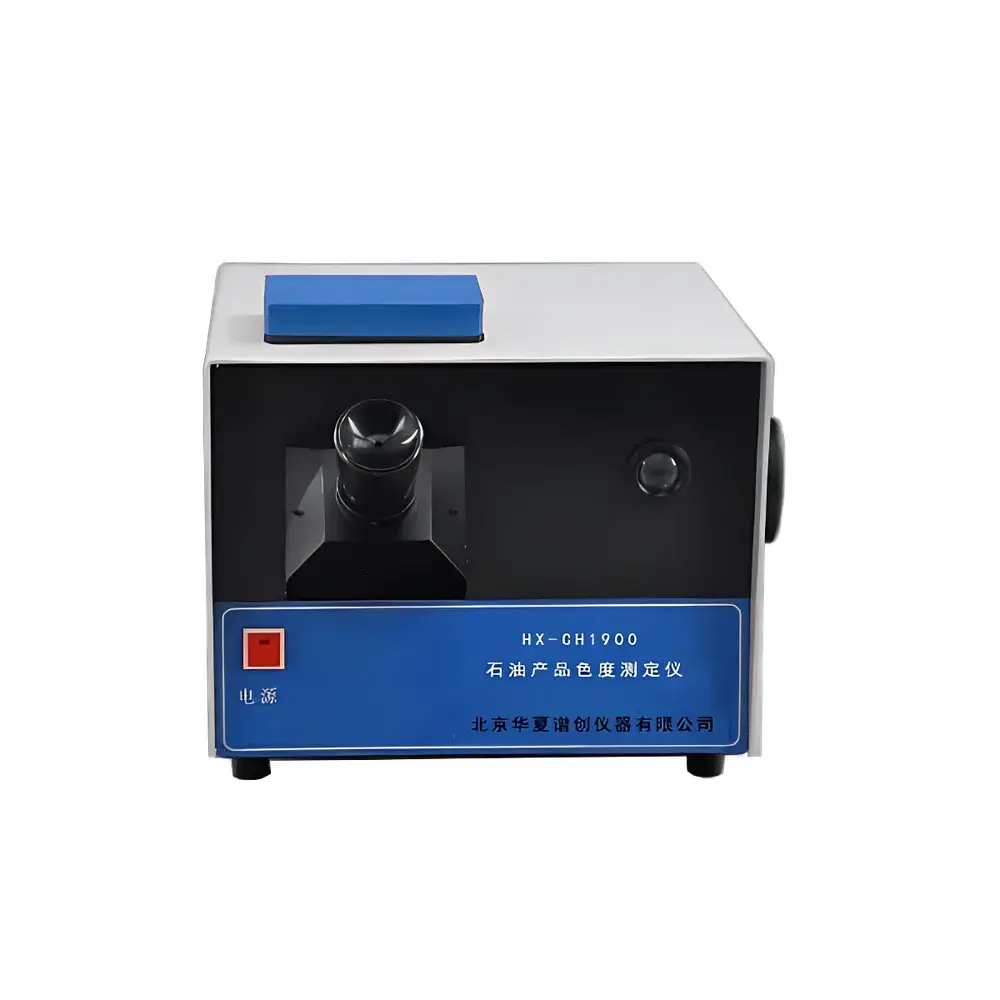
Spectra Invent HX-CH1900 Petroleum Product Colorimeter
| Brand | Spectra Invent |
|---|---|
| Origin | Beijing, China |
| Manufacturer Type | Authorized Distributor |
| Country of Manufacture | China |
| Model | HX-CH1900 |
| Price Range | USD 150–15,000 |
| Light Source | Frosted Opal Incandescent Lamp (220 V ±10%, 50 Hz ±10%) |
| Color Scale | ASTM D1500 (0.5–8.0), GB/T 6540 (1–17), DL/T 429.2 |
| Sample Volume | 20 mL |
| Cell Diameter | Φ32 mm |
| Cell Height | 120–130 mm |
| Viewing Aperture | 17 × Φ14 mm holes with calibrated glass color standards |
| Operating Temperature | 5–45 °C |
| Relative Humidity | ≤85% RH |
| Power Consumption | <500 W |
| Dimensions (W×D×H) | 400 × 320 × 295 mm |
| Weight | 4 kg |
Overview
The Spectra Invent HX-CH1900 Petroleum Product Colorimeter is a visual comparison instrument engineered for standardized color assessment of transparent to slightly hazy petroleum-based liquids—including lubricating oils, base stocks, distillates, and refined hydrocarbon fractions. It operates on the principle of matched-field visual color grading, where the sample—contained in a standardized cylindrical cell—is simultaneously viewed alongside a rotating disc of certified glass color standards under controlled, spectrally stabilized illumination. This method conforms to the fundamental photometric geometry defined in ASTM D1500, GB/T 6540, and DL/T 429.2, ensuring traceable, operator-independent evaluation of yellowness or brownish tint intensity across industrial and regulatory workflows. Unlike instrumental colorimeters based on spectrophotometry or tristimulus analysis, the HX-CH1900 delivers direct, human-vision-aligned results without algorithmic interpolation—making it suitable for routine QC laboratories where method equivalence to legacy reference procedures is required.
Key Features
- Optically balanced dual-path viewing system: Illumination is evenly split between the sample cell and the 17-position standard color wheel, minimizing parallax and glare-induced perceptual bias.
- Frosted opal incandescent lamp (220 V ±10%, 50 Hz ±10%) provides stable CIE Standard Illuminant A–like spectral output—critical for consistent interpretation across ASTM D1500 and GB/T 6540 scales.
- Adjustable optical eyepiece with independent focus and brightness control enables precise alignment for operators with varying visual acuity, supporting ISO 8554-compliant observer calibration protocols.
- Standardized sample cell (Φ32 mm × 125 mm nominal height) ensures repeatable pathlength and meniscus geometry; 20 mL fill volume aligns with ASTM D1500 procedural requirements.
- Robust aluminum alloy chassis and precision-machined color wheel housing provide mechanical stability during repeated rotation and long-term thermal drift resistance within 5–45 °C ambient range.
Sample Compatibility & Compliance
The HX-CH1900 accepts clear to mildly turbid liquid hydrocarbons with kinematic viscosity below 100 cSt at 40 °C—covering turbine oils, hydraulic fluids, diesel fuel fractions, naphthas, and white mineral oils. Samples must be free of suspended particulates and water droplets prior to testing; filtration through 0.8 µm membrane filters and dehydration via molecular sieves are recommended per ASTM D4176 practice. The instrument satisfies essential metrological criteria outlined in ISO/IEC 17025:2017 Clause 6.4.3 for visual comparator devices used in accredited testing laboratories. Its conformance to ASTM D1500 and GB/T 6540 supports data acceptance in API RP 1529, ISO 8573-1 (for compressor oil verification), and refinery internal specifications aligned with IP 127 and EN ISO 2049.
Software & Data Management
As a manual visual comparator, the HX-CH1900 does not incorporate embedded firmware or digital data output. However, it is fully compatible with LIMS-integrated documentation workflows when paired with validated electronic lab notebooks (ELNs) that support ASTM E2500-17 Annex A3 structured observation templates. Operators may record results—including observed color number, observer ID, date/time stamp, sample identification, and environmental conditions (temperature/humidity)—in accordance with GLP principles. For audit readiness, laboratories deploying this instrument should maintain calibration logs for the color wheel (traceable to NIM or NIST-traceable reference sets), lamp replacement history, and annual verification reports per ISO/IEC 17025 Clause 7.7. No FDA 21 CFR Part 11 compliance is applicable, as no electronic records are generated by the device itself.
Applications
- Routine quality control of finished lubricants against ASTM D1500 specification limits prior to shipment.
- Monitoring oxidation stability in transformer oils via periodic color shift tracking (DL/T 429.2).
- Batch release testing of jet fuel fractions in accordance with DEF STAN 91-91 Annex G.
- Raw material screening of solvent-refined base oils entering hydrotreating units.
- Teaching and method validation in university analytical chemistry labs focusing on classical petroleum test methods.
FAQ
Does the HX-CH1900 require annual recalibration?
Yes—while the glass color standards are inherently stable, the instrument’s optical alignment, lamp spectral output, and wheel indexing accuracy must be verified annually using a certified reference set traceable to national metrology institutes.
Can it measure non-petroleum samples such as edible oils or pharmaceutical solvents?
It may be used for preliminary assessment, but results are not valid under official ASTM or pharmacopoeial methods unless method equivalence is formally demonstrated and documented per ICH Q2(R2).
Is the color wheel interchangeable with other ASTM D1500 comparators?
No—the HX-CH1900 uses a proprietary 17-position wheel calibrated specifically to its optical geometry; substitution with third-party wheels invalidates conformance to cited standards.
What maintenance is required beyond lamp replacement?
Quarterly cleaning of optical surfaces with lens-grade isopropanol, biannual inspection of wheel bearing play, and verification of cell dimension tolerances per ASTM D1500 Annex A1.
Does the instrument meet explosion-proof requirements for refinery field use?
No—it is designed for laboratory environments only and lacks Class I Division 1 certification; portable battery-operated alternatives are recommended for zone-hazardous locations.






