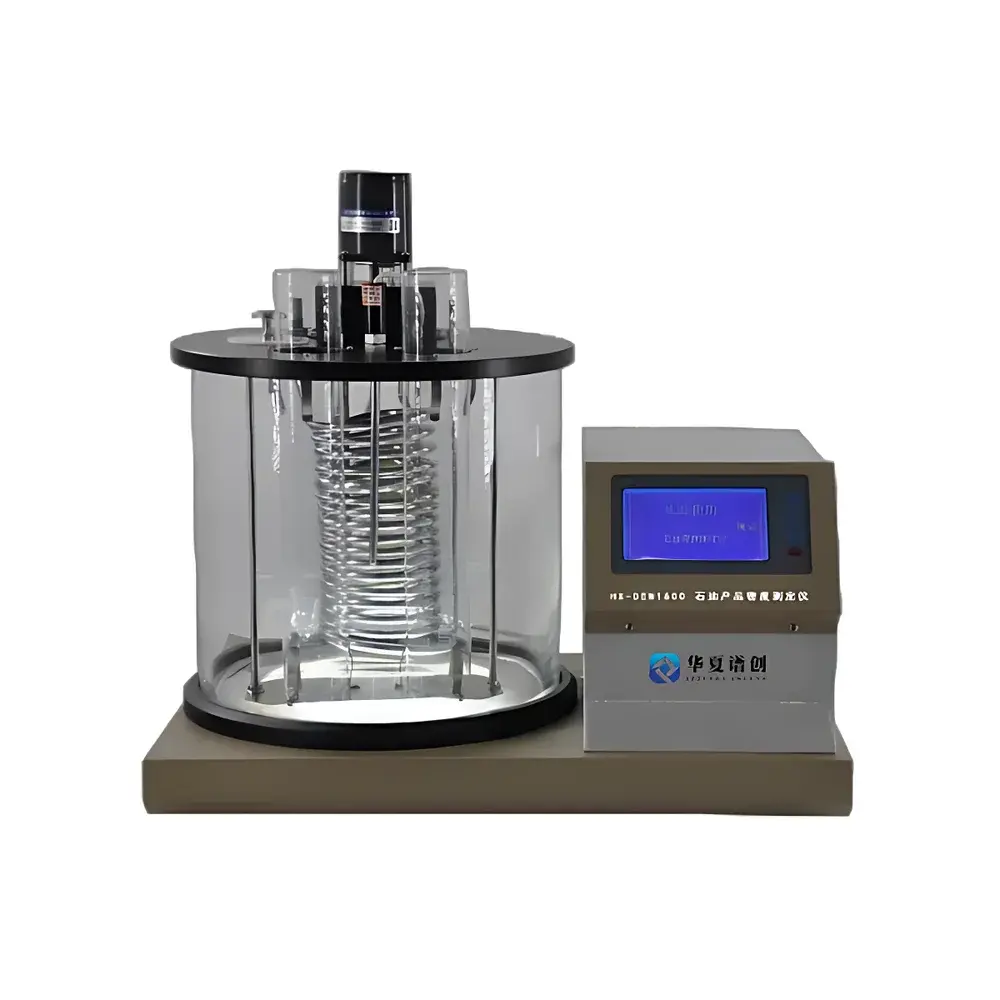
Spectra Invent HX-DEN1600 Petroleum Products Density Analyzer
| Brand | Spectra Invent |
|---|---|
| Origin | Beijing, China |
| Manufacturer Type | Authorized Distributor |
| Country of Manufacture | China |
| Model | HX-DEN1600 |
| Power Consumption | <1500 W |
| Temperature Control Range | 15–100 °C (down to 20 °C with optional chiller) |
| Temperature Stability | ±0.1 °C |
| Sample Capacity | 500 mL per station |
| Dual-Sample Stations | 2 |
| Display | 320×240 pixel LCD with capacitive touch interface |
| Dimensions (Analyzer) | 545 × 370 × 500 mm |
| Weight (Analyzer) | 18.4 kg |
| Operating Ambient | 5–45 °C, ≤85% RH |
| Compliance | GB/T 1884, GB/T 1885 |
Overview
The Spectra Invent HX-DEN1600 Petroleum Products Density Analyzer is a precision laboratory instrument engineered for the accurate determination of density in petroleum-based liquids—spanning transparent, low-viscosity fluids (e.g., gasoline, naphtha, kerosene) to moderately viscous materials (e.g., diesel, lubricating oils, residual fuels). It operates on the principle of hydrostatic weighing (also known as the pycnometer method), fully compliant with ASTM D1298 and ISO 3675, and aligned with national standards GB/T 1884 (Standard Test Method for Density of Crude Oil and Liquid Petroleum Products by Hydrometer) and GB/T 1885 (Petroleum Measurement Tables). Density measurement at controlled temperatures is critical for volumetric correction, custody transfer calculations, compositional inference, and quality assurance in refining and distribution workflows. The HX-DEN1600 delivers traceable, repeatable results by integrating high-stability temperature regulation, gravimetric sample handling, and microprocessor-driven data acquisition—ensuring metrological integrity across routine QC and regulatory reporting environments.
Key Features
- Microprocessor-controlled dual-station design enables parallel analysis of two independent samples, improving throughput without compromising thermal equilibrium or measurement repeatability.
- PID auto-tuning temperature regulation maintains setpoint stability within ±0.1 °C across the full operational range (15–100 °C); optional integrated chiller extends low-temperature capability to 20 °C for cold-density applications such as winter-grade fuel testing.
- Capacitive-touch 320×240 LCD interface provides intuitive navigation, real-time temperature feedback, and direct access to calibration history, user-defined test protocols, and result logging.
- Robust mechanical architecture supports standard ASTM/GB-compliant glass pycnometers (typically 25 mL or 50 mL) and accommodates up to 500 mL total sample volume per run—ideal for heterogeneous or sediment-prone feedstocks requiring representative sampling.
- Comprehensive electrical safety and thermal isolation meet IEC 61010-1 requirements; power input is rated AC 220 V ±10%, 50 Hz, with peak draw <1500 W under full thermal load.
Sample Compatibility & Compliance
The HX-DEN1600 is validated for use with refined petroleum fractions, crude blends, biofuels (e.g., FAME, hydrotreated esters), and select non-aqueous industrial solvents. It excludes highly volatile, corrosive, or reactive substances (e.g., liquid chlorine, anhydrous HF, concentrated oxidizers) due to material compatibility constraints of its stainless-steel bath and borosilicate glass interface components. All density determinations adhere strictly to GB/T 1884–2000 and GB/T 1885–1998 methodologies—including mandatory temperature equilibration time, meniscus reading protocol, and air buoyancy correction. Instrument validation documentation supports GLP-compliant laboratories; audit trails (via optional USB export) are structured to align with FDA 21 CFR Part 11 data integrity expectations when paired with Spectra Invent’s certified software module.
Software & Data Management
The embedded firmware supports local storage of ≥1000 test records, each timestamped and tagged with operator ID, ambient conditions, calibration date, and thermal stabilization duration. Raw mass and temperature readings are retained at 0.1 mg and 0.01 °C resolution respectively. Optional SpectraLink™ Desktop Suite (v3.2+) enables CSV/Excel export, statistical trend analysis (mean, SD, RSD, control charting), and automated report generation conforming to ISO/IEC 17025 documentation requirements. Data encryption, user role permissions (admin/operator/auditor), and electronic signature capture are available for regulated environments. No cloud dependency—data remains on-device or exported via encrypted USB drive.
Applications
- Routine density verification in refinery QC labs for gasoline, jet fuel (Jet A-1), and distillate diesel per IP 160/ASTM D4052.
- Custody transfer reconciliation at terminals and marine loading facilities, where API gravity and base density serve as contractual parameters.
- Research applications correlating density with aromaticity index, sulfur content, or simulated distillation profiles (e.g., using GC×GC or NMR-derived compositional models).
- Regulatory compliance testing for EN 590 (automotive diesel), ASTM D975 (diesel fuel oils), and USP (pharmaceutical-grade hydrocarbons used in excipient manufacturing).
- Environmental screening of contaminated soils or water emulsions via solvent-extracted hydrocarbon density profiling.
FAQ
Does the HX-DEN1600 support automatic pycnometer filling or vacuum degassing?
No—it requires manual sample introduction and degassing per GB/T 1884 Section 7.3. Automated fluid handling is not integrated; this preserves method fidelity and avoids entrained air artifacts common in pump-based systems.
Can the instrument be calibrated with NIST-traceable standards?
Yes. Certified reference materials (e.g., NIST SRM 2771, 2772, or equivalent national metrology institute standards) are supported for both temperature sensor and balance subsystem verification.
Is firmware upgrade capability available remotely?
Firmware updates require local USB installation using Spectra Invent’s signed update package; no internet-connected remote update functionality is implemented for cybersecurity compliance.
What maintenance intervals are recommended for long-term accuracy?
Annual verification of temperature sensor drift and balance linearity is advised. Bath fluid (silicone oil) replacement is required every 24 months under continuous operation; cleaning of pycnometer wells and touchscreen surface is recommended after each shift.