
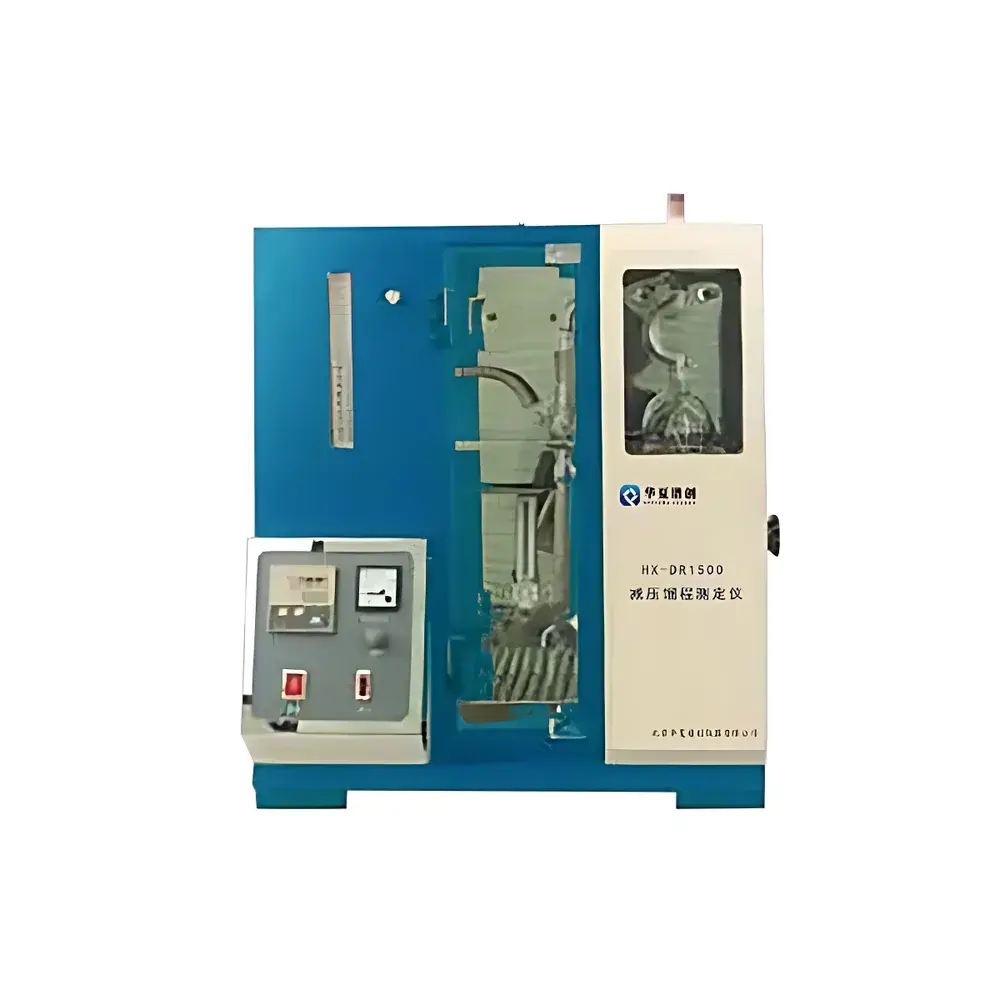
SPECTRA INVENT HX-DR1500 Vacuum Distillation Apparatus
| Brand | SPECTRA INVENT |
|---|---|
| Origin | Beijing, China |
| Manufacturer Type | Authorized Distributor |
| Country of Manufacture | China |
| Model | HX-DR1500 |
| Price Range | USD 1,400–14,000 (FOB) |
| Temperature Range | Ambient to 360 °C |
| Temperature Accuracy | ±1 °C |
Overview
The SPECTRA INVENT HX-DR1500 Vacuum Distillation Apparatus is a dedicated analytical instrument engineered for precise determination of vacuum distillation curves of heavy petroleum fractions—including vacuum gas oils (VGO), residua, and bitumen feedstocks—according to standardized test methods such as ASTM D1160, ASTM D2892, and IP 123. Operating under controlled reduced-pressure conditions (typically 1–10 mmHg absolute), the system enables accurate separation and boiling point distribution analysis of high-boiling components that would decompose or oxidize under atmospheric distillation. The apparatus integrates a calibrated vacuum control manifold, programmable heating mantle with dual-zone thermal regulation, and a precision condensation system featuring chilled glycol circulation. Its design complies with fundamental requirements for reproducible vacuum distillation in refinery QC laboratories, R&D centers, and third-party testing facilities performing hydrocarbon fractionation characterization.
Key Features
- Programmable vacuum control system with digital pressure transducer (range: 0.1–100 mmHg, resolution: 0.1 mmHg) and automatic feedback regulation to maintain setpoint stability within ±0.3 mmHg over extended runs
- Dual-zone heating mantle with independent PID controllers: lower zone for flask heating (ambient–360 °C), upper zone for column preheating (ambient–200 °C) to minimize thermal gradients and prevent vapor condensation in the neck
- High-precision temperature measurement using calibrated Pt100 RTD sensors at critical locations—boiling flask, side-arm, and condenser inlet—with real-time compensation for ambient drift
- Automated distillate collection via motorized fraction receiver carousel (10-position, 10–100 mL capacity per vial), synchronized with volume or time-based triggering
- Integrated safety interlocks including overtemperature cutoff (370 °C hard limit), vacuum loss alarm, and cooling water flow monitoring to ensure operational integrity during prolonged distillations
- Robust stainless-steel and borosilicate glass construction compliant with API RP 2510 and ISO 8502-2 material compatibility guidelines for hydrocarbon service
Sample Compatibility & Compliance
The HX-DR1500 accommodates standard ASTM D1160/D2892 sample volumes (100 mL for D1160; 150 mL for D2892) and accepts feedstocks with initial boiling points above 250 °C and final boiling points up to 565 °C (equivalent to 360 °C at 1 mmHg). It supports samples with viscosity up to 1000 cSt at 100 °C and total sulfur content ≤ 5 wt%. The system meets mechanical and procedural prerequisites for GLP-compliant data generation when operated with documented SOPs and calibration records. While not certified to UL/CE for full CE marking, its electrical architecture conforms to IEC 61010-1:2010 safety standards for laboratory equipment. Traceability of temperature and pressure calibrations follows ISO/IEC 17025 principles when performed using NIST-traceable reference instruments.
Software & Data Management
The HX-DR1500 operates with embedded firmware supporting manual and semi-automated distillation protocols. Optional PC-based SPECTRA DISTIL v3.2 software provides full method programming, real-time parameter logging (temperature, pressure, collected volume, time), and ASTM-compliant curve generation (TBP—True Boiling Point). Data export is available in CSV, PDF, and XML formats compatible with LIMS integration. Audit trail functionality records operator ID, method version, calibration timestamps, and any parameter override—meeting foundational requirements for FDA 21 CFR Part 11 compliance when deployed with network authentication and electronic signature modules. All raw data files are timestamped and checksum-verified to prevent unauthorized modification.
Applications
- Refinery process optimization: Characterization of vacuum tower feed and bottoms to model fractionator performance and adjust draw-off temperatures
- Fuel blending assessment: Quantification of heavy-end cut points in marine fuel (IFO 380, IFO 180) and bunker fuel specifications per ISO 8217
- Catalyst evaluation: Monitoring boiling range shifts in hydroprocessed VGO to assess saturation and cracking severity
- Crude assay support: Generating vacuum distillation cuts for detailed hydrocarbon analysis (DHA) and simulated distillation (SimDis) correlation
- Regulatory reporting: Fulfilling ASTM D2892 requirements for crude oil assay submissions to regulatory agencies and pipeline operators
- R&D of alternative feedstocks: Distillation profiling of pyrolysis oils, bio-residues, and plastic-derived hydrocarbons under controlled vacuum conditions
FAQ
What vacuum levels can the HX-DR1500 achieve and maintain during distillation?
The system achieves and stabilizes pressures from 0.5 mmHg to 100 mmHg absolute, with typical operating range of 1–5 mmHg for ASTM D1160 and 5–40 mmHg for ASTM D2892.
Is the instrument compatible with ASTM D5236 for high-vacuum molecular distillation?
No—the HX-DR1500 is designed for conventional vacuum fractional distillation per D1160/D2892, not high-vacuum (<0.1 mmHg) molecular distillation applications covered by D5236.
Does the system include factory calibration certificates for temperature and pressure sensors?
Yes—each unit ships with individual calibration reports traceable to national metrology institutes (NIM, China), valid for 12 months from date of shipment.
Can the HX-DR1500 be integrated into an existing LIMS environment?
Yes—via TCP/IP or RS-232 interface using ASTM WK55612-compliant data schema; SPECTRA DISTIL v3.2 supports direct LIMS push with configurable field mapping.
What maintenance intervals are recommended for the vacuum pump and condenser system?
Oil-sealed rotary vane pump oil should be changed every 500 operating hours; glycol chiller fluid requires replacement annually or per manufacturer’s specification—both supported by scheduled maintenance logs in the software.





