
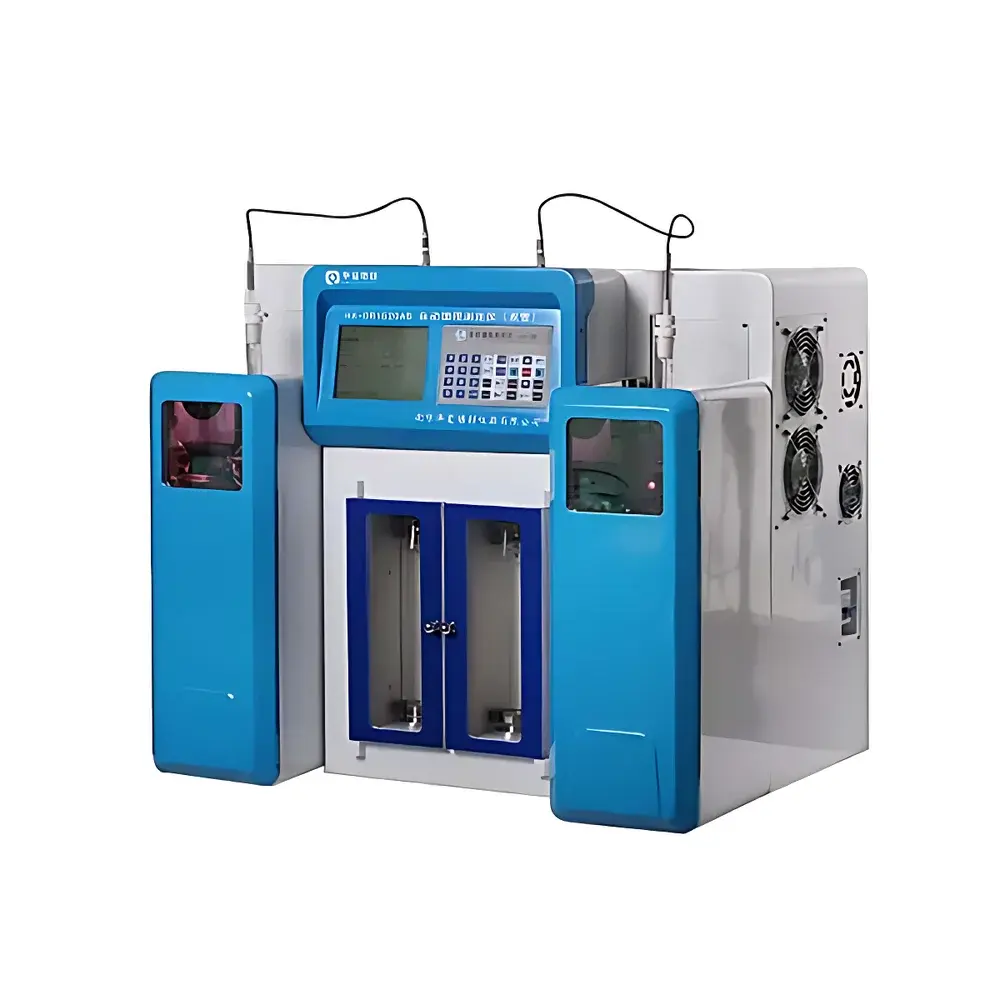
Spectra Invent HX-DR1520AS Dual-Tube Automatic Distillation Apparatus
| Brand | Spectra Invent |
|---|---|
| Origin | Beijing, China |
| Manufacturer Type | Authorized Distributor |
| Country of Manufacture | China |
| Model | HX-DR1520AS |
| Test Pressure | Atmospheric (101.3 kPa) |
| Temperature Range | 0–400 °C |
| Temperature Accuracy | ±0.1 °C |
| Cold Bath Range | 0–60 °C |
| Distillation Rate | 2–5 mL/min |
| Volume Measurement Range | 0–100 mL |
| Volume Resolution | 0.1 mL |
Overview
The Spectra Invent HX-DR1520AS Dual-Tube Automatic Distillation Apparatus is an engineered solution for standardized atmospheric distillation analysis of petroleum fractions and volatile organic liquids. Designed in strict conformance with ASTM D86, GB/T 6536, and GB/T 7534, the instrument implements a fully automated, dual-channel distillation protocol based on classical batch distillation principles under ambient pressure. It measures the relationship between recovered volume and vapor temperature during controlled heating, delivering reproducible boiling point distribution profiles essential for refinery process control, fuel specification compliance, and quality assurance in hydrocarbon production. The system integrates precision PT100 temperature sensing, optical meniscus detection, and programmable infrared heating to ensure thermal uniformity and minimize superheat artifacts—critical for accurate initial boiling point (IBP), final boiling point (FBP), and intermediate recovery point determination.
Key Features
- Dual independent distillation channels enable parallel testing of two samples or method validation runs, improving laboratory throughput without compromising inter-channel thermal isolation.
- Optical meniscus tracking system uses high-resolution digital imaging and real-time edge-detection algorithms to identify the liquid meniscus position in the graduated cylinder—mimicking human visual judgment per ASTM D86 Annex A1, eliminating operator subjectivity and enhancing repeatability.
- Automated zero-point calibration initiates at the start of each run, dynamically aligning the optical baseline to the cylinder’s reference mark to compensate for mechanical drift or minor cylinder placement variance.
- Integrated nitrogen purge and auto-extinguish function activates upon detection of excessive vapor accumulation or abnormal flame propagation risk, supporting safe operation during high-volatility sample analysis in accordance with OSHA 1910.106 and NFPA 30 guidelines.
- Intelligent dry point recognition algorithm analyzes both temperature slope inflection and rate-of-volume-change cessation to determine FBP objectively—reducing reliance on manual endpoint interpretation.
- 10.1-inch true-color resistive touchscreen interface (800 × 600) provides intuitive navigation, real-time curve visualization, and on-device method storage compliant with GLP audit requirements.
Sample Compatibility & Compliance
The HX-DR1520AS is validated for use with naphtha, gasoline, jet fuel (Jet A-1, JP-8), diesel fuels (EN 590, ASTM D975), heating oils, kerosene, and other mineral-based hydrocarbon mixtures. It also supports non-petroleum volatile organics including alcohols, ketones, and esters—provided samples exhibit no thermal decomposition below 400 °C. All operational parameters—including heating rate ramp profiles, condensate collection timing, and cold bath temperature setpoints—are programmable to satisfy variant requirements across ASTM D86 (Method 0, 1, 2, 3, 4), ISO 3405, and GB/T 6536 Class 0–4. Instrument firmware includes built-in compliance checks for temperature sensor calibration traceability (NIST-traceable PT100), volume measurement linearity verification, and thermal gradient validation reports.
Software & Data Management
The embedded control software supports full data capture at 0.5-second intervals for both temperature and recovered volume, generating ASTM-compliant distillation curves (T vs. % recovered) with automatic annotation of IBP, 10%, 50%, 90%, and FBP points. Export formats include CSV, PDF, and XML (ASTM E1382-compliant). Audit trail functionality logs all user actions, parameter modifications, and calibration events with timestamps and operator ID—meeting FDA 21 CFR Part 11 requirements when deployed with networked authentication and electronic signature modules. Optional LIMS integration via TCP/IP or RS-232 enables centralized data archiving and cross-instrument trending.
Applications
- Refinery QC/QA: Real-time monitoring of crude cut points and fractionator performance.
- Fuel certification: Verification of volatility specifications for gasoline (RVP, T50, T90), aviation turbine fuel (distillation band limits), and marine distillate fuels.
- Research & development: Boiling point distribution modeling for alternative fuel blends (e.g., bioethanol-gasoline, FAME-diesel).
- Contract laboratories: Accredited testing per ISO/IEC 17025 for third-party distillation reporting.
- Academic instruction: Teaching classical distillation thermodynamics and standard test methodology in chemical engineering labs.
FAQ
Does the HX-DR1520AS support vacuum distillation?
No. This model operates exclusively at atmospheric pressure (101.3 kPa) and is not equipped with vacuum regulation or pressure compensation features.
Can the instrument be calibrated using certified reference standards?
Yes. Calibration procedures follow ASTM D86 Annex B and include traceable mercury-in-glass thermometer verification, volumetric cylinder certification (ISO 4787), and PT100 resistance calibration against NIST SRM 1720E.
Is remote operation or network connectivity available?
Standard configuration includes RS-232 and Ethernet ports; optional OPC UA or Modbus TCP firmware enables SCADA integration and remote monitoring via secure LAN/WAN environments.
What maintenance intervals are recommended for long-term accuracy?
Optical lens cleaning every 50 runs; cold bath refrigerant service every 18 months; annual full system verification including heater response time, temperature uniformity mapping, and meniscus detection repeatability assessment.
How does the system handle samples with high wax or asphaltene content?
Samples must be pre-filtered and free of suspended solids. For waxy feeds, users should preheat the sample container to ≥45 °C prior to loading to prevent nozzle clogging—consistent with ASTM D86 Section 7.3.





