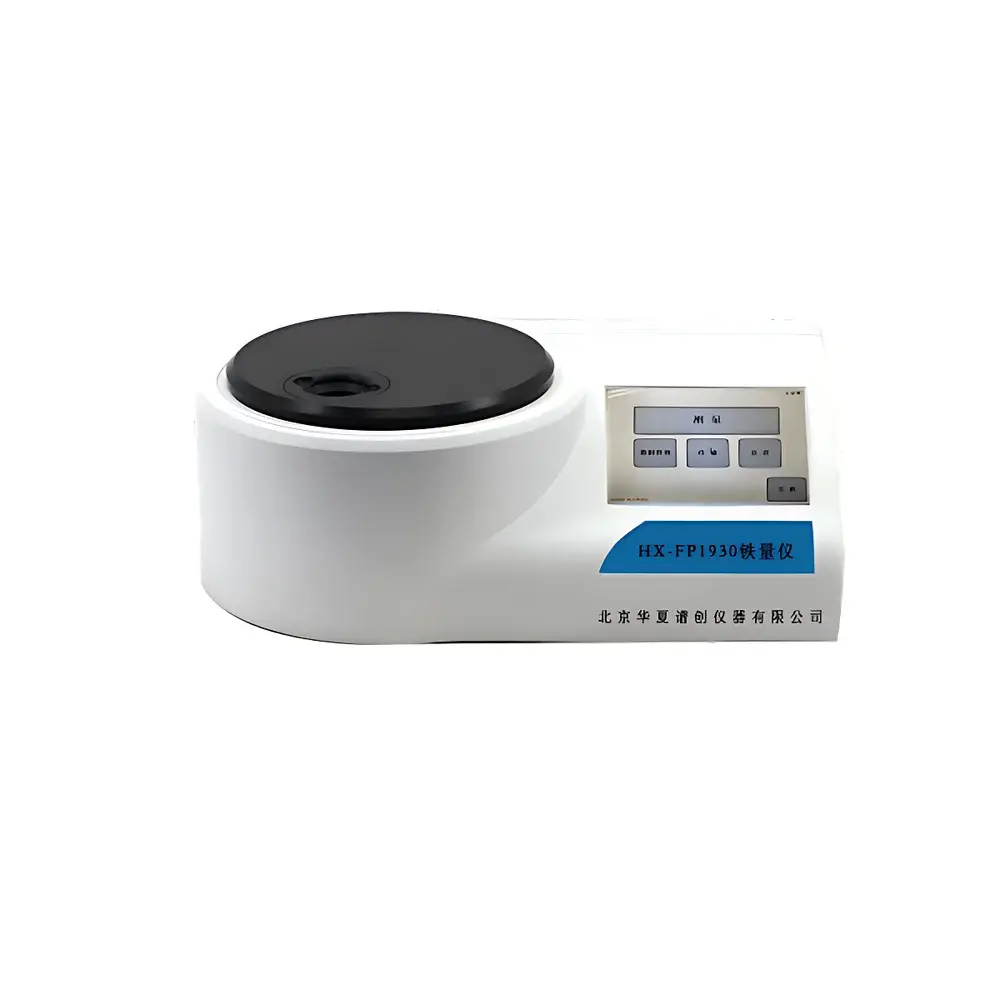
Spectra Invent HX-FP1930 Ferrography Analyzer
| Brand | Spectra Invent (Chinainvent) |
|---|---|
| Origin | Beijing, China |
| Manufacturer Type | Authorized Distributor |
| Country of Manufacture | China |
| Model | HX-FP1930 |
| Price Range | USD 140 – 14,000 |
| Power Supply | AC 220 V ±10%, 50–60 Hz |
| Operating Temperature | 10–30 °C |
| Display | 120×90 LCD |
| Repeatability | ±4 PQ or ±1% (whichever is greater) |
| Resolution | 1 PQ |
| Measurement Time | 7 s per sample |
| Minimum Detectable Level | 5 PQ |
| Ferromagnetic Particle Detection Threshold | >1 µm |
| Interface | USB Type-B (female) |
| Measurement Range | 0–15,000 PQ |
| Dimensions | 371 × 226 × 138 mm |
| Weight | 3.8 kg |
Overview
The Spectra Invent HX-FP1930 Ferrography Analyzer is a dedicated ferromagnetic particle quantification instrument engineered for condition-based maintenance in industrial and aerospace lubrication systems. It operates on the principle of electromagnetic induction: a precisely calibrated excitation coil generates a stable magnetic field; when a lubricant sample—containing ferromagnetic wear debris such as iron, nickel, or cobalt—is introduced into the sensing zone, the localized distortion of the magnetic flux induces a measurable voltage change in a secondary detection coil. This induced signal is linearly proportional to the total ferromagnetic mass concentration in the sample, expressed in Particle Quantifier (PQ) units—a dimensionless, instrument-specific metric widely adopted in oil analysis laboratories for rapid, non-destructive wear severity assessment.
Key Features
- Patented high-stability sensor architecture with low-noise analog signal conditioning circuitry, ensuring consistent baseline drift <0.5% over 8-hour continuous operation.
- Automated sample handling sequence: oil injection, magnetic field activation, signal acquisition, and result display—all completed within 7 seconds per measurement.
- Zero-sample-prep workflow: undiluted used oils (mineral, synthetic, or semi-synthetic), hydraulic fluids (ISO VG 32–68), and greases (after light homogenization) can be measured directly in standard 15-mL glass vials.
- Integrated 120×90-pixel monochrome LCD with graphical user interface supporting dual-language navigation (English/Chinese) and real-time trend plotting.
- Full alphanumeric keyboard input for customizable file naming, batch ID entry, and operator annotation—critical for traceability in ISO/IEC 17025-accredited labs.
- Rugged benchtop design (3.8 kg, IP20-rated enclosure) optimized for QC environments where vibration isolation and EMI immunity are essential.
Sample Compatibility & Compliance
The HX-FP1930 is validated for use with mineral-based, PAO, and ester-based lubricants meeting ASTM D4378, D6595, and ISO 4406 standards. It detects ferromagnetic particles ≥1 µm in equivalent spherical diameter, including both free particles and agglomerates—making it suitable for early-stage wear detection in gearboxes, turbines, hydraulic pumps, and diesel engine crankcase oils. While not a replacement for analytical ferrography (ASTM D5183), it serves as a primary screening tool aligned with SAE ARP5563 and MIL-STD-2104D maintenance protocols. The instrument complies with IEC 61000-4-2 (ESD immunity) and meets CE marking requirements for electromagnetic compatibility (2014/30/EU).
Software & Data Management
Bundled PC software (Windows 10/11 compatible) provides secure, audit-ready data management. Each measurement record includes timestamp, operator ID, sample ID, PQ value, and environmental metadata (ambient temperature, instrument serial number). Software supports configurable pass/fail thresholds, statistical process control (SPC) charts (X-bar/R), and automated PDF report generation compliant with GLP and FDA 21 CFR Part 11 requirements—including electronic signatures, audit trails, and role-based access control. Export formats include CSV (for LIMS integration), XML (for enterprise MES systems), and native .spq binary archives with embedded calibration checksums.
Applications
- Routine monitoring of turbine and compressor lubricants in power generation facilities.
- Preventive maintenance of wind turbine gearboxes under ISO 23755-1 guidelines.
- Wear trend analysis for marine diesel engines operating under ISO 8528-10 service conditions.
- Field-deployable diagnostics for mining and construction equipment fleets using SAE J1832 lubricant specifications.
- Quality assurance of new lubricants during OEM qualification testing (e.g., API SP, ACEA C6).
FAQ
What does “PQ” stand for, and how is it calibrated?
PQ stands for Particle Quantifier—a unit defined by the instrument’s magnetic sensitivity and reference calibration using NIST-traceable iron oxide suspensions. Calibration is performed annually using certified PQ reference standards (SRM 2877 series) and documented per ISO/IEC 17025 Clause 6.6.
Can the HX-FP1930 distinguish between different types of ferromagnetic metals?
No. It measures total ferromagnetic mass response without elemental discrimination. For compositional analysis, complementary techniques such as SEM-EDS or ICP-OES are required.
Is the instrument suitable for field use in mobile maintenance units?
Yes—its compact footprint, USB-powered data transfer, and 7-second cycle time support deployment in truck-mounted labs. Battery operation requires an external 220 V AC inverter (not included).
Does the software support multi-user environments with permission levels?
Yes. Administrator, analyst, and reviewer roles are enforced with password protection and session logging, satisfying GMP Annex 11 and ISO 13485 documentation requirements.
How often does the sensor require recalibration?
Factory recalibration is recommended every 12 months or after 5,000 measurements, whichever occurs first. Daily verification using blank oil and PQ 100 reference standard is advised per ASTM D6595 Section 8.3.
Related Products