
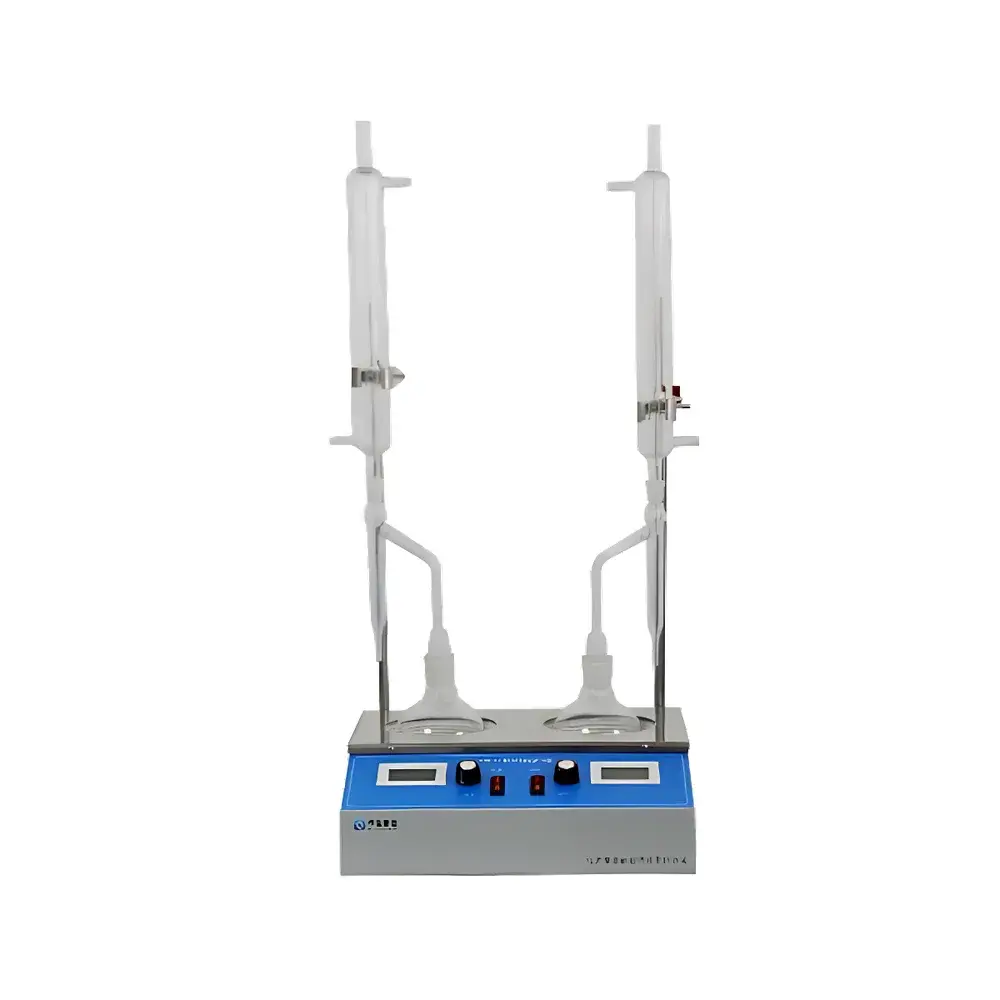
Spectra Invent HX-TM1750S Dual-Station Petroleum Water Content Analyzer (Distillation Method)
| Brand | Spectra Invent |
|---|---|
| Origin | Beijing, China |
| Manufacturer Type | Authorized Distributor |
| Country of Origin | China |
| Model | HX-TM1750S |
| Price Range | USD 140 – 14,000 |
Overview
The Spectra Invent HX-TM1750S Dual-Station Petroleum Water Content Analyzer is a precision laboratory instrument engineered for quantitative determination of water content in crude oil and related petroleum products via standardized distillation methodology. It operates in strict accordance with GB/T 8929—2006, the People’s Republic of China National Standard titled “Determination of Water Content in Crude Oil—Distillation Method”, which aligns closely with internationally recognized principles found in ASTM D95 and ISO 9029. The system employs a controlled thermal separation process: sample and solvent (typically xylene or toluene) are co-distilled in a reflux assembly; liberated water vapor condenses and separates in a calibrated receiver due to immiscibility and density differential. This gravimetrically traceable, solvent-based distillation technique remains a primary reference method for custody transfer, refinery feedstock qualification, and regulatory compliance testing where high reproducibility and method transparency are required.
Key Features
- Dual-station independent configuration enables simultaneous analysis of two samples under identical environmental conditions—reducing inter-assay variability and increasing laboratory throughput without cross-contamination risk.
- Individual analog voltage regulators and digital voltage indicators per channel allow precise, real-time control of heating power to each distillation bath—critical for maintaining consistent reflux rates across varying sample viscosities and boiling points.
- Electric heating baths constructed from braided fiberglass-insulated resistive elements eliminate open flame hazards and provide uniform thermal distribution around the 1000 mL round-bottom flasks—ensuring stable, repeatable distillation kinetics and minimizing localized overheating or bumping.
- Modular glassware assembly—including dual 400 mm straight-tube condensers, dual 0.05 mL graduation receivers, and integrated drying tubes—adheres to GB/T 8929 dimensional and functional specifications, supporting full method validation and audit readiness.
- Compact benchtop footprint (520 × 290 × 700 mm) and lightweight design (5 kg net) facilitate integration into QC laboratories, field service vans, or mobile analytical units without requiring structural reinforcement or dedicated utility circuits.
Sample Compatibility & Compliance
The HX-TM1750S is validated for use with crude oils, fuel oils, bitumens, and other hydrocarbon streams exhibiting water contents ranging from 0.05% to 30% (v/v), provided appropriate solvent selection and distillation time optimization are applied. It supports routine verification against certified reference materials (CRMs) traceable to NIM (National Institute of Metrology, China) and is compatible with GLP-compliant documentation workflows. While GB/T 8929 is its primary normative reference, the instrument’s operational parameters and glassware geometry permit method adaptation to ASTM D95 (for distillate fuels), ASTM D4006 (for crude oil), and ISO 9029 (petroleum products—determination of water—distillation method), subject to laboratory-specific method validation per ISO/IEC 17025 requirements.
Software & Data Management
The HX-TM1750S is a manually operated, hardware-only distillation system with no embedded microprocessor or digital interface. All operational parameters—including heating voltage, distillation duration, and receiver volume readings—are recorded manually by the analyst. This analog architecture ensures intrinsic electromagnetic compatibility (EMC) stability, eliminates firmware-related failure modes, and simplifies 21 CFR Part 11 compliance in regulated environments: raw data (receiver volume, ambient temperature/humidity logs, operator ID, sample ID) are entered directly into paper-bound or validated LIMS-integrated electronic lab notebooks (ELN). Calibration records for glassware (per ISO 4787) and voltage meters (per JJG 124) must be maintained separately as part of the laboratory’s metrological management system.
Applications
- Custody transfer quantification at pipeline terminals, marine loading facilities, and storage depots—where water correction factors directly impact volumetric billing and API gravity calculations.
- Refinery feedstock screening to prevent downstream catalyst poisoning, corrosion in desalters, and emulsion instability during atmospheric/vacuum distillation.
- Quality assurance of blended fuels and residual oils prior to shipment—ensuring conformance with contractual water limits (e.g., ≤0.5% v/v for marine bunker fuels per ISO 8217).
- Research and development studies on demulsifier efficacy, dehydration kinetics, and interfacial tension behavior in water-in-oil emulsions.
- Third-party inspection and certification services operating under CNAS (China National Accreditation Service) or equivalent ILAC-MRA signatory accreditation scopes.
FAQ
Is the HX-TM1750S compliant with ASTM D95 or ISO 9029?
Yes—its physical configuration, glassware dimensions, and thermal control range satisfy the apparatus requirements of both standards when operated per their respective procedural clauses.
Can the unit be used for non-petroleum samples such as biodiesel or lubricants?
It may be adapted for such matrices following full method validation per ISO 17025, including specificity, linearity, LOD/LOQ, and recovery assessment—but GB/T 8929 explicitly covers only crude oil and petroleum-derived hydrocarbons.
Does the system include automated endpoint detection or data logging?
No—this is a manual distillation platform. Endpoint determination relies on visual observation of condensate clarity and cessation of water droplet accumulation in the receiver.
What maintenance is required for long-term accuracy?
Annual recalibration of voltage meters and periodic verification of receiver calibration (using certified water standards) are recommended; glassware must be cleaned with chromic acid or suitable solvent rinses to prevent residue-induced meniscus distortion.
Is technical support available outside mainland China?
Spectra Invent provides remote application consultation and documentation in English; spare glassware and heating elements are distributed globally through authorized partners under standard warranty terms.





