
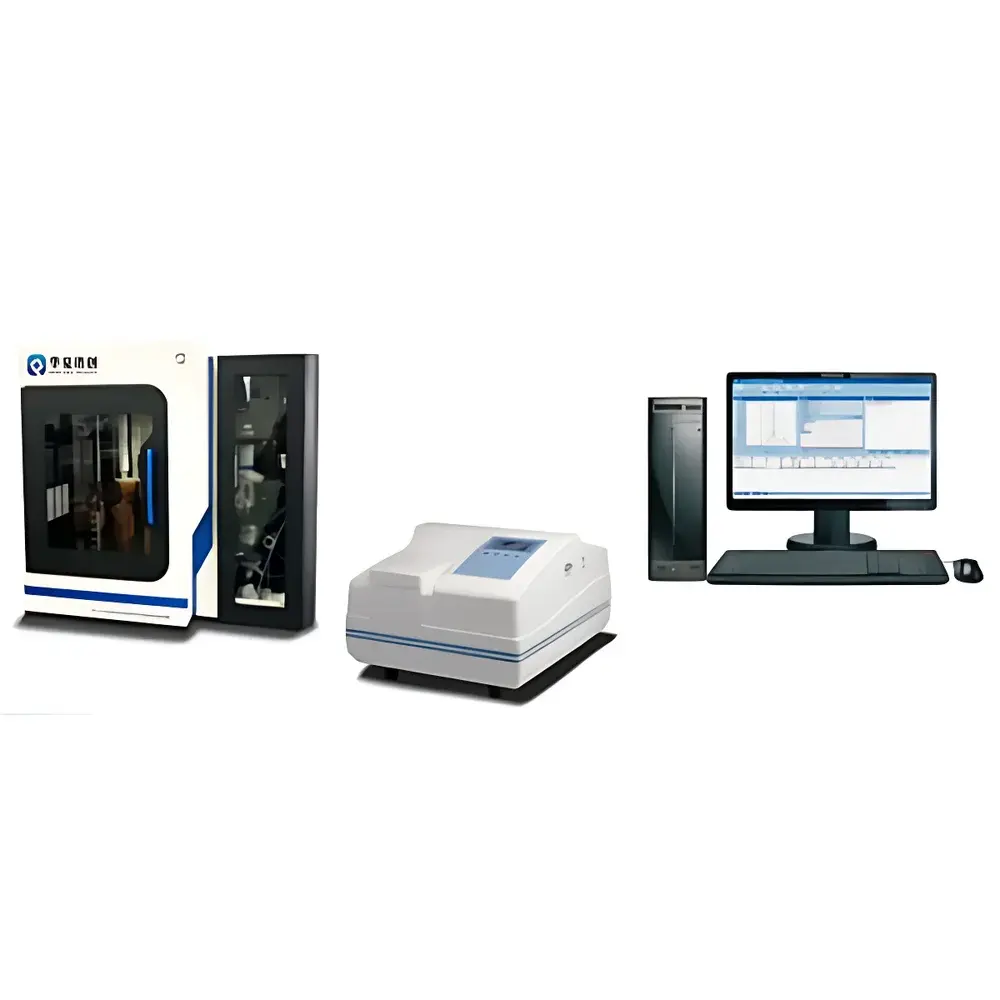
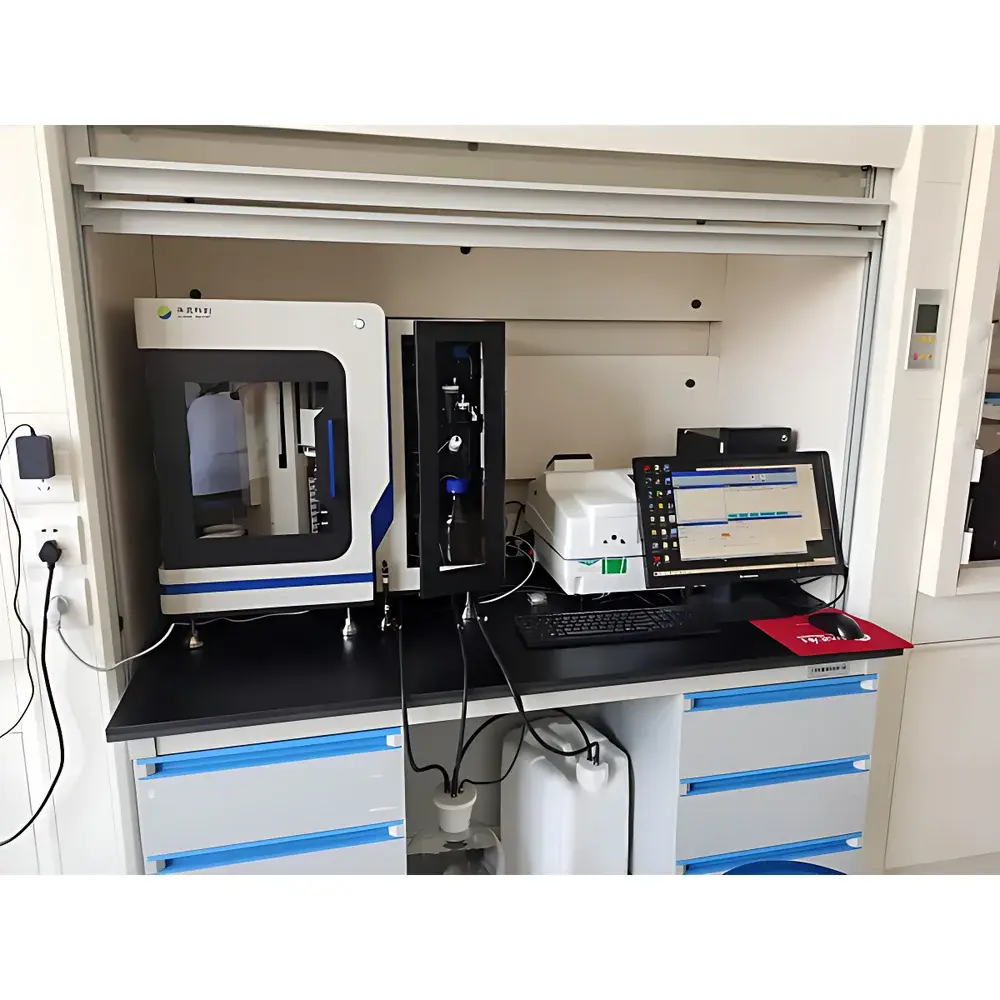
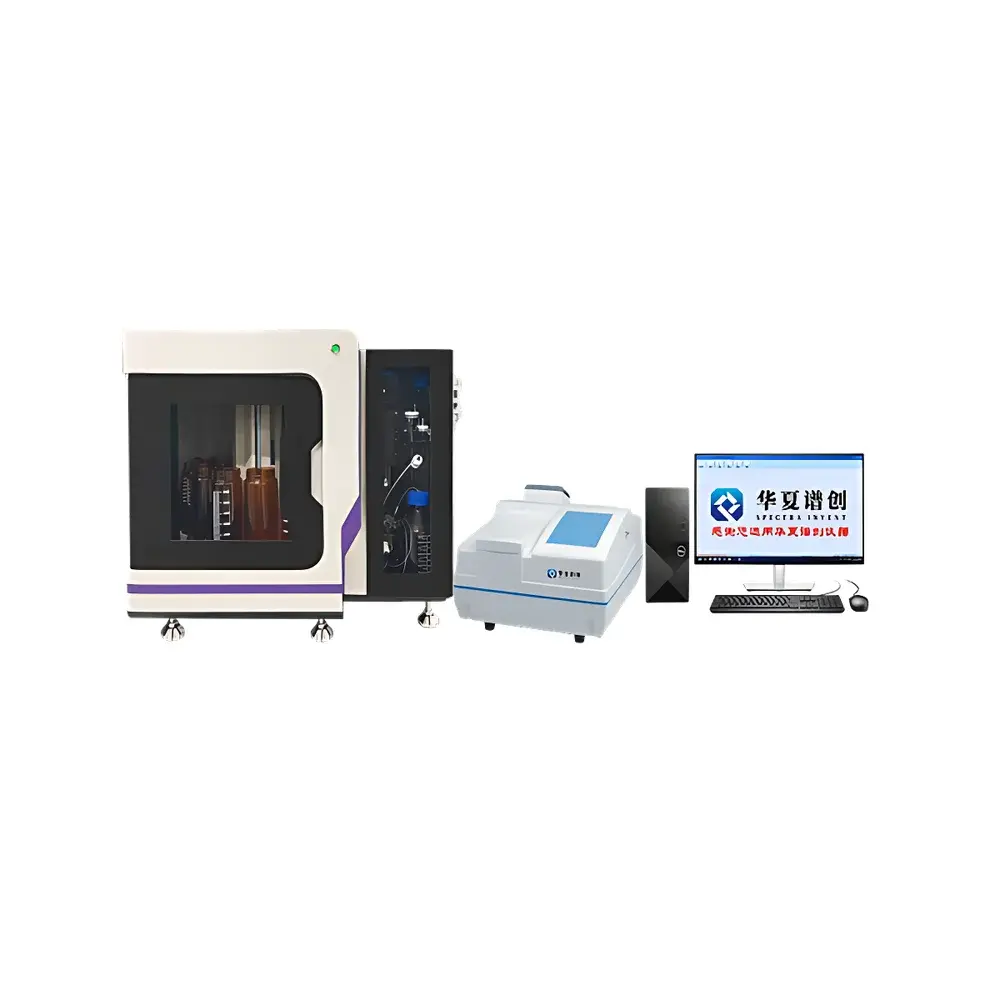
Spectra Invent OIL-530P Fully Automated Fluorescence Spectrophotometric Oil-in-Water Analyzer
| Brand | Spectra Invent |
|---|---|
| Origin | Beijing, China |
| Manufacturer Type | Authorized Distributor |
| Instrument Type | Laboratory-Based |
| Model | OIL-530P |
| Measurement Principle | Fluorescence Spectrophotometry |
| Measurement Range | 0–5 mg/L (with automatic dilution for over-range samples) |
| Detection Limit | 0.005 mg/L |
| Accuracy | ≤2% error |
| Optical Range | 200–900 nm |
| Monochromator Design | Dual-grating |
| Scan Speed | Up to 48,000 nm/min |
| Bandwidth Adjustment | Multi-step selectable |
| Sample Capacity | 10–14 positions on 360° rotatable sample carousel |
| Extraction Efficiency | ≥95% |
| Sample Vessel | Certified amber glass vials compliant with Chinese national standards (HJ 637–2018, GB/T 16488–1996) |
Overview
The Spectra Invent OIL-530P is a laboratory-grade, fully automated fluorescence spectrophotometric analyzer engineered for precise quantification of petroleum hydrocarbons in aqueous matrices—primarily surface water, groundwater, wastewater, and industrial effluents. It operates on the principle of ultraviolet-excited fluorescence detection, where polycyclic aromatic hydrocarbons (PAHs) and aliphatic hydrocarbon fractions absorb UV light (typically 220–350 nm excitation) and emit characteristic fluorescence signals in the visible range (300–550 nm). This method offers superior selectivity and sensitivity compared to infrared or gravimetric alternatives, particularly for low-concentration environmental monitoring applications governed by regulatory frameworks such as China’s HJ 637–2018 and international equivalents (e.g., EPA Method 1664A, ISO 9377-2). The instrument integrates optical, fluidic, and control subsystems into a single compact platform, enabling trace-level oil-in-water analysis without manual intervention across sample preparation, extraction, phase separation, measurement, and system conditioning.
Key Features
- High-Stability Excitation Source: Equipped with an ozone-free, long-life xenon lamp providing stable spectral output across 200–900 nm; paired with a red-sensitive photomultiplier tube (PMT) detector optimized for fluorescence quantum yield in the 300–550 nm emission window.
- Dual-Monochromator Architecture: Two independently adjustable grating monochromators ensure high spectral resolution, minimal stray light (<0.001%), and flexible excitation/emission wavelength selection—critical for matrix-specific interference mitigation.
- Fully Automated Sample Processing: Integrated robotic liquid handling performs volumetric sampling, reagent dispensing (e.g., n-hexane or CCl4), high-speed vortex-assisted liquid–liquid extraction, membrane-based oil–water phase separation, and post-analysis pneumatic line purging—all under software-defined protocol control.
- Contactless Volume Measurement: Ultrasonic level sensing enables non-invasive, real-time volume determination of aqueous and organic phases with ±0.02 mL repeatability—eliminating pipetting errors and cross-contamination risks.
- Intelligent Dilution & Calibration: Onboard precision syringe pump automatically prepares multi-point calibration curves from stock standards and executes serial dilutions for samples exceeding 5 mg/L, applying real-time correction factors based on measured dilution ratios.
- Integrated Safety & Maintenance Systems: Infrared door-position interlock halts operation if the sample chamber is open; activated carbon gas adsorption module captures volatile organic emissions; hydrophobic membrane separators remove residual moisture from extract streams, eliminating desiccant replacement cycles.
Sample Compatibility & Compliance
The OIL-530P accepts standard amber glass sample vials (40 mL, compliant with HJ 637–2018 and GB/T 16488–1996), supporting direct field-to-lab analysis when used with the optional integrated sampling kit (including certified sampling bottles, insulated transport cases, and preservation protocols). It accommodates both filtered and unfiltered water matrices, provided suspended solids do not exceed 100 mg/L (pre-filtration recommended per ISO 5667-3). The system meets functional requirements for GLP-compliant laboratories: full audit trail logging, user-access controls, electronic signature support, and data integrity safeguards aligned with FDA 21 CFR Part 11 principles. All analytical procedures are traceable to national standard reference materials (GBW(E) 080913, CNRM-10101a).
Software & Data Management
Control and data acquisition are managed via SpectraSoft™ v4.x—a Windows-based application featuring method editor, sequence scheduler, real-time chromatogram-like fluorescence scan visualization, and automated report generation (PDF/CSV/XLSX). Raw spectral data (excitation/emission matrices), peak integration parameters, dilution logs, and system diagnostic timestamps are stored in a relational SQLite database with SHA-256 hash verification. Software supports LIMS integration via ASTM E1384-compliant HL7 messaging and includes built-in validation tools for IQ/OQ documentation per ISO/IEC 17025:2017 Annex A.2.
Applications
- Regulatory compliance monitoring for municipal wastewater discharge permits (e.g., China’s “Discharge Standard of Pollutants for Municipal Wastewater Treatment Plants” GB 18918–2002)
- Environmental impact assessment (EIA) of oilfield operations, petrochemical facilities, and marine port activities
- Drinking water source protection zone surveillance and emergency spill response
- Research on hydrocarbon biodegradation kinetics and sorption behavior in aquatic sediments
- Quality control of industrial cooling water, boiler feedwater, and closed-loop process streams
FAQ
What extraction solvents are compatible with the OIL-530P?
n-Hexane, cyclohexane, and tetrachloroethylene are validated per HJ 637–2018; carbon tetrachloride may be used under controlled ventilation per local safety regulations.
Does the system support remote diagnostics and firmware updates?
Yes—via secure TLS-encrypted Ethernet connection; remote access requires pre-authorized IP whitelisting and two-factor authentication.
Can the instrument be integrated with existing laboratory automation systems?
It supports RS-232, USB CDC, and Modbus TCP interfaces for handshake communication with robotic arms, autosamplers, and central LIMS platforms.
Is method validation documentation provided?
Each unit ships with a Factory Acceptance Test (FAT) report, Certificate of Conformance, and a template Method Validation Kit covering specificity, linearity (R² ≥ 0.999), LOD/LOQ verification, and intermediate precision testing.
What maintenance intervals are recommended for routine operation?
Optical alignment verification every 6 months; PMT gain calibration quarterly; extraction membrane replacement every 500 runs or 12 months—whichever occurs first.







