
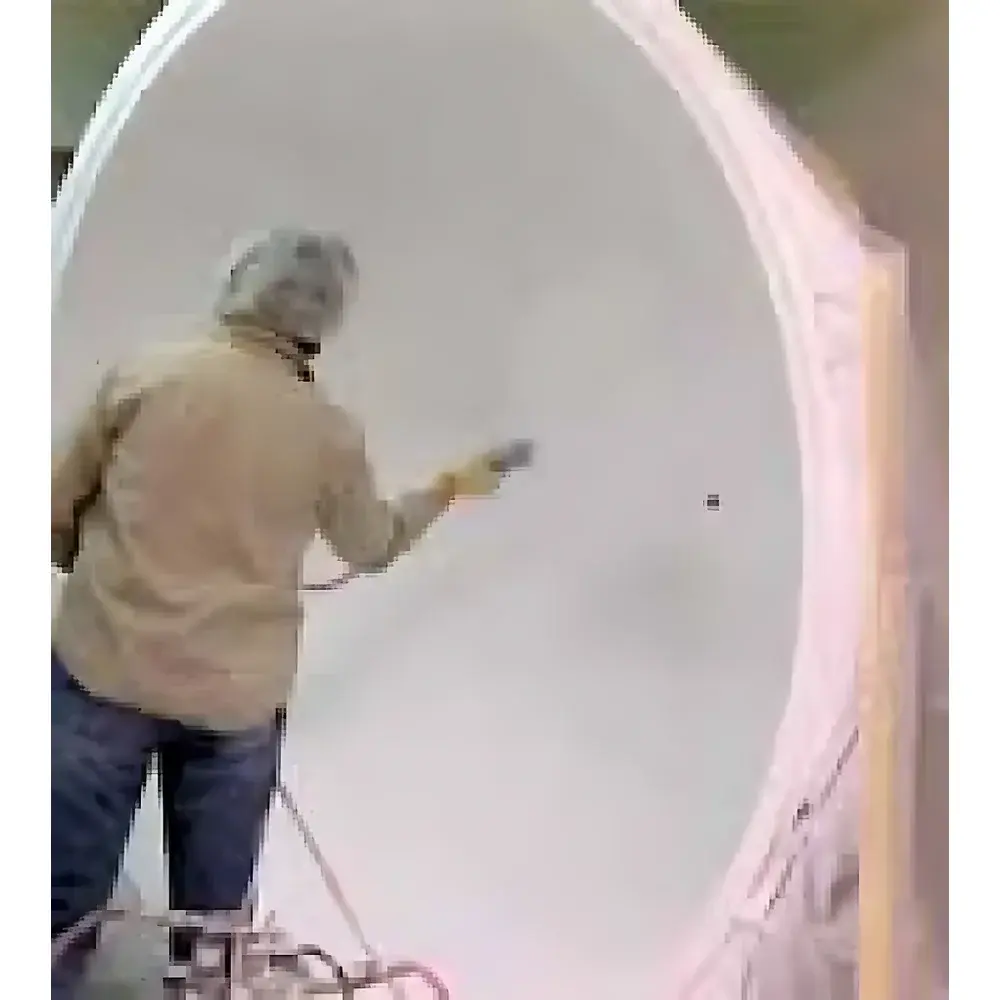
SPECTRAFLECT® Reflective Coating by Labsphere
| Brand | Labsphere |
|---|---|
| Origin | USA |
| Model | SF |
| Wavelength Range | 300–2400 nm |
| Reflectance | >99% (400–1100 nm, ≥0.5 mm thickness) |
| Lambertian Characteristic | Near-perfect |
| Thermal Stability | Up to 100°C |
| Laser Damage Threshold | 1.7 J/cm² @ 532 nm, Q-switched Nd:YAG |
| Composition | Barium sulfate–based aqueous formulation |
| Application Method | Air-spray only |
| Substrate Compatibility | Universal (metal, plastic, ceramic, composites) |
| Toxicity | Non-toxic |
| Solvent | Water-based |
| Re-coatability | Yes |
| Adhesion Prep | Degreasing + grit blasting |
Overview
SPECTRAFLECT® is a proprietary, high-reflectance, near-Lambertian coating engineered by Labsphere—a U.S.-based leader in optical calibration and diffuse reflectance materials. Unlike conventional reflective paints or PTFE-based coatings, SPECTRAFLECT® leverages a precisely formulated aqueous suspension of ultra-fine barium sulfate particles to deliver spectrally uniform, isotropic scattering across the ultraviolet–visible–near-infrared (UV-VIS-NIR) spectrum. Its operational principle relies on Mie scattering from sub-wavelength, high-refractive-index particles embedded in a low-absorption binder matrix—enabling minimal angular dependence and exceptional bidirectional reflectance distribution function (BRDF) homogeneity. Designed for critical radiometric and photometric applications, SPECTRAFLECT® serves as the reference-grade diffuse reflector in integrating spheres, spectrophotometer baffles, calibration standards, lamp housings, and light collection optics where spectral fidelity, spatial uniformity, and long-term stability are non-negotiable.
Key Features
- Ultra-high diffuse reflectance: >99% between 400–1100 nm when applied at ≥0.5 mm thickness; maintains >95% reflectance from 300–2400 nm
- Exceptional Lambertian behavior: BRDF deviation < ±1.5% over ±80° viewing angles—validated per ASTM E259 and ISO 2813 standards
- Water-based, non-toxic formulation: Compliant with OSHA 29 CFR 1910 and EU REACH Annex XVII; no VOCs, heavy metals, or halogenated solvents
- Air-spray application only: Enables rapid, repeatable coating on complex geometries—including large-diameter integrating spheres (>2 m) and internal cavity surfaces
- Thermal resilience: Stable up to 100°C continuous exposure; no yellowing, cracking, or reflectance drift after 500 h at 85°C/85% RH (per IEC 60068-2-30)
- Laser damage resistance: Certified LIDT of 1.7 J/cm² at 532 nm, 10 ns pulse width, 10 Hz repetition rate—suitable for moderate-power CW and pulsed VIS/NIR sources
- Recoatability and repairability: Fully compatible with overcoating without interlayer delamination; enables field refurbishment of aging sphere interiors
Sample Compatibility & Compliance
SPECTRAFLECT® adheres robustly to rigorously prepared substrates—including aluminum, stainless steel, anodized aluminum, machined acrylic, and ceramic composites—following standardized surface conditioning: alkaline degreasing followed by Al₂O₃ grit blasting (60–120 µm grit size) to achieve Ra ≈ 3–5 µm surface roughness. It is routinely specified in systems requiring traceable NIST-traceable reflectance calibration (e.g., NIST SRM 2035, 2036), and meets the optical stability criteria outlined in USP for photometric system qualification. The coating is widely accepted in FDA-regulated instrumentation design workflows under 21 CFR Part 11-compliant documentation protocols, particularly for UV-VIS spectrophotometers used in pharmaceutical QC labs. Its absence of outgassing (tested per ASTM E595) qualifies it for vacuum-compatible optical enclosures up to 1×10⁻⁵ Torr.
Software & Data Management
While SPECTRAFLECT® itself is a passive material, its performance validation integrates seamlessly into Labsphere’s certified calibration ecosystem. Reflectance spectra acquired using Labsphere’s CDS-2000 or UV-VIS-NIR Spectralon® Reference Standards are processed via Labsphere’s proprietary REFLECT™ software—supporting ASTM E275, ISO 13468, and CIE 15:2018 spectral analysis workflows. All spectral data files include embedded metadata (coating lot number, application date, substrate ID, thickness verification method), enabling full GLP/GMP audit trails. Raw reflectance datasets are exportable in ASTM E1331-compliant .jdx format and can be imported directly into MATLAB®, Python (via PySpectra), or commercial radiometric modeling tools such as FRED™ and LightTools® for Monte Carlo ray tracing validation.
Applications
- Integrating sphere interior coating for absolute reflectance/transmittance measurement systems (ASTM E1331, ISO 13468)
- Diffuse reflectance standards for UV-VIS-NIR spectrophotometers (NIST-traceable calibration transfer)
- Light collection efficiency enhancement in LED and laser diode test fixtures
- Baffling and stray-light suppression in astronomical instrumentation and Earth observation sensors
- Reference panels for hyperspectral imaging validation (e.g., NASA AVIRIS, ESA PRISMA ground truthing)
- Photobioreactor illumination uniformity optimization in algal cultivation R&D
- Calibration targets for UAV-mounted multispectral cameras operating in 350–1700 nm bands
FAQ
What is the minimum recommended coating thickness for optimal reflectance?
A nominal dry film thickness of 0.5 mm (20 mils) is required to achieve >99% reflectance in the 400–1100 nm range and ensure optical opacity. Thickness verification is performed via cross-sectional SEM or calibrated eddy-current gauging.
Can SPECTRAFLECT® be applied to curved or porous substrates?
Yes—provided surface preparation (degreasing + grit blasting) is uniformly executed. Porous substrates (e.g., sintered aluminum oxide) require a sealer coat (Labsphere’s SEALANT-1) prior to SPECTRAFLECT® application.
Is post-application curing required?
No thermal cure is needed. Ambient air drying for 24 h at 23°C/50% RH achieves full binder crosslinking. Forced convection at ≤40°C may reduce drying time to 6 h without compromising scatter uniformity.
How does humidity affect long-term reflectance stability?
Accelerated aging tests show <0.3% reflectance loss at 400 nm after 1,000 h at 85°C/85% RH. No measurable change occurs under controlled lab conditions (<30°C, <60% RH) over 10 years.
Does Labsphere provide application training or on-site coating services?
Yes—Labsphere offers certified technician-led on-site coating for spheres >1.5 m diameter or geometrically constrained assemblies, including environmental monitoring and thickness mapping per ISO/IEC 17025-accredited procedures.



