
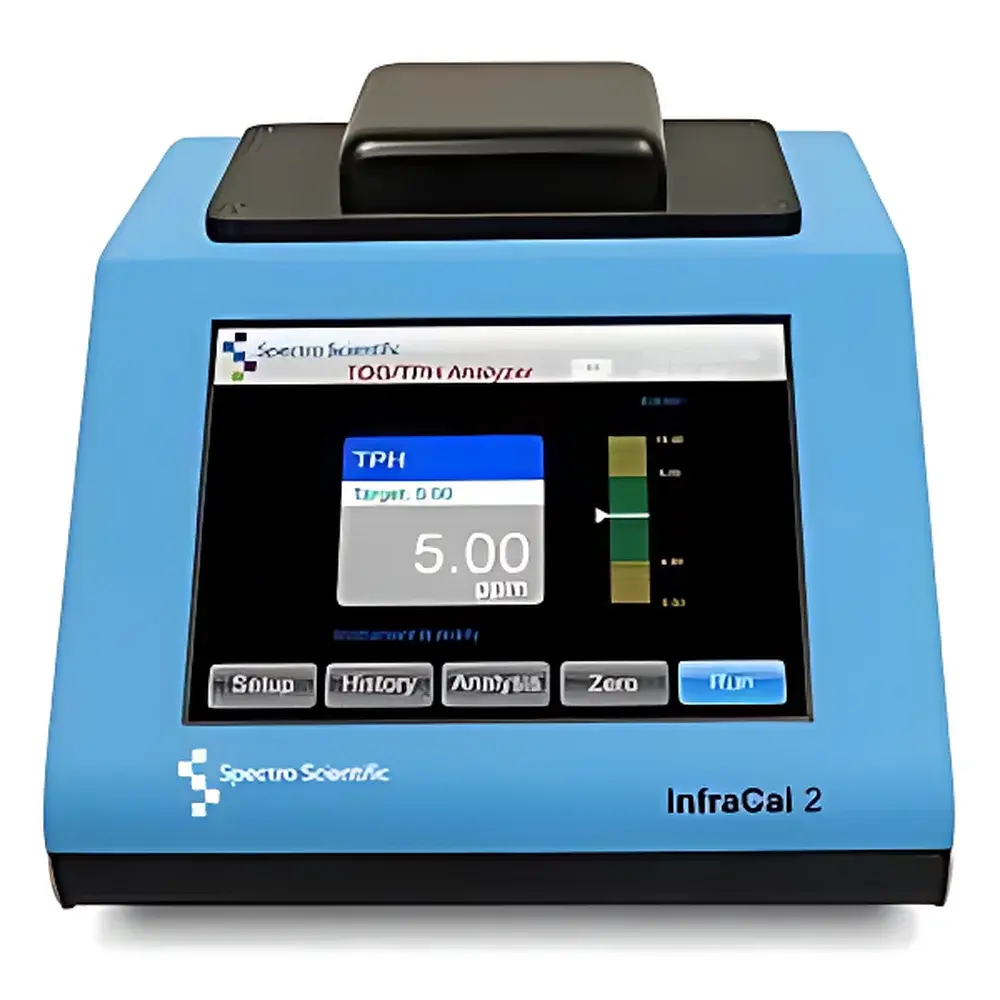
Spectro Scientific InfraCal 2 TRANS-SP Infrared Oil-in-Water and Total Petroleum Hydrocarbons (TPH) Analyzer
| Brand | Spectro Scientific |
|---|---|
| Origin | USA |
| Manufacturer Type | Manufacturer |
| Origin Category | Imported |
| Model | InfraCal 2 TRANS-SP |
| Detection Limit (Water) | 0.1 ppm |
| Detection Limit (Soil) | 1 ppm |
| Extraction Solvents | Perchloroethylene (PCE), S-316, Freon-113, AK-225 |
| Compliant Standards | EPA Method 413.2, EPA Method 418.1, EPA Method 1664, ASTM D7066-04, ISO 9377-2 |
| Wavelength | 3.4 µm (2930 cm⁻¹) |
| Power Supply | 18 V DC, 3.3 A (internal Li-ion battery or universal AC/DC adapter) |
| Weight | 2.6 kg (net), 3.2 kg (with battery) |
| Dimensions | 17 cm × 19.8 cm × 13.2 cm |
| Operating Temperature | 5–40 °C |
| Analysis Time | 10–15 min (including extraction) |
| Repeatability | ±0.1 ppm |
| Data Interface | USB, RS-232 |
| Sample Cell | 10 mm pathlength quartz cuvette with PTFE-sealed cap |
Overview
The Spectro Scientific InfraCal 2 TRANS-SP is a field-deployable, infrared-based analyzer engineered for quantitative determination of total petroleum hydrocarbons (TPH) in soil and oil-in-water (TOG) or fat, oil, and grease (FOG) in aqueous matrices. It operates on the principle of mid-infrared absorption spectroscopy at the characteristic C–H stretching band near 2930 cm⁻¹ (3.4 µm), where aliphatic hydrocarbons—including mineral oils, diesel, gasoline, lubricants, and animal/vegetable fats—exhibit strong, stoichiometric absorbance. Following solvent extraction (e.g., perchloroethylene, S-316, or Freon-113), the analyte-rich organic phase is introduced into a precision 10 mm quartz cuvette with a PTFE-sealed cap to prevent volatile loss. The instrument’s optical system delivers high signal-to-noise ratio measurements, enabling detection down to 0.1 ppm in water and 1 ppm in soil (dry weight basis), with linear dynamic range extending to 1000+ ppm (water) and 5000+ ppm (soil). Designed for rugged environmental monitoring applications—from offshore drilling platforms to municipal wastewater treatment plants—the InfraCal 2 TRANS-SP meets the technical requirements of EPA Methods 413.2, 418.1, and 1664, as well as ASTM D7066-04 and ISO 9377-2, supporting regulatory reporting under Clean Water Act and RCRA frameworks.
Key Features
- Field-ready portable design: Compact footprint (17 × 19.8 × 13.2 cm), lightweight (2.6 kg net), and battery-operated (integrated Li-ion pack, 18 V DC, 3.3 A) for extended off-grid deployment.
- Infrared photometric detection at 2930 cm⁻¹: Optimized for aliphatic C–H bond absorption; eliminates interference from aromatic or oxygenated organics when used with appropriate extraction solvents.
- Multi-curve calibration capability: Supports up to six user-defined or factory-installed calibration curves—enabling method-specific quantification for petroleum hydrocarbons (e.g., S-316 or PCE-based calibrations) or mixed FOG matrices (e.g., 50:50 isooctane/caprylic acid per ASTM D7066).
- Secure data management: Password-protected instrument interface, onboard storage for ≥1000 test records, and export via USB or RS-232 to LIMS or QA/QC databases.
- Robust sample handling: Quartz cuvettes with inert PTFE stoppers ensure minimal evaporation loss of volatile fractions during measurement—critical for reproducible low-level analysis.
- Rapid turnaround: Full analytical cycle—including solvent extraction, phase separation, and spectrophotometric reading—completed in ≤15 minutes without requiring trained laboratory personnel.
Sample Compatibility & Compliance
The InfraCal 2 TRANS-SP accommodates diverse environmental matrices through standardized liquid–liquid or solid–liquid extraction protocols. For water samples, EPA 1664-compliant gravimetric or infrared-compatible extraction yields the organic phase for direct cuvette loading. Soil and sediment samples are processed using Soxhlet, ultrasonic, or shake-flask methods per EPA 413.2 or ISO 9377-2, followed by dehydration (anhydrous Na₂SO₄) and filtration prior to analysis. Certified reference standards—including NIST-traceable S-316 and PCE-based TOG/TPH calibration sets (e.g., part nos. 403-1041, 403-1078)—are available for method validation and instrument verification. The analyzer supports GLP-compliant workflows via audit-trail-enabled software (optional SpectroSoft™), and its performance aligns with data integrity expectations under FDA 21 CFR Part 11 when integrated with validated IT systems.
Software & Data Management
Instrument control, calibration, and data export are managed via an embedded microprocessor interface with alphanumeric LCD display and membrane keypad. Calibration curves may be loaded from USB memory or programmed manually using concentration–absorbance pairs. Each measurement record stores timestamp, operator ID (if password-authenticated), curve ID, sample ID, and raw absorbance value. Data export formats include CSV and TXT for seamless import into Excel, LIMS, or statistical analysis packages. Optional SpectroSoft™ PC software provides advanced features: multi-instrument fleet monitoring, automated report generation (PDF/Excel), trend analysis across sampling events, and electronic signature support for regulated environments. All firmware updates are delivered via secure USB download, ensuring long-term compliance with evolving method revisions.
Applications
- Regulatory compliance testing: Routine monitoring of produced water, refinery effluents, and landfill leachate per EPA 1664 and ASTM D7066.
- Site remediation assessment: Quantification of TPH in excavated soils, drill cuttings, and contaminated sediments pre- and post-treatment.
- Wastewater pretreatment verification: FOG screening in food processing, biodiesel, and pharmaceutical facility discharges.
- Oil spill response: Rapid on-site triage of water and shoreline soil samples to prioritize containment and cleanup efforts.
- QA/QC in environmental laboratories: Field verification of lab results, method transfer validation, and proficiency testing support.
FAQ
What extraction solvents are compatible with the InfraCal 2 TRANS-SP?
Perchloroethylene (PCE), S-316, Freon-113, and AK-225 are validated solvents due to their infrared transparency at 2930 cm⁻¹ and efficient hydrocarbon extraction capacity. Selection depends on regulatory method requirements and matrix characteristics.
Does the instrument require daily calibration?
No. Factory-installed calibration curves remain stable over time; however, periodic verification using certified reference standards (e.g., 403-1041 or 403-1078) is recommended before each batch of samples per EPA QA/G-5 and ISO/IEC 17025 guidelines.
Can the InfraCal 2 TRANS-SP distinguish between petroleum hydrocarbons and biological oils?
Not inherently—its 2930 cm⁻¹ band responds to all aliphatic C–H bonds. However, method-specific calibration (e.g., FOG-focused 403-1040 curve) combined with solvent selection and sample pretreatment enables semi-selective quantification in mixed matrices.
Is the quartz cuvette reusable?
Yes. Cuvettes (part no. 403-0012) are chemically resistant and designed for repeated use after thorough solvent rinsing and air drying; PTFE caps prevent cross-contamination and solvent evaporation.
How is data integrity maintained during field use?
Password protection, operator ID logging, immutable timestamping, and exportable audit-ready records ensure traceability. When paired with SpectroSoft™ and validated procedures, the system satisfies ALCOA+ principles for regulated environmental testing.
Related Products







