
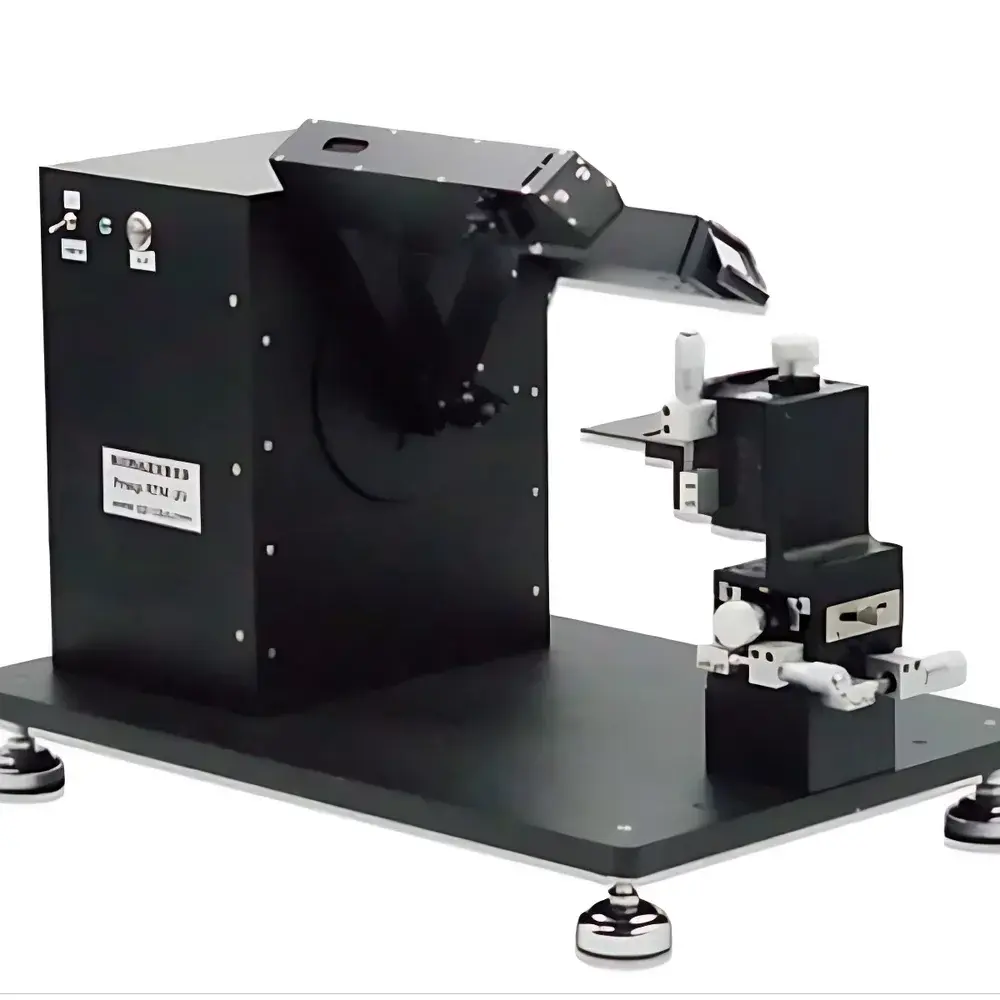
SPL ProSp-RTM-UV Full-Angle Spectral Goniometer
| Brand | SPL |
|---|---|
| Origin | Zhejiang, China |
| Manufacturer Type | Authorized Distributor |
| Product Category | Domestic |
| Model | RTM-UV |
| Price Range | USD 14,000 – 28,000 |
| Angular Range (Detector Arm) | 0–360° |
| Angular Range (Source Arm) | 0–270° |
| Angular Resolution | 0.01° |
| Spectral Range | 250–2500 nm |
| Compatible Spectrometer | Ocean Insight Fiber-Optic Spectrometers |
| Measurement Modes | Specular Reflection (Top/Bottom), Transmission, Radiance, Scattering, Fluorescence |
| Automation | Motorized Dual-Axis Goniometric Control with Software-Defined Scan Sequences |
| Light Sources | Integrated Tungsten-Halogen Lamp + External Source Port |
| Optical Modularity | Filter, Polarizer, and Waveplate Integration Support |
| Compliance | Designed for ASTM E308, ISO/CIE 15, USP <857>, and GLP-aligned data acquisition workflows |
Overview
The SPL ProSp-RTM-UV Full-Angle Spectral Goniometer is an engineered optical measurement platform designed for quantitative angular-resolved spectral characterization of advanced optical materials and microstructured surfaces. Operating on the principle of goniometric spectroscopy, it precisely controls both incident and detection beam geometries relative to a stationary or motorized sample stage, enabling systematic acquisition of bidirectional reflectance distribution functions (BRDF), bidirectional transmittance distribution functions (BTDF), and angle-dependent emission spectra. Unlike fixed-angle spectrophotometers, the RTM-UV implements high-fidelity dual-axis rotational mechanics—0–360° detector arm rotation and 0–270° source arm articulation—allowing full hemispherical coverage of scattering and reflection space. Its native spectral bandwidth spans 250–2500 nm, fully compatible with modular Ocean Insight fiber-coupled spectrometers (e.g., QE Pro, Maya2000 Pro), ensuring UV-VIS-NIR continuity without hardware reconfiguration. The system is calibrated traceably to NIST-traceable standards and supports spectral radiometric calibration via optional calibrated reference lamps.
Key Features
- Motorized dual-axis goniometry with sub-arcminute angular resolution (0.01° step size) and repeatability ±0.02°
- Modular optical path architecture: integrated tungsten-halogen broadband source plus dedicated port for external lasers, LEDs, or synchrotron beamlines
- Software-defined measurement sequences: programmable scan ranges, angular step intervals, integration times, and loop repetitions per configuration
- Five standardized optical modes—top-side specular reflection, bottom-side reflection, normal/transverse transmission, directional radiance, and fluorescence/scattering—each with dedicated optical path alignment routines
- Open-path design supporting in-situ insertion of polarization optics (linear/circular polarizers, quarter-wave plates), bandpass/notch filters, and neutral density elements without realignment
- Real-time spectral feedback during angular sweeps with live preview, peak tracking, and on-the-fly normalization against reference spectra
Sample Compatibility & Compliance
The RTM-UV accommodates planar and low-curvature samples up to Ø50 mm and 25 mm thickness, including thin-film stacks (SiO₂/TiO₂ multilayers), plasmonic metasurfaces, OLED emitter layers, AR/HR coatings, photonic crystal slabs, and anisotropic biomaterials (e.g., structural coloration in beetle cuticles). Sample mounting uses kinematic V-groove clamps with micrometer-adjustable height and tilt compensation. All measurement protocols align with ASTM E308 (computing CIE tristimulus values from spectral data), ISO/CIE 15:2018 (colorimetry), and USP (spectrophotometric system suitability). Audit-ready data export includes timestamped metadata, instrument configuration logs, and raw spectral arrays compliant with HDF5 and CSV formats—supporting 21 CFR Part 11–aligned electronic signatures when deployed with validated LabArchives or LabTrove ELN integrations.
Software & Data Management
Control and analysis are executed via ProSp-Goniometer Suite v3.2—a Windows-based application built on Qt and Python 3.9 with PyVISA and NumPy backends. The GUI provides intuitive mode selection, angular coordinate mapping (polar/azimuthal or Cartesian projection), and dynamic ROI definition for spectral averaging. Automated batch processing enables BRDF matrix generation across user-defined (θᵢ, θᵣ, φᵣ) grids, with optional interpolation to standard CIE gonioconfigurations. Export options include spectral irradiance (W·sr⁻¹·m⁻²·nm⁻¹), reflectance factor (%), and absolute transmittance. Raw data files embed EXIF-style headers containing spectrometer model, grating configuration, slit width, and calibration date. Version-controlled script templates (Python/Jupyter) are provided for custom analysis pipelines—including Kramers–Kronig transformation, effective medium modeling, and Mueller matrix reconstruction.
Applications
- Development and QA of anti-reflective and high-reflectance optical coatings for aerospace and lithography optics
- Characterization of angle-sensitive interference filters and dichroic mirrors used in fluorescence microscopy and hyperspectral imaging
- Quantitative evaluation of surface plasmon resonance (SPR) coupling efficiency in biosensor substrates under variable incidence
- Microstructure–optical response correlation in photonic crystal fibers and dielectric metasurfaces
- Angle-resolved photoluminescence mapping of perovskite quantum dot films and micro-LED arrays
- Forensic analysis of security features in banknotes and ID documents using polarization-resolved gonioreflectance
FAQ
What spectrometers are certified for use with the RTM-UV?
Ocean Insight QE Pro, Maya2000 Pro, Flame-T, and HR4000 models are fully supported; custom firmware patches ensure synchronized trigger timing between spectrometer acquisition and goniometer position updates.
Can the system perform polarization-resolved measurements?
Yes—the optical path includes two standardized SM1-threaded ports (one pre-sample, one post-sample) for inserting motorized rotating polarizers or liquid-crystal variable retarders, with software synchronization to angular position.
Is vacuum or environmental chamber integration possible?
The base platform is compatible with third-party environmental stages (e.g., Linkam LTS420) via flange-mounted adapters; optical feedthroughs support UV-grade fused silica windows for inert gas or low-pressure operation.
How is angular accuracy verified and maintained?
Each unit ships with a NIST-traceable autocollimator verification report; onboard capacitive encoders are factory-calibrated against laser interferometric references, and users may perform periodic validation using a collimated HeNe beam and retroreflector target.
Does the system support GLP-compliant audit trails?
Yes—ProSp-Goniometer Suite logs all operator actions, parameter changes, and hardware events in encrypted SQLite databases with SHA-256 hash integrity checks, meeting ALCOA+ data governance requirements for regulated laboratories.




