
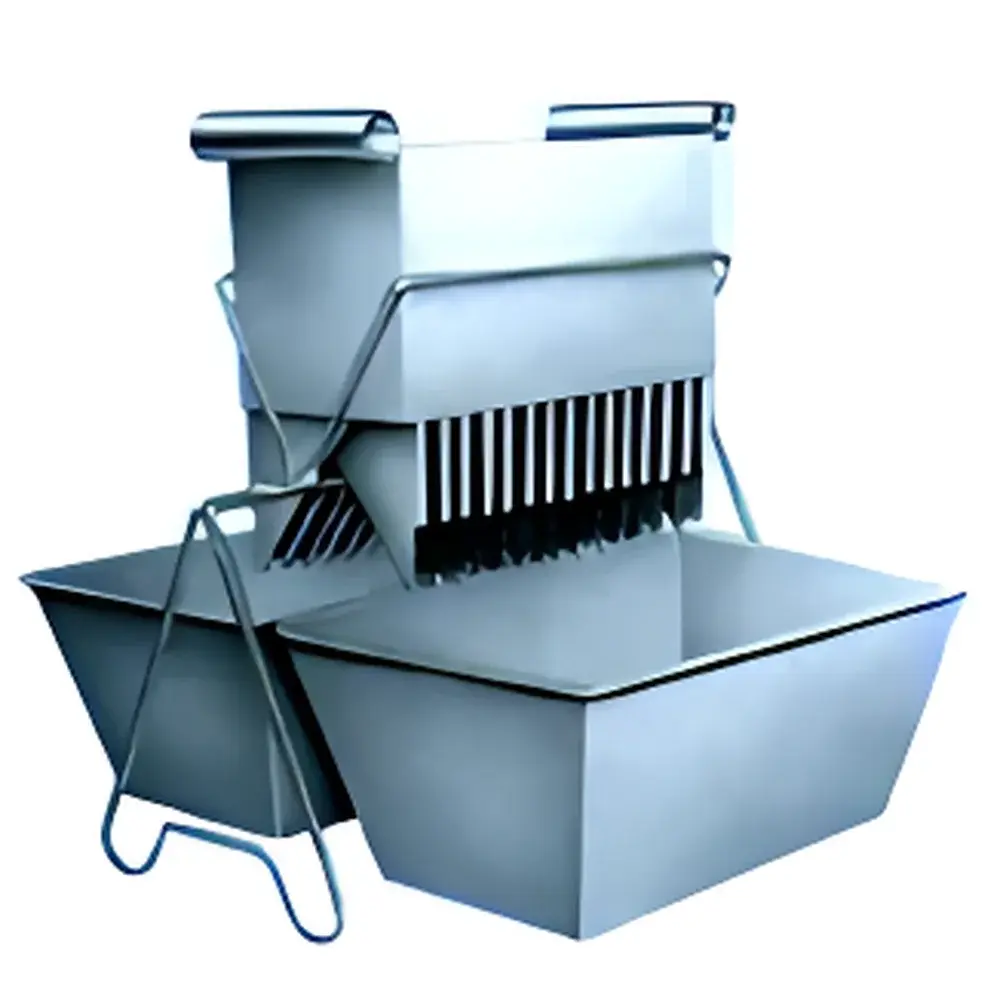
Stainless Steel Trough-Type Sample Divider
| Key | Origin: China |
|---|---|
| Manufacturer Type | Distributor |
| Pricing | Upon Request |
| Slot Count (Large) | 16 |
| Slot Width (Large) | 32.5 mm |
| Max Feed Size (Large) | ≤13 mm |
| Slot Count (Medium) | 18 |
| Slot Width (Medium) | 15 mm |
| Max Feed Size (Medium) | ≤6 mm |
| Slot Count (Small) | 24 |
| Slot Width (Small) | 7.5 mm |
| Max Feed Size (Small) | ≤3 mm |
| Minimum Slope Angle | ≥60° |
Overview
The Stainless Steel Trough-Type Sample Divider is a precision mechanical sample splitting device engineered for reproducible, bias-free reduction of bulk granular materials—primarily coal, ores, mineral aggregates, and other dry particulate solids—according to standardized laboratory protocols. It operates on the principle of alternate-channel division: a homogeneous stream of material is fed onto a symmetrical array of parallel, equally spaced, downward-inclined slots; gravity directs particles into alternating collection chutes, ensuring each subsample receives statistically representative material from the entire feed cross-section. Designed in strict compliance with GB/T 474–2008 “Methods for Preparation of Coal Samples”, this divider guarantees minimal segregation and high inter-laboratory reproducibility when integrated into certified sampling workflows. Its robust stainless steel construction ensures long-term dimensional stability, corrosion resistance, and ease of cleaning—critical attributes for maintaining sample integrity across repeated use in QA/QC, geological survey, and power generation laboratories.
Key Features
- Full stainless steel (AISI 304) fabrication for structural rigidity, non-reactivity, and compliance with hygiene-sensitive environments.
- Three standardized configurations—Large, Medium, and Small—to accommodate varying feed particle size distributions and throughput requirements.
- Slot geometry engineered to meet or exceed the minimum 60° incline specified in GB/T 474, minimizing particle rolling bias and ensuring consistent flow dynamics.
- Interchangeable slot plates (available as optional accessories) allow reconfiguration between nominal size classes without replacing the entire frame.
- Modular base design with adjustable leveling feet supports stable operation on standard laboratory benches or mobile carts.
- Optional full-enclosure housing available to suppress dust emission, reduce operator exposure, and prevent cross-contamination during high-volume coal sampling.
Sample Compatibility & Compliance
This sample divider is validated for use with dry, free-flowing granular materials having particle sizes up to 13 mm (Large), 6 mm (Medium), and 3 mm (Small). It is not intended for cohesive, fibrous, or moisture-sensitive samples without prior drying or conditioning. The device conforms to the geometric and operational requirements defined in GB/T 474–2008 and aligns with the fundamental principles of ISO 13909–1:2016 (Coal and coke — Sampling — Part 1: Sampling procedures) and ASTM D2234/D2234M–22 (Standard Practice for Collection of a Gross Sample of Coal). When used as part of an end-to-end sampling system—including primary sampling, crushing, and subsequent analysis—it supports adherence to ISO/IEC 17025:2017 competency requirements for testing laboratories.
Software & Data Management
As a purely mechanical, manual-feed instrument, this trough-type divider does not incorporate embedded electronics, sensors, or software interfaces. Its operation requires no calibration software, firmware updates, or digital connectivity. However, it is fully compatible with LIMS-integrated sampling workflows: operators record configuration parameters (slot count, width, feed size class), batch ID, date/time, and operator signature in standardized logbooks or electronic forms aligned with GLP documentation practices. Traceability is maintained through physical labeling of collected sub-samples and linkage to upstream sampling event records.
Applications
- Routine preparation of analytical coal samples for proximate analysis (moisture, ash, volatile matter, fixed carbon), ultimate analysis (C, H, N, S, O), and calorific value determination.
- Reduction of exploration core samples or bulk mine run-of-mine (ROM) material for geochemical assay and metallurgical testing.
- Subsampling of industrial minerals (e.g., limestone, bauxite, phosphate rock) prior to XRF, XRD, or wet chemistry analysis.
- Quality control in cement, aggregate, and biomass pellet production facilities where homogeneity verification is mandated by internal SOPs or industry standards (e.g., EN 15350, ASTM C117).
- Reference material homogenization and distribution in proficiency testing schemes accredited to ISO/IEC 17043.
FAQ
Is this sample divider suitable for wet or sticky materials?
No. It is designed exclusively for dry, free-flowing granular solids. Moisture content above 8% w/w or significant clay/fine dust content may cause slot bridging and introduce splitting bias.
Can I validate the splitting accuracy of my unit?
Yes. Accuracy verification is performed using tracer particle tests per GB/T 474 Annex B or ISO 13909–5:2016. A known mass of inert, visually distinguishable particles (e.g., colored ceramic beads) is mixed into a representative feed sample; recovery rates in both outlet fractions are quantified to assess deviation from theoretical 50:50 split.
Does the device require periodic recalibration?
No. As a passive mechanical device with no moving parts or measurement transducers, it requires only visual inspection for slot deformation, wear, or contamination before each use. Dimensional verification against certified gauge blocks is recommended annually.
What safety certifications does it carry?
The unit complies with general laboratory equipment safety principles under IEC 61010–1. Optional enclosed models include CE-marked dust extraction interface ports compatible with Class H vacuum systems per EN 60335–1.
Are spare slot plates and mounting hardware available?
Yes. All three standard slot configurations (16-slot, 18-slot, 24-slot) are offered as field-replaceable kits, including stainless steel fasteners, alignment guides, and installation torque specifications.



