
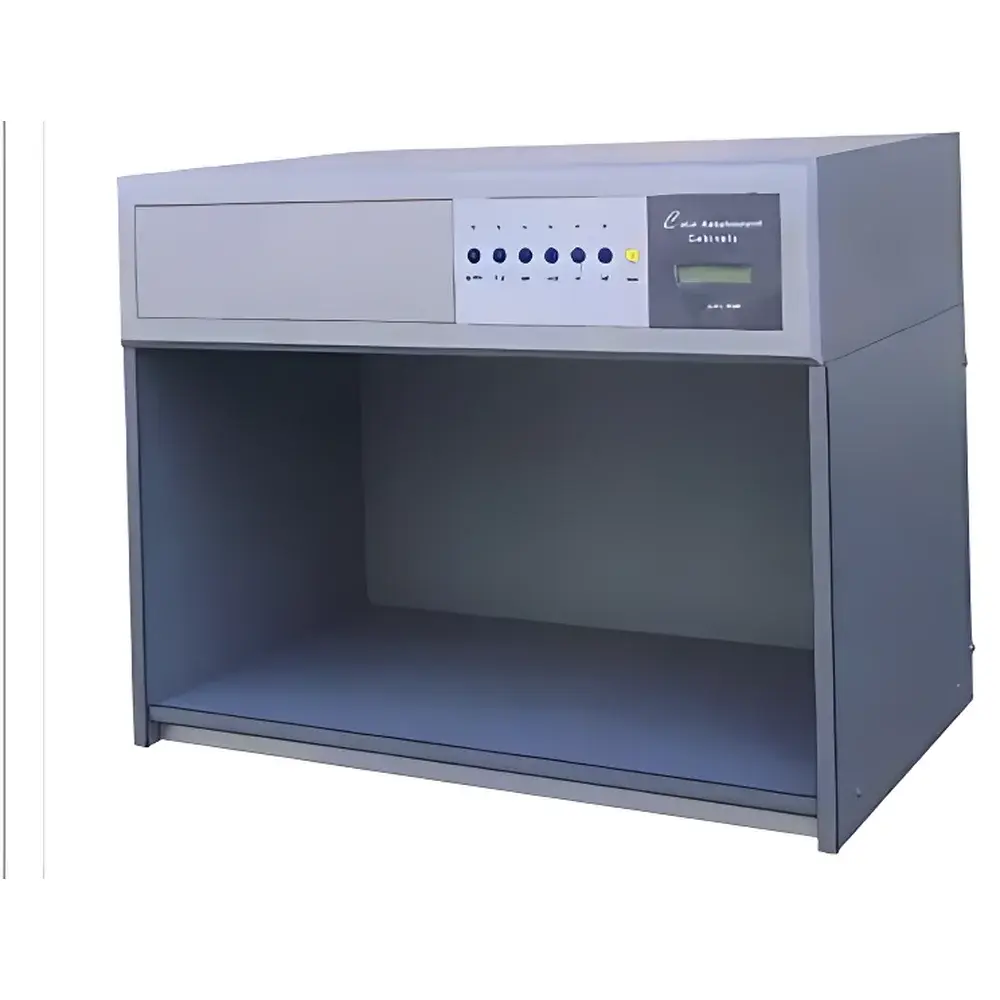
Standard Light Booth – JIANHU Model JH-SLB Series
| Brand | JIANHU |
|---|---|
| Origin | Shanghai, China |
| Model | JH-SLB |
| Light Sources | D65 (6500K, 20W), TL84 (4000K, 18W), F (2700K, 40W), UV (365 nm, 20W) |
| Control | Automatic Source Switching |
| Features | Real-time Lamp Hour Tracking, Metamerism Assessment Capability, Instant-On Operation, Low Thermal Output, Compact Benchtop Design |
Overview
The JIANHU JH-SLB Series Standard Light Booth is an engineered color evaluation instrument designed for consistent, repeatable visual assessment of color appearance under standardized illumination conditions. It operates on the principle of controlled spectral simulation—reproducing internationally recognized illuminants to eliminate subjective variability caused by ambient lighting. This booth supports critical quality control workflows in textile, paint, printing, plastics, and automotive industries where color fidelity across production batches and supply chains must comply with global specifications. Its core function is to enable reliable detection of metamerism—the phenomenon where two samples match under one light source but diverge under another—by providing simultaneous or sequential exposure to multiple CIE-standard illuminants.
Key Features
- Multi-illuminant configuration with four calibrated light sources: D65 (CIE standard daylight, 6500K), TL84 (European/Japanese retail lighting, 4000K), F (incandescent reference, 2700K), and UV (365 nm blacklight for fluorescence inspection).
- Real-time lamp hour monitoring for each source—displaying individual usage time and cumulative operational hours—to support scheduled maintenance and ensure photometric stability over service life.
- Microprocessor-controlled automatic switching between illuminants with zero warm-up delay and no perceptible flicker, enabling immediate comparative evaluation without thermal drift or spectral settling delays.
- Thermally optimized LED-based architecture (where applicable) or high-CRI fluorescent tube design that minimizes radiant heat output—eliminating the need for active cooling systems and preventing sample temperature rise during extended viewing sessions.
- Benchtop form factor (typical footprint: 580 × 380 × 320 mm) with matte-black interior walls and neutral gray viewing surface to suppress stray light and enhance contrast perception.
Sample Compatibility & Compliance
The JH-SLB accommodates flat and three-dimensional specimens up to 300 mm × 300 mm × 150 mm (L×W×H), including fabric swatches, coated panels, injection-molded parts, and packaging prototypes. Its optical geometry conforms to ISO 3664:2009 (Graphic technology and photography — Viewing conditions) and ASTM D1729–19 (Standard Practice for Visual Appraisal of Colors and Color Differences of Objects). While not certified to IEC 61000-3-2 for electromagnetic compatibility or ISO/IEC 17025 for calibration traceability, the unit is routinely deployed in laboratories operating under ISO 9001 and ISO 14001 quality management systems. For regulated environments requiring audit readiness, optional documentation packages—including factory-verified spectral power distribution (SPD) reports per illuminant—can be supplied upon request.
Software & Data Management
The JH-SLB operates via integrated tactile push-button interface with LED status indicators; no external PC or proprietary software is required for basic operation. However, it supports integration into enterprise-level color management ecosystems through optional RS-232 or USB-to-serial adapters. When connected, third-party color analysis platforms (e.g., X-Rite Color iQC, Datacolor Tools) can log illuminant selection timestamps, lamp usage data, and operator ID entries—enabling GLP-compliant record retention and facilitating FDA 21 CFR Part 11–aligned electronic audit trails when paired with validated software layers.
Applications
- Textile and apparel: Shade matching across dye lots, batch-to-batch consistency verification, and retailer-specific lighting compliance (e.g., Walmart’s TL84 requirement).
- Pigment and coating formulation: Visual validation of hue, chroma, and lightfastness under UV exposure prior to accelerated weathering tests.
- Printing and packaging: Detection of substrate-induced metamerism in CMYK vs. spot color reproduction, especially on recycled or optically brightened papers.
- Automotive interiors: Evaluation of trim components under D65 (daylight) and F (interior cabin lighting) to confirm perceived color harmony across lighting conditions.
- Quality assurance labs: First-article inspection, incoming material verification, and supplier dispute resolution where objective lighting conditions are contractually mandated.
FAQ
What standards does the JH-SLB comply with for color evaluation?
It meets the geometric and spectral requirements specified in ISO 3664:2009 and ASTM D1729–19 for viewing conditions in graphic arts and industrial color assessment.
Can the UV source be used for fluorescence quantification?
The 365 nm UV lamp enables qualitative detection of fluorescent whitening agents (FWAs) and optical brighteners but is not calibrated for quantitative fluorimetry; dedicated spectrophotometers with integrating spheres are recommended for absolute fluorescence measurement.
Is lamp replacement user-serviceable?
Yes—fluorescent tubes and UV lamps follow industry-standard G13 base configurations and can be replaced without tools; LED modules (if configured) require factory recalibration post-replacement.
Does the booth include a calibration certificate?
Standard units ship without NIST-traceable calibration documentation; however, accredited third-party calibration services (including SPD verification and illuminance uniformity mapping) are available as an add-on option.
How is metamerism assessed using this booth?
By sequentially illuminating identical samples under D65 and TL84 (or other paired sources), observers evaluate whether color matches persist—failure to match confirms metameric behavior, guiding formulation adjustments or substrate selection.



