
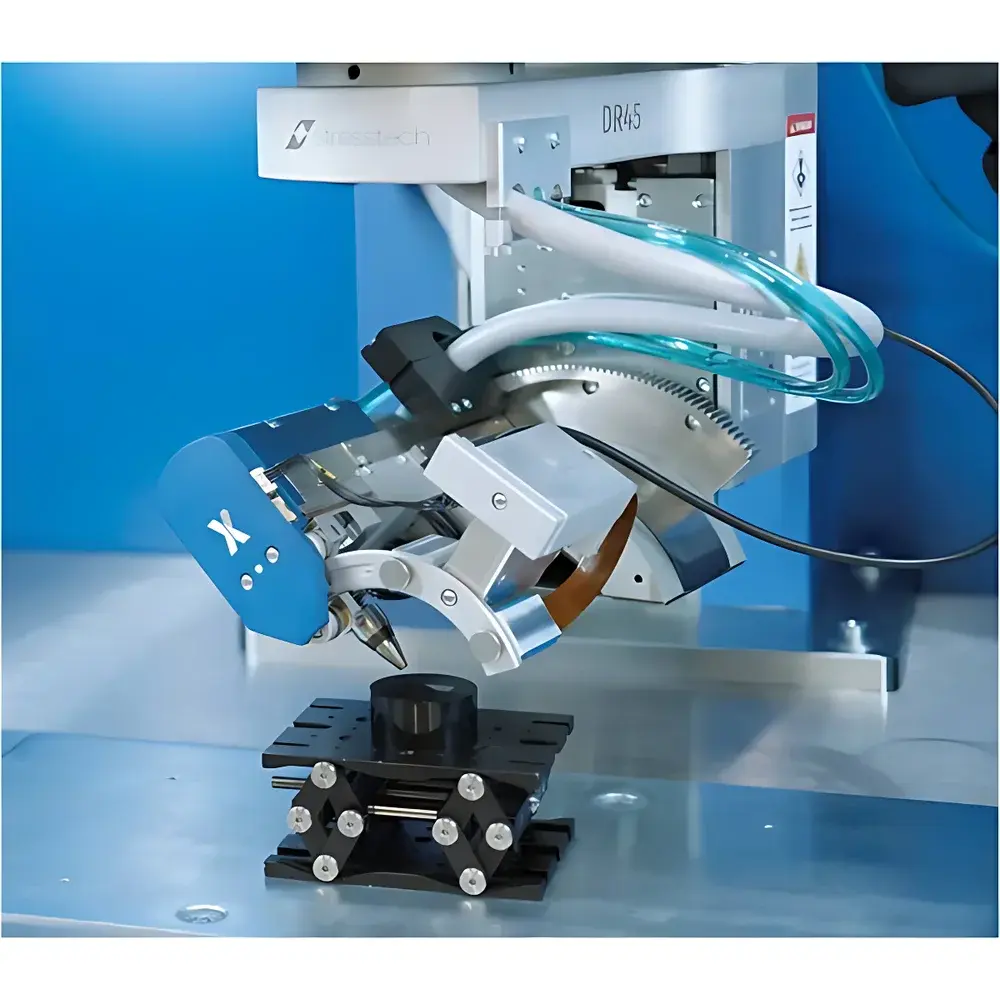
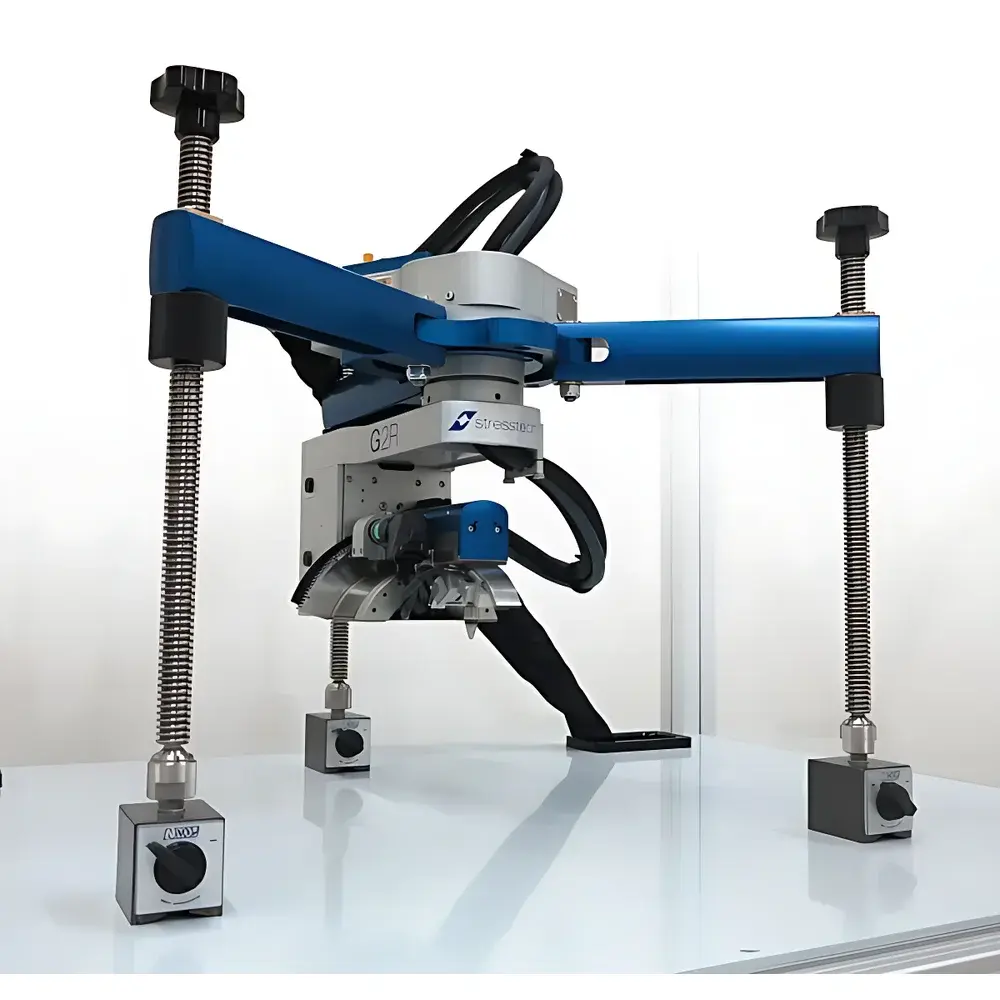
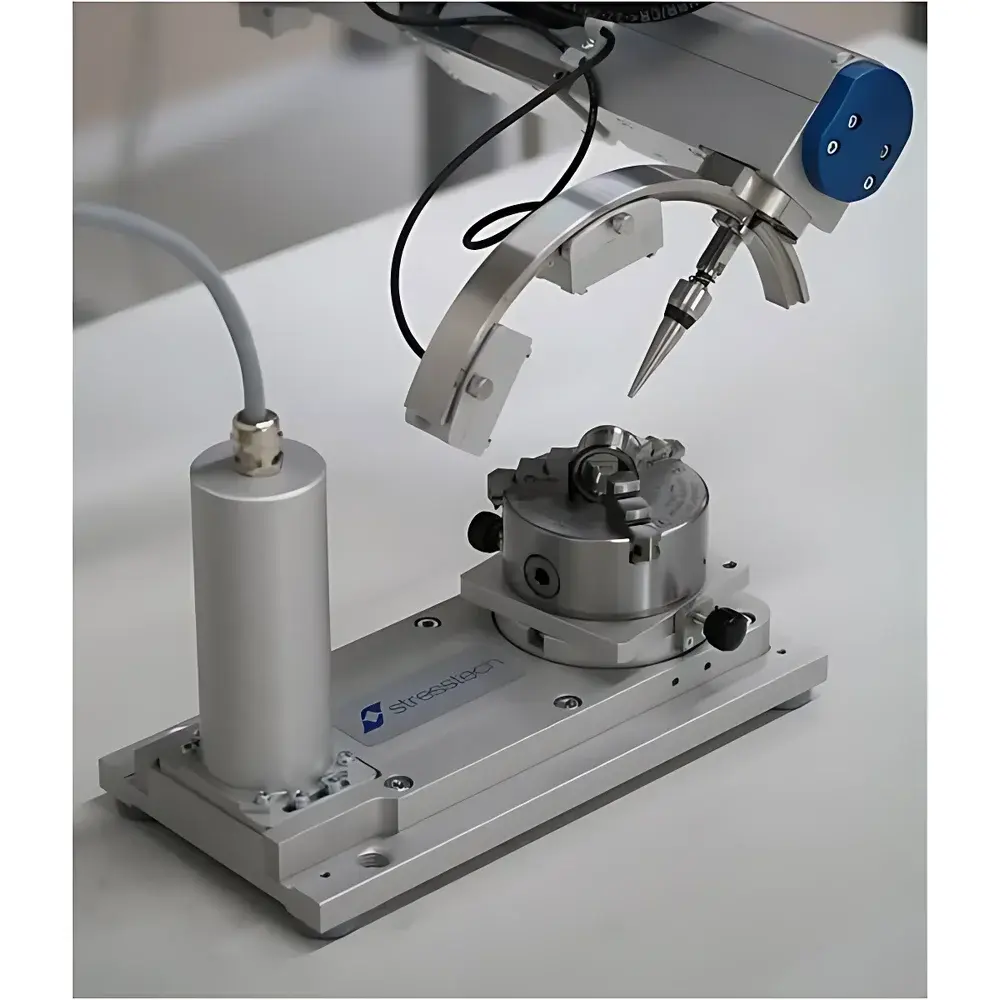
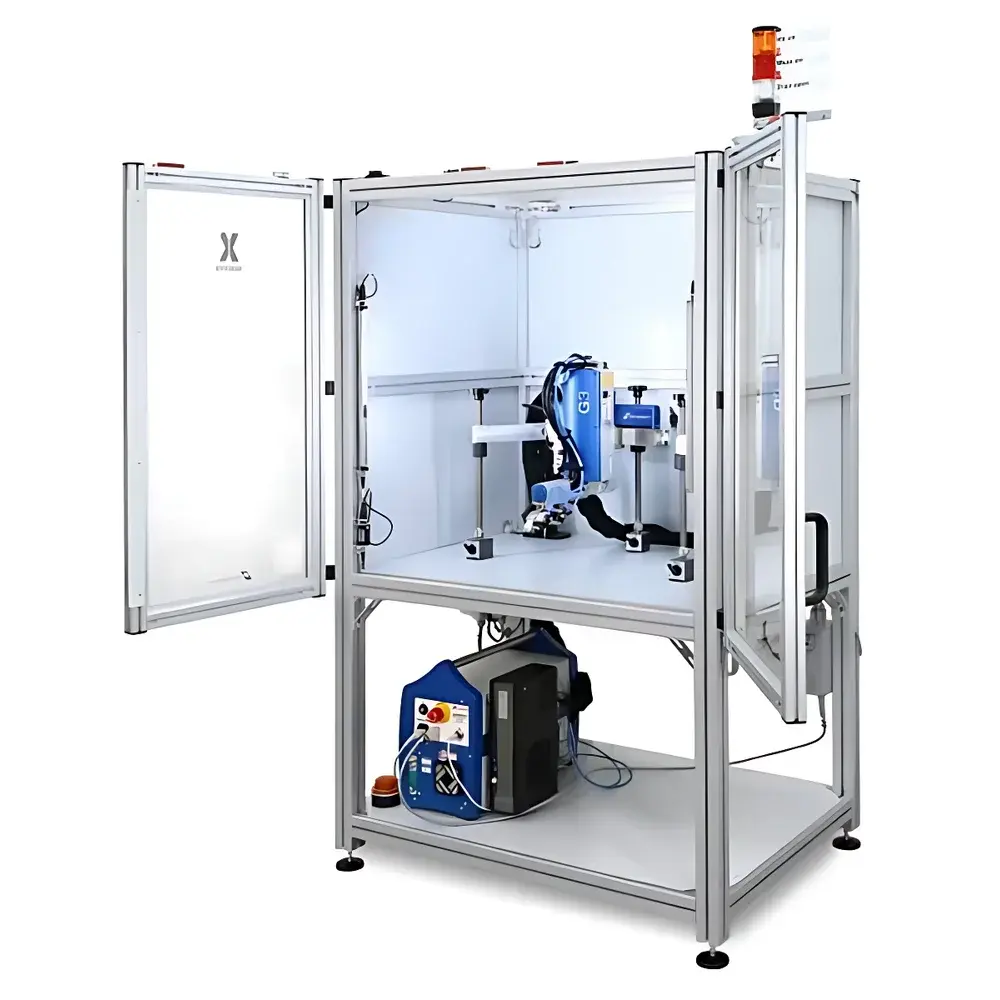
Stresstech xstress 3000 Portable X-Ray Residual Stress Analyzer
| Brand | Stresstech Oy |
|---|---|
| Origin | Finland |
| Model | xstress 3000 |
| Cooling | Air-cooled (no water cooling required) |
| Portability | Fully portable, field-deployable |
| Sample Handling | No size limitation, shape-independent measurement |
| Target Options | Multiple anode materials (Cr, Co, Fe, Cu, Mo) with quick-swap design |
| Goniometer | Integrated φ-rotation system for enhanced peak intensity and angular accuracy |
| Compliance | Designed for ASTM E915, ISO 21432, and EN 15305-compliant residual stress evaluation |
Overview
The Stresstech xstress 3000 is a fully portable, laboratory-grade X-ray diffraction (XRD)-based residual stress analyzer engineered for non-destructive, quantitative determination of macroscopic residual stresses in polycrystalline materials. It operates on the sin²ψ method—measuring lattice strain via precise angular shifts of Bragg diffraction peaks under controlled incident angles—and converts these shifts into stress values using material-specific elastic constants. Unlike fixed-laboratory systems, the xstress 3000 integrates a high-stability microfocus X-ray tube, silicon strip detector, and motorized goniometer into a rugged, air-cooled platform that requires no external water supply or vibration-isolated tables. Its compact architecture enables deployment in production floors, foundries, aerospace maintenance hangars, and field sites—without compromising metrological integrity. The system is calibrated traceably to NIST-traceable reference standards and supports both surface and depth-resolved stress profiling when coupled with electrochemical polishing or layer removal techniques.
Key Features
- True portability: Weighing under 25 kg, battery-operated option available; full setup completed by one operator in ≤10 minutes without specialized tools
- Air-cooled X-ray source: Eliminates dependency on water chillers or plumbing—ideal for cleanroom, outdoor, or mobile lab environments
- Modular anode system: Interchangeable Cr, Co, Fe, Cu, and Mo targets optimized for specific lattice spacings (e.g., Cr Kα for ferritic steels, Co Kα for austenitic stainless steels and ceramics)
- φ-rotation goniometer: Rotates the sample about its normal axis during data collection to average grain orientation effects—critical for coarse-grained or textured materials (grain size > 10 µm) and improves peak signal-to-noise ratio by up to 40%
- No sample size constraints: Accommodates components from turbine blades to welded pipelines; measurement spot size adjustable from 1–3 mm diameter
- Integrated real-time alignment camera: Ensures precise positioning on complex geometries (e.g., curved surfaces, weld toes, gear teeth) without physical contact
Sample Compatibility & Compliance
The xstress 3000 is validated for ferrous alloys (carbon steels, tool steels, cast irons), non-ferrous metals (Al, Ti, Ni-based superalloys), ceramics (Al₂O₃, ZrO₂), and cemented carbides. It supports residual austenite quantification per ASTM E975 and ISO 20832, enabling concurrent phase analysis during stress measurement. All measurement protocols adhere to ASTM E915 (Standard Test Method for Verifying the Alignment of X-Ray Diffraction Instrumentation for Residual Stress Measurement), ISO 21432 (Non-destructive testing — Standard test method for determining residual stresses by X-ray diffraction), and EN 15305 (Non-destructive testing — Qualification of radiographic film digitisation systems). Data acquisition and reporting are structured to support GLP/GMP audit trails and 21 CFR Part 11 compliance when integrated with Stresstech’s optional secure software module.
Software & Data Management
Controlled via Stresstech’s proprietary xstress Studio software (Windows 10/11 compatible), the system provides guided workflow navigation—from sample registration and beam alignment to stress tensor calculation and uncertainty estimation. Raw diffraction patterns are stored in vendor-neutral .xy format; processed results include principal stresses (σ₁, σ₂, σ₃), shear components, full stress tensor matrices, and confidence intervals derived from peak fitting residuals and instrument calibration history. Batch reporting supports customizable PDF/Excel export with embedded metadata (operator ID, timestamp, location GPS tag, calibration certificate ID). Audit logs record all parameter changes, file modifications, and user logins—fully compliant with FDA 21 CFR Part 11 electronic signature requirements when configured with role-based access control.
Applications
- Weld quality assurance: Mapping heat-affected zone (HAZ) stresses in pipeline girth welds and structural steel joints
- Aerospace component certification: Residual stress verification on machined titanium landing gear parts and nickel-alloy turbine disks post-shot peening
- Additive manufacturing validation: In-process and post-build stress assessment of LPBF and EBM-built Inconel 718 and Ti-6Al-4V components
- Surface engineering R&D: Quantifying compressive stress gradients induced by laser shock peening, deep rolling, or nitriding
- Failure analysis labs: Correlating subsurface stress anomalies with fatigue crack initiation sites in failed bearings or gears
- Ceramic coating integrity: Evaluating interfacial stress in thermal barrier coatings (TBCs) on gas turbine blades
FAQ
Does the xstress 3000 require external cooling or compressed air?
No—it is fully air-cooled and operates without auxiliary utilities. No water lines, chillers, or pneumatic systems are needed.
Can it measure residual stress through paint or thin oxide layers?
Yes, provided the coating thickness is ≤20 µm and composed of low-Z elements (e.g., acrylic, epoxy, Al₂O₃); higher-Z coatings (e.g., Zn, Cr) may attenuate the diffracted signal and require removal or correction modeling.
Is depth-profiling capability built-in or add-on?
Depth profiling is enabled via integration with certified electrolytic polishers (e.g., Struers Tenpol series) or mechanical layer removal systems; the xstress 3000 acquires stress data at each step with automated position registration.
What level of training is required for ISO 17025-compliant operation?
Stresstech offers certified operator training (2-day intensive course) covering measurement uncertainty estimation per ISO/IEC 17025:2017 Annex A.3, including repeatability studies, inter-laboratory comparison protocols, and report generation for accredited testing.
How is calibration maintained across field deployments?
Each unit ships with a NIST-traceable Si reference standard; daily verification uses the built-in auto-calibration routine against this standard, logging results to the audit trail. Annual recalibration is performed by Stresstech-certified service engineers.
Related Products







