
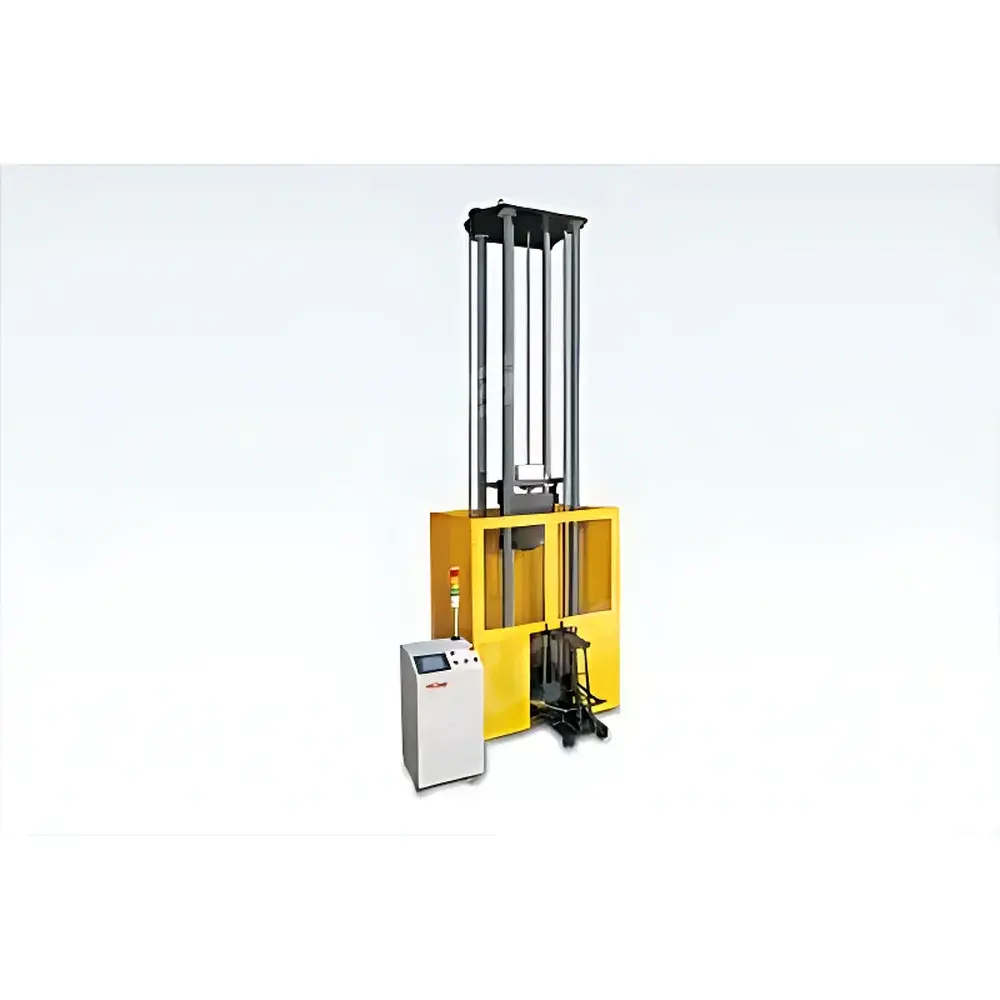
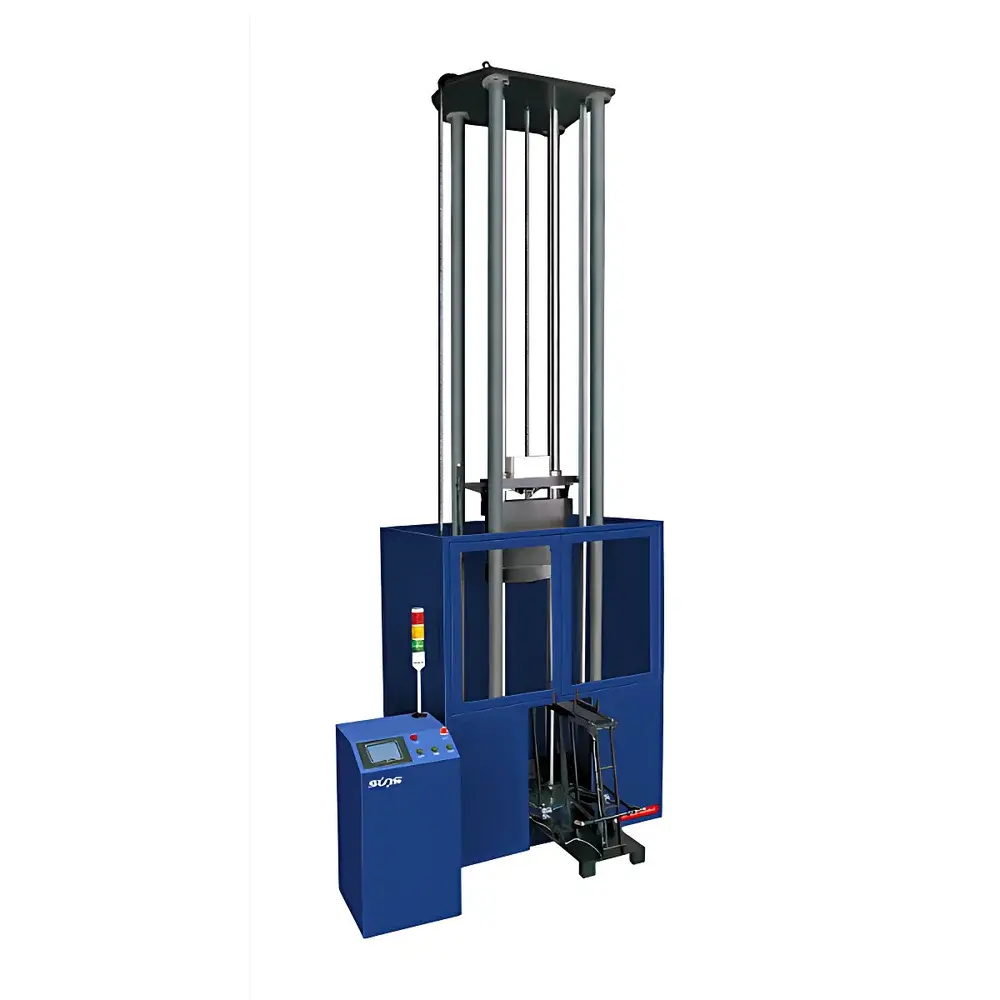
SUNS NDT Series Metal Drop Weight Impact Tester DTM2000
| Brand | SUNS |
|---|---|
| Origin | Guangdong, China |
| Manufacturer Type | Manufacturer |
| Product Category | Domestic |
| Model | DTM2000 Series |
| Instrument Type | Drop Weight Impact Tester |
| Impact Energy | 6000 J |
| Impact Velocity | 3.8–7.7 m/s |
| Hammer Moment (Impact Constant) | 6000 J |
| Load Cell Range | 6000 J |
| Maximum Lift Height | 750–3062 mm |
Overview
The SUNS NDT Series Metal Drop Weight Impact Tester (Model DTM2000) is a precision-engineered apparatus designed specifically for the determination of the Nil-Ductility Transition (NDT) temperature of ferritic steels in accordance with standardized fracture toughness assessment protocols. Based on the principle of dynamic drop-weight impact testing, the system delivers controlled gravitational energy to a notched specimen mounted on a rigid anvil, enabling the identification of the highest temperature at which brittle fracture initiates without measurable plastic deformation. This measurement is critical for structural integrity evaluation in nuclear reactor pressure vessels, pipelines, offshore platforms, and low-temperature service components where catastrophic cleavage fracture must be rigorously excluded during design and qualification.
Key Features
- Automated specimen handling and precise positioning mechanism — reduces operator dependency and enhances repeatability across sequential tests.
- Rigid four-column frame architecture with monolithic solid steel base plate — engineered for minimal deflection and high modal stiffness during high-energy impact events (up to 6000 J).
- Monoblock hammer assembly fabricated from high-strength alloy steel — optimized for fatigue resistance and dimensional stability under repeated high-velocity impact loading.
- Self-locking hammer grip-and-release mechanism — mechanically engaged upon lift; remains secured under gravity and retains lock state during power loss — compliant with ISO 14122-3 and EN 60204-1 safety requirements.
- Full-height interlocked safety enclosure with dual-channel light curtain and emergency stop circuitry — meets Category 3 PLd per ISO 13857 and supports risk assessment per ISO 12100.
- Dedicated anvil exchange tooling — enables rapid, repeatable replacement of test anvils (e.g., for ASTM E208 vs. GB/T 6803 configurations) without recalibration.
- Integrated fault-detection logic — monitors real-time status of specimen placement, hammer lock engagement, guard door closure, and lift height confirmation; triggers audible/visual alarms and halts operation if any safety or procedural condition is unmet.
Sample Compatibility & Compliance
The DTM2000 series accommodates standard Charpy-type specimens per ASTM E208-22 (10 mm × 10 mm × 55 mm) and GB/T 6803–2008 (15 mm × 15 mm × 120 mm), with optional fixtures for subsize geometries. Anvil geometry and support spacing are configurable to satisfy both U.S. and Chinese national standards. The system is fully compatible with NDT temperature mapping procedures requiring multiple specimens tested incrementally across a defined thermal range (typically −196 °C to +50 °C using liquid nitrogen or environmental chambers). All mechanical and control subsystems conform to CE marking directives (2006/42/EC Machinery Directive), and documentation supports GLP-compliant audit trails when integrated with validated LIMS environments.
Software & Data Management
Control and data acquisition are managed via a Siemens SIMATIC S7-1200 PLC interfaced with a 10.1″ industrial touchscreen HMI. Firmware supports deterministic timing resolution ≤1 ms for hammer release synchronization and load cell sampling at ≥10 kHz. Raw force-time traces, impact velocity (calculated from encoder-based lift height and free-fall kinematics), and pass/fail classification per ASTM E208 Annex A1 are stored in CSV and XML formats. Optional OPC UA server module enables seamless integration into enterprise MES or QMS platforms. Audit trail functionality — including user login, parameter changes, test execution logs, and calibration history — satisfies FDA 21 CFR Part 11 requirements when deployed with electronic signature validation.
Applications
- Determination of Nil-Ductility Transition (NDT) temperature for reactor pressure vessel steels (e.g., ASTM A533, A302, A508 Class 2).
- Qualification of weld metal and heat-affected zones (HAZ) in thick-section ferritic weldments.
- Material acceptance testing per ASME Section III, Division 1, Appendix G and RCC-M Appendix ZA.
- Research-grade fracture mechanics studies involving cleavage initiation thresholds under dynamic loading.
- Support for probabilistic fracture mechanics (PFM) modeling inputs in aging management programs for nuclear infrastructure.
FAQ
What standards does the DTM2000 comply with for NDT testing?
ASTM E208-22, GB/T 6803–2008, and ISO 148-1:2016 (for general impact energy verification); full traceability to national metrology institutes is supported via optional load cell calibration certificates.
Can the system operate at cryogenic temperatures?
Yes — the tester is designed for integration with external environmental chambers; specimen cooling and thermal soak are performed externally, while the impact event itself occurs at ambient or conditioned temperature.
Is remote diagnostics and firmware update capability available?
Standard Ethernet interface supports remote maintenance via VPN-secured access; firmware updates require authenticated USB media and follow IEC 62443-3-3 security guidelines.
What is the typical calibration interval for the load cell and position encoder?
Annual calibration is recommended per ISO/IEC 17025; load cell calibration includes linearity, hysteresis, and zero-drift verification across 10%–100% of full scale (6000 J equivalent).
Does the system support automated reporting for regulatory submissions?
Yes — customizable report templates (PDF/XLSX) include test parameters, raw data plots, pass/fail determinations, operator ID, timestamp, and digital signature fields aligned with 21 CFR Part 11 Annex 11 expectations.
Related Products



