
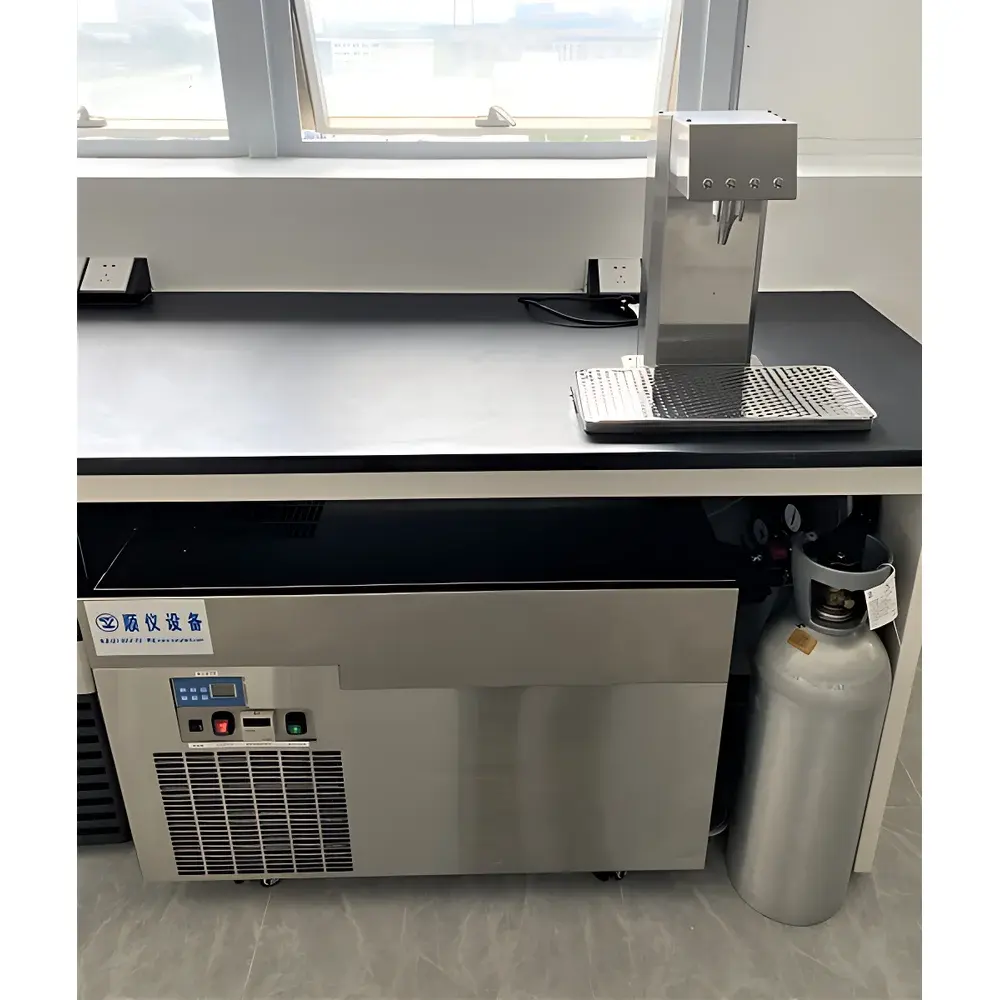
Sunyitech SY-350 Laboratory-Scale Carbonated Beverage Carbonation & Filling System
| Brand | Sunyitech |
|---|---|
| Model | SY-350 |
| Origin | Shanghai, China |
| Production Capacity | 20–50 L/h |
| CO₂ Saturation Range | Up to 4.5 vol CO₂ (adjustable) |
| Refrigeration System | Integrated imported compressor, setpoint 5 °C |
| Pressure Control | Single-stage precision CO₂ regulator valve |
| Filling Mode | Continuous inline carbonated liquid dispensing |
| Control System | SUNYITECH proprietary integrated PLC-based HMI interface |
| Power Supply | 3 kW, 220 V AC |
| Wetted Materials | SUS316L stainless steel |
| Filtration | Integrated inlet water filter + CO₂ pressure-reducing regulator with gauge |
| Dimensions (W×D×H) | 1500 × 800 × 1600 mm |
| Includes | Stainless steel operator workstation |
Overview
The Sunyitech SY-350 is a fully integrated, bench-to-pilot scale carbonation and filling system engineered for controlled, reproducible production of carbonated beverages under laboratory conditions. It operates on the principle of pressurized gas dissolution—specifically, the forced absorption of food-grade CO₂ into chilled liquid (typically purified water or formulated beverage base) within a sealed, temperature-stabilized carbonation chamber. Dissolution follows Henry’s law kinetics, where solubility is directly proportional to partial pressure and inversely related to temperature; the SY-350 leverages this by maintaining precise refrigeration at 5 °C and adjustable CO₂ headspace pressure via its single-stage regulator. Unlike batch sparging or diffusion-based systems, this unit employs continuous counter-current contact between liquid and CO₂ in a dedicated saturation column, enabling consistent volumetric CO₂ loading up to 4.5 volumes—matching industry-standard thresholds for premium sparkling waters and functional carbonated drinks. Its self-contained architecture eliminates dependency on external chillers, compressed air networks, or centralized gas manifolds, making it suitable for ISO Class 7 clean benches, university food science labs, and corporate R&D facilities operating under GLP-aligned workflows.
Key Features
- Compact monoblock design (1500 × 800 × 1600 mm) optimized for limited lab floor space without compromising process integrity
- Integrated refrigeration module using an imported hermetic compressor, maintaining stable 5 °C coolant loop for optimal CO₂ solubility and bubble nucleation control
- SUS316L stainless steel wetted path—including carbonation tower, filling nozzle, piping, and reservoir—ensuring corrosion resistance, cleanability, and compliance with FDA 21 CFR 178.3570 and EC 1935/2004 for food contact materials
- Continuous-flow carbonation architecture with residence time optimization, minimizing dissolved oxygen ingress and preserving sensory stability during pilot-scale trials
- Single-stage CO₂ pressure regulation with calibrated gauge, enabling repeatable adjustment of carbonation intensity across experimental batches
- SUNYITECH-developed HMI-driven control system with one-touch operation sequences, real-time temperature/pressure logging, and user-accessible parameter presets for method standardization
- Dedicated high-CO₂ discharge valve designed to mitigate foaming during filling, supporting consistent fill volume accuracy ±1.5% across 20–50 L/h throughput range
Sample Compatibility & Compliance
The SY-350 accommodates aqueous formulations including purified water, flavored syrups, juice blends, functional electrolyte solutions, and low-viscosity dairy alternatives—provided total dissolved solids (TDS) remain below 12,000 ppm and viscosity does not exceed 5 mPa·s at 20 °C. It supports ASTM D512-20 (chloride), ISO 8587:2010 (sensory evaluation of carbonation perception), and USP (conductivity testing of purified water used in carbonated product preparation). All electrical components meet CE/IEC 61000-6-3 EMI immunity standards, and the control system architecture allows audit-ready data export in CSV format for traceability in GMP-aligned development environments.
Software & Data Management
The embedded SUNYITECH control interface runs on a deterministic real-time OS, recording timestamped values for refrigerant outlet temperature, CO₂ inlet pressure, and fill cycle duration. Data is stored locally on industrial-grade microSD and exportable via USB port without requiring network connectivity—supporting air-gapped lab security policies. While the system does not implement full 21 CFR Part 11 electronic signature functionality, it provides configurable user access levels (Operator / Technician / Administrator), session logs, and immutable parameter change history—enabling alignment with ALCOA+ data integrity principles during method validation.
Applications
- Rapid prototyping of carbonated functional beverages (e.g., caffeine-infused sparkling water, vitamin-enhanced seltzers)
- Stability testing of CO₂ retention under varied storage temperatures and container types (PET, glass, aluminum)
- Optimization of sugar-acid-CO₂ interaction matrices for mouthfeel and perceived effervescence intensity
- Training platform for food engineering students on mass transfer fundamentals in pressurized liquid–gas systems
- Pre-commercial scale trials supporting shelf-life studies per ISO 22000:2018 Clause 8.5.2 (validation of process controls)
- Supporting formulation work for clean-label carbonated products compliant with EU Regulation (EC) No 1333/2008 on food additives
FAQ
What is the minimum batch volume supported for method development?
The system achieves stable carbonation performance from 5 L minimum charge volume; however, optimal repeatability is observed at ≥10 L due to thermal mass stabilization in the refrigerated loop.
Can the unit be validated for IQ/OQ protocols?
Yes—SUNYITECH provides factory calibration certificates for temperature sensor (±0.3 °C), pressure transducer (±1.0% FS), and flow meter (±2.5% reading); full qualification documentation templates are available upon request.
Is CO₂ gas supply included?
No—users must provide food-grade CO₂ (≥99.9% purity, ISO 8573-1 Class 2 oil/water content) via standard CGA-320 cylinder connection; the supplied regulator set interfaces directly with common industrial gas manifolds.
Does the system support nitrogen or mixed-gas carbonation?
The current configuration is optimized exclusively for CO₂; nitrogen or CO₂/N₂ blending requires hardware modification and is not covered under standard warranty.
What maintenance intervals are recommended?
Compressor oil inspection every 12 months; stainless steel surfaces require passivation after 200 operational hours or following any acid-based cleaning agent use; CO₂ regulator diaphragm replacement recommended every 18 months under continuous operation.



