
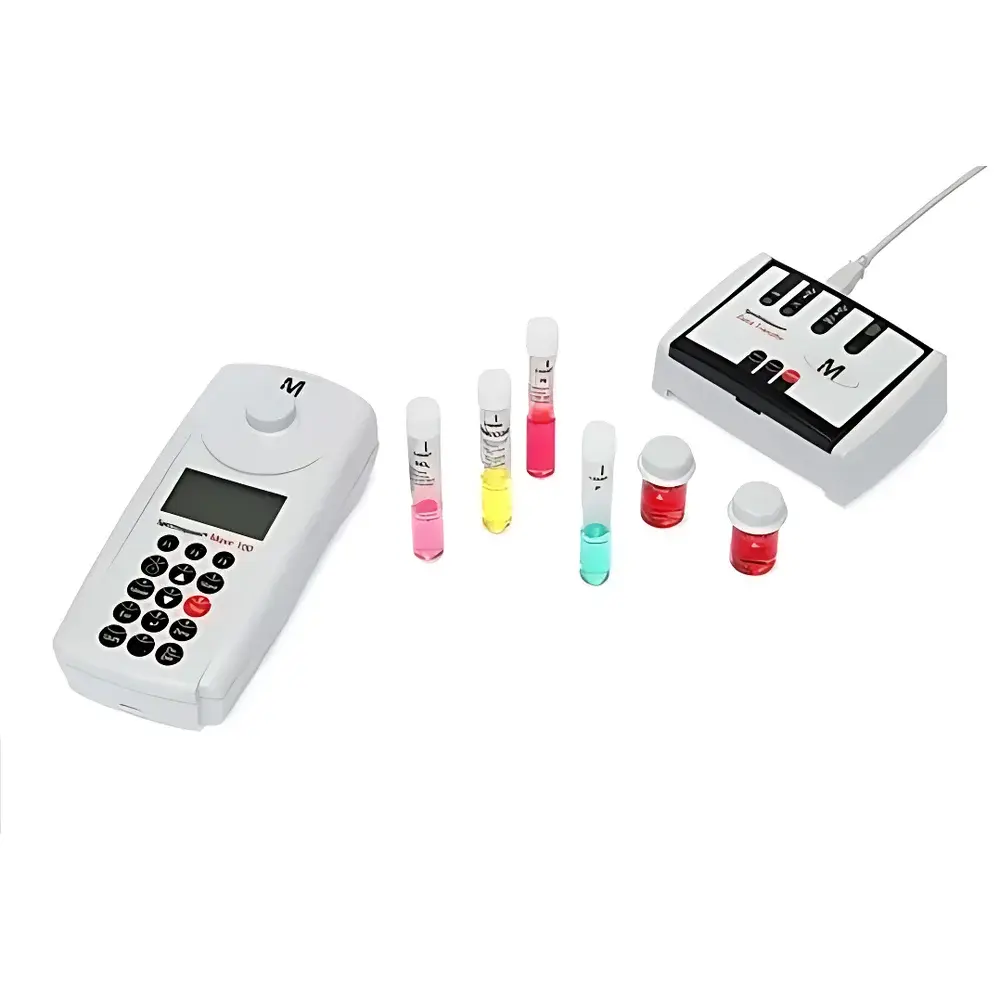
Supelco Spectroquant Move100 Portable Multi-Parameter Water Quality Analyzer
| Brand | Supelco |
|---|---|
| Origin | Germany |
| Model | Move100 |
| Instrument Type | Portable/Handheld Water Quality Analyzer |
| Measured Parameters | COD, Ammonia-Nitrogen (NH₃-N), Total Phosphorus (TP) |
| Protection Rating | IP68 |
| Preloaded Calibration Curves | >100 |
| Compliance | AQA (Analytical Quality Assurance) Function Enabled |
| Regulatory Context | Designed for field use in compliance with ISO 7027, ISO 6060, ISO 15681-1, and EPA Method 410.4 / 365.2 / 365.3 |
Overview
The Supelco Spectroquant Move100 Portable Multi-Parameter Water Quality Analyzer is an integrated photometric field instrument engineered for rapid, on-site quantification of critical water quality parameters—including chemical oxygen demand (COD), ammonia-nitrogen (NH₃-N), and total phosphorus (TP)—using standardized colorimetric methods. Based on proven spectrophotometric detection principles (absorbance measurement at defined wavelengths, typically 420–850 nm), the Move100 employs pre-programmed, factory-validated calibration curves aligned with internationally recognized test protocols. Its compact, handheld architecture eliminates reliance on laboratory infrastructure, enabling real-time decision-making during environmental monitoring campaigns, wastewater treatment plant audits, drinking water distribution assessments, and emergency response operations. The device operates without external power sources for extended periods via rechargeable lithium-ion batteries, supporting continuous field deployment under variable ambient conditions.
Key Features
- IP68-rated rugged enclosure—fully dust-tight and submersible up to 1.5 m for 30 minutes—ensuring operational reliability in harsh outdoor environments including rain, mud, and high-humidity zones.
- Integrated optical system with tungsten-halogen light source and precision interference filters, delivering stable photometric performance across temperature ranges from 0 °C to 40 °C.
- Preloaded library of over 100 validated analytical curves, covering standard methods for COD (dichromate digestion, 600 nm), NH₃-N (salicylate or Nessler method, 420 nm or 655 nm), TP (ascorbic acid reduction, 880 nm), nitrate, nitrite, chlorine species, hardness, and heavy metals (e.g., Cu²⁺, Fe²⁺/³⁺).
- Onboard AQA (Analytical Quality Assurance) functionality—including blank verification, calibration verification standards, and drift monitoring—to support traceable data integrity per ISO/IEC 17025 and GLP requirements.
- Intuitive touchscreen interface with multilingual support (English, German, French, Spanish), automatic unit conversion (mg/L, µmol/L, ppm), and contextual help prompts for reagent handling and measurement validation.
Sample Compatibility & Compliance
The Move100 accepts standard 13-mm and 16-mm round glass or plastic cuvettes (including pre-filled reagent vials from Merck/Supelco’s Spectroquant line), accommodating sample volumes from 0.5 mL to 10 mL. It supports both direct measurement and digestion-assisted protocols (e.g., closed-vessel thermal digestion for COD and TP at 148 °C). All onboard methods are aligned with key regulatory frameworks: ISO 6060 (COD), ISO 14429 (ammonia), ISO 15681-1 (phosphorus), EPA Methods 410.4 (COD), 365.2 (phosphorus), and 365.3 (ammonia), as well as DIN EN ISO 7027 (turbidity). Device firmware and calibration records maintain audit trails compatible with FDA 21 CFR Part 11-compliant data management systems when paired with Spectroquant LabStation software.
Software & Data Management
Data export is supported via USB-C and Bluetooth 5.0 connectivity to Windows/macOS PCs or Android/iOS mobile devices. The optional Spectroquant LabStation desktop application enables centralized method configuration, firmware updates, report generation (PDF/CSV), and electronic signature workflows. All measurements store timestamp, GPS coordinates (when connected to external GNSS module), operator ID, cuvette lot number, and AQA verification status. Audit logs record user actions—including curve selection, calibration edits, and result overrides—with immutable timestamps, satisfying GMP/GLP documentation requirements for regulated environmental laboratories.
Applications
- Routine surveillance of surface water bodies (rivers, lakes, reservoirs) for eutrophication indicators (TP, NH₃-N) and organic load (COD).
- Compliance monitoring at municipal wastewater treatment plants—effluent discharge verification against national limits (e.g., EU Urban Wastewater Directive, US Clean Water Act NPDES permits).
- Source water assessment for potable supply systems, including raw intake screening and distribution network leak detection via sudden parameter shifts.
- Industrial process water control in food & beverage, pharmaceutical, and semiconductor manufacturing where rinse water quality must meet ISO 14644-1 Class 8 or USP specifications.
- Emergency response to chemical spills or algal blooms, enabling immediate triage and prioritization of remediation efforts based on quantitative field data.
FAQ
Does the Move100 require annual recalibration by a certified service provider?
No—routine user-performed verification using included AQA standards satisfies ISO/IEC 17025 interim verification requirements; full recalibration is recommended every 24 months or after physical impact.
Can custom calibration curves be imported?
Yes—LabStation software supports secure import of user-defined curves in CSV format, subject to password-protected method locking and version-controlled revision history.
Is the instrument compatible with third-party reagents?
Only Spectroquant-certified reagent sets are validated for method accuracy and reproducibility; use of non-Supelco reagents voids AQA compliance and metrological traceability.
What battery life can be expected during continuous field operation?
Up to 12 hours of active measurement time per charge (tested at 25 °C, 10 measurements/hour), with low-power sleep mode extending standby duration to 72 hours.
How is data security ensured during wireless transmission?
Bluetooth pairing uses AES-128 encryption; all exported files include SHA-256 checksums, and LabStation enforces role-based access control with multi-factor authentication options.
Related Products







