
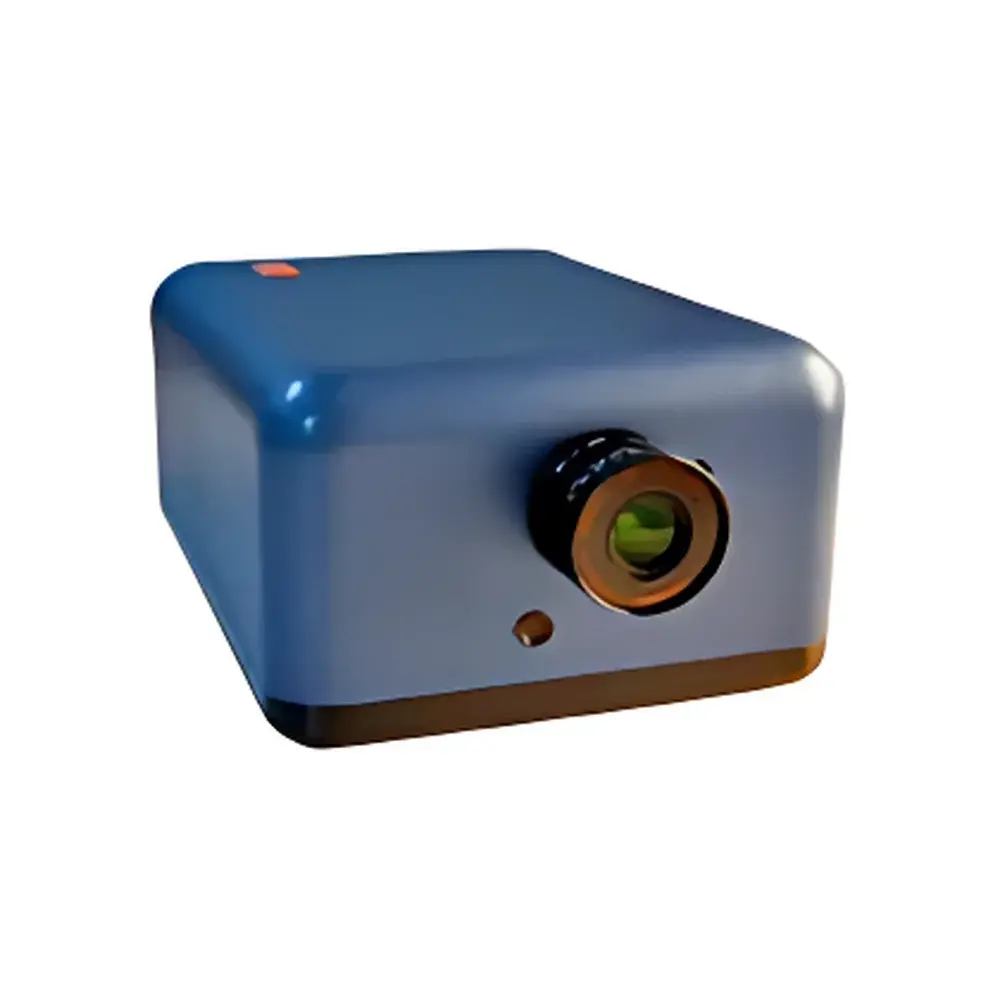
SurfaceOptics SOC710 SWIR Pushbroom Hyperspectral Imaging Spectrometer
| Brand | SurfaceOptics |
|---|---|
| Origin | USA |
| Model | SOC710 SWIR |
| Spectral Range | 900–1700 nm |
| Spectral Resolution | 2.75 nm |
| Spatial Pixels | 640 × 568 |
| Spectral Bands | 288 |
| Digital Resolution | 14 bit |
| F-number | f/2.0 |
| Scan Method | Internal Translation-Based Pushbroom |
| Scan Rate | 60–120 lines/sec |
| Acquisition Time per Cube | ~10 s |
| Lens Options | 8 mm, 12.5 mm, 16 mm, 25 mm, 35 mm, 50 mm |
| Interface | USB |
| Power Supply | DC 12 V / AC 220 V |
Overview
The SurfaceOptics SOC710 SWIR is a research-grade pushbroom hyperspectral imaging spectrometer engineered for high-fidelity spectral-spatial data acquisition in the shortwave infrared (SWIR) region. Operating on the principle of spatial scanning via precision linear translation—combined with slit-based dispersion and focal plane array detection—the instrument captures contiguous, calibrated spectral cubes (x, y, λ) with high radiometric stability and geometric fidelity. Unlike snapshot or tunable filter systems, the pushbroom architecture ensures consistent illumination geometry and eliminates temporal misregistration between bands, making it especially suitable for ground-based field spectroscopy, laboratory material characterization, and calibration transfer studies where pixel-level spectral integrity is critical. Designed as the successor to the SOC720 platform, the SOC710 SWIR integrates mechanical refinements—including reduced mass, optimized thermal management, and enhanced optical alignment repeatability—without compromising spectral fidelity or radiometric linearity.
Key Features
- SWIR spectral coverage from 900 nm to 1700 nm with nominal spectral resolution of 2.75 nm (FWHM), enabling discrimination of overtone and combination bands of C–H, O–H, and N–H functional groups.
- Cryogenically cooled InGaAs detector array (640 × 568 pixels) delivering low-noise performance and high quantum efficiency across the full operating range.
- Fixed f/2.0 aperture and interchangeable lens options (8 mm to 50 mm) supporting flexible field-of-view selection—from wide-area survey (e.g., 0.5 m GSD at 5 m working distance with 8 mm lens) to targeted micro-scale analysis.
- Real-time pushbroom acquisition at 60–120 lines per second, yielding full hyperspectral cubes (~10 seconds per cube under typical operational settings) with synchronized position tracking via integrated encoder feedback.
- 14-bit digitization with on-board non-uniformity correction (NUC), dark current subtraction, and gain stabilization—ensuring reproducible radiance calibration across extended measurement sessions.
- USB 3.0 interface for direct host communication; compatible with Windows-based acquisition software and third-party SDKs for custom integration into automated QA/QC or remote sensing workflows.
Sample Compatibility & Compliance
The SOC710 SWIR is optimized for ground-based, non-contact reflectance and radiance measurements of solid, semi-solid, and particulate samples—including soils, vegetation canopies, pharmaceutical tablets, mineral specimens, polymer films, and cultural heritage artifacts. Its SWIR sensitivity supports ASTM E1777-21 (Standard Practice for Reflectance Spectroscopy of Solid Materials), ISO 18331-2:2018 (Imaging spectrometry — Part 2: Data processing), and USP (Near-Infrared Spectroscopy). The system supports GLP-compliant documentation through metadata-embedded acquisition logs (including timestamp, GPS coordinates if externally synchronized, lens ID, integration time, and NUC status), and meets electromagnetic compatibility requirements per FCC Part 15 Class B and CE EN 61326-1.
Software & Data Management
Acquisition and preprocessing are managed via SurfaceOptics’ native HyperSpectra Studio v4.x, which provides real-time preview, spectral library matching (with optional ENVI/IDL export), and batch-processed radiometric calibration using NIST-traceable reference panels. All raw and processed data are stored in hierarchical data format (HDF5), preserving embedded metadata per HDF-EOS conventions. The SDK enables programmatic control via Python, MATLAB, or C++ APIs—facilitating integration with LIMS, MES, or automated sample handling platforms. Audit trails, user authentication, and electronic signatures comply with FDA 21 CFR Part 11 when deployed in regulated environments (e.g., pharmaceutical raw material ID or coating uniformity verification).
Applications
- Agricultural phenotyping: Quantification of leaf water content, nitrogen status, and stress-induced biochemical shifts via SWIR absorption features (e.g., 1450 nm, 1940 nm).
- Geological mapping: Discrimination of clay mineralogy (kaolinite, smectite), carbonates, and hydroxides based on diagnostic OH-stretching harmonics.
- Pharmaceutical quality control: Identification of API polymorphs, excipient distribution, and tablet coating thickness using multivariate spectral unmixing.
- Recycling sorting: Real-time classification of plastic types (PET, HDPE, PP) via unique C–H combination band patterns between 1600–1750 nm.
- Museum conservation: Non-invasive pigment identification and binder analysis in historical paintings without sampling.
FAQ
What is the minimum working distance for the 8 mm lens configuration?
Typical minimum focus distance is 0.3 m; optimal spatial resolution is achieved at ≥0.5 m for field uniformity and depth-of-field constraints.
Does the SOC710 SWIR support external triggering or synchronization with LiDAR or GPS?
Yes—TTL-compatible trigger input and PPS (pulse-per-second) sync port enable hardware-level coordination with time-of-flight sensors or georeferencing modules.
Is radiometric calibration traceable to NIST standards?
Calibration certificates include uncertainty budgets referenced to NIST SRM 2035 (diffuse reflectance standard) and SRM 1920c (spectral irradiance standard), valid for two years post-certification.
Can the system operate continuously for extended field campaigns?
Thermal design permits uninterrupted operation up to 8 hours at ambient temperatures ≤35 °C; active cooling maintains detector stability within ±0.1 °C over duration.
What spectral preprocessing algorithms are embedded in HyperSpectra Studio?
Includes Savitzky-Golay smoothing, continuum removal, multiplicative scatter correction (MSC), and principal component analysis (PCA) for exploratory spectral clustering.



