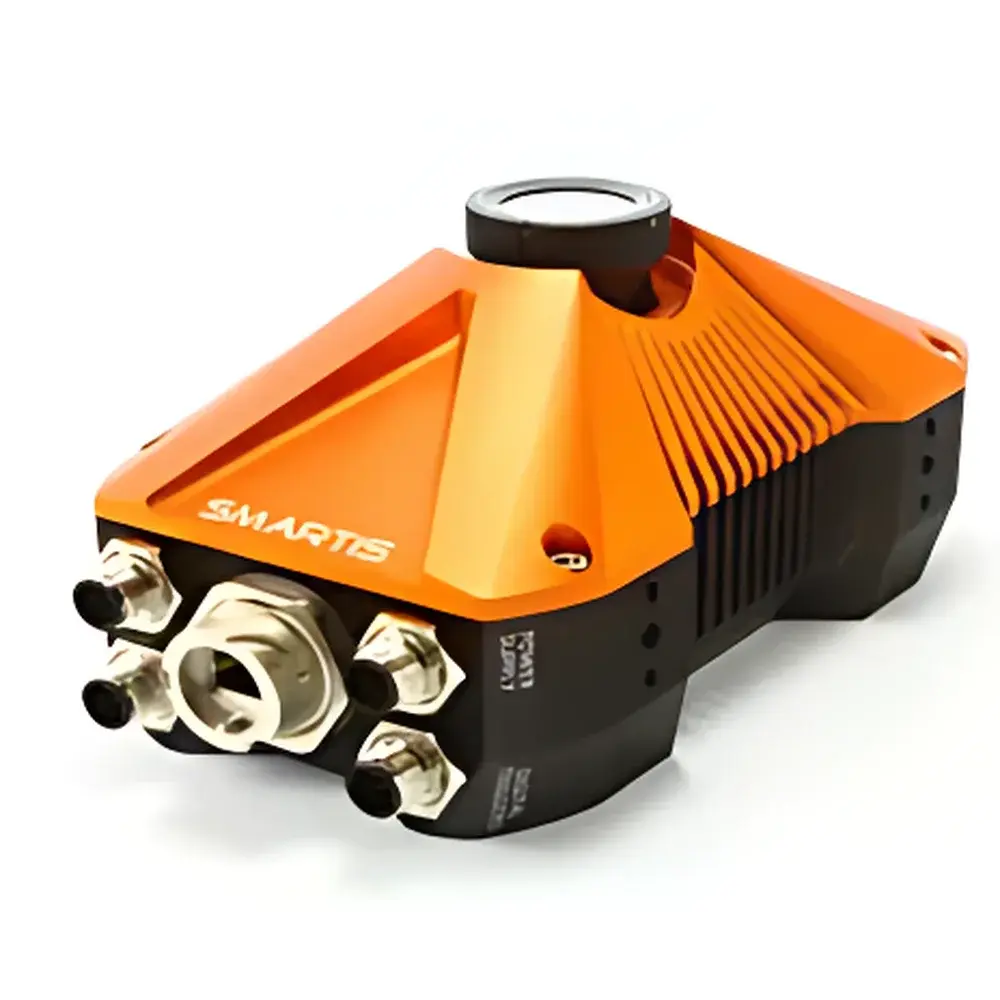
Workswell SMARTIS Advanced Thermal Imaging System
| Origin | Czech Republic |
|---|---|
| Manufacturer Type | Authorized Distributor |
| Origin Category | Imported |
| Model | SMARTIS |
| Pricing | Upon Request |
Overview
The Workswell SMARTIS Advanced Thermal Imaging System is a self-contained, industrial-grade thermal camera platform engineered for precision non-contact temperature measurement and real-time thermal monitoring in demanding environments. Based on uncooled vanadium oxide (VOx) microbolometer focal plane array (FPA) technology, the SMARTIS operates in the long-wave infrared (LWIR) spectral band of 7.5–13.5 µm—optimized for atmospheric transmission and emissivity stability across common industrial materials. Unlike PC-dependent thermal cameras, SMARTIS integrates a fully functional embedded web server, enabling autonomous operation: configuration, live streaming, ROI-based analytics, and alarm triggering occur directly on-device without external computing infrastructure. Its dual-resolution architecture—offering either 640×512 or 336×256 detector arrays—supports scalable deployment from high-fidelity R&D diagnostics to robust process control in manufacturing, energy, and predictive maintenance applications.
Key Features
- Embedded Linux-based web server for zero-client setup, remote configuration, and browser-based visualization via standard HTTP/HTTPS
- Native TCP/IP Ethernet interface (100 Mbps, RJ-45 with metal cable gland) for seamless integration into SCADA, PLC, and MES systems
- Four isolated analog outputs (0–24 mA current loop or ±12 VDC voltage) for direct connection to DCS or PID controllers
- Seven isolated open-collector digital outputs and four high-voltage isolated digital inputs (up to 36 VDC) supporting hardware-triggered acquisition, alarm latching, and synchronized multi-camera deployments
- Full-range factory calibration traceable to NIST-equivalent standards; certified accuracy of ±2% or ±2 °C across the entire operating range
- Thermal sensitivity (NETD) ≤ 50 mK at 30 °C scene temperature—enabling reliable detection of subtle thermal gradients in low-contrast scenarios
- Rugged aluminum housing rated IP54 (IP67 with lens cover), operational from 0 °C to +50 °C ambient, and storage-rated from −30 °C to +60 °C
- Modular optical design: interchangeable manual-focus lenses with FOVs from 17° to 69°, supporting spatial resolution optimization per working distance and target size
Sample Compatibility & Compliance
SMARTIS is designed for broad material compatibility across metallic, ceramic, polymer, and composite surfaces, with adjustable emissivity compensation (0.01–1.00 in 0.01 steps) and reflected apparent temperature correction. It complies with CE marking requirements under the EU Electromagnetic Compatibility (2014/30/EU) and RoHS Directive (2011/65/EU). The system supports audit-ready operation in regulated environments: firmware logging includes timestamped configuration changes, ROI parameter sets, and output state transitions—facilitating GLP/GMP alignment where thermal validation protocols require documented instrument behavior. While not FDA 21 CFR Part 11–certified out-of-the-box, its secure administrator/operator password hierarchy, configuration lockout, and immutable event logs provide foundational controls for validation-driven workflows.
Software & Data Management
No proprietary desktop software is required. All functionality is accessed through a responsive HTML5 web interface compatible with Chrome, Edge, and Firefox. Users define ROIs—including points, lines, polygons, rectangles, and circles—via intuitive drag-and-drop canvas interaction. Measurement modes include spot temperature, line profiles, area min/max/avg statistics, and dynamic threshold-based alarms. Real-time video streams support digital zoom, pseudo-color palette selection (iron, rainbow, grayscale), and overlay of measurement annotations, scale bars, and user-defined text labels. Raw thermal frames (16-bit radiometric TIFF) and metadata (timestamp, lens ID, emissivity, ambient temp) are exportable via HTTP GET or FTP. Firmware updates are performed over-the-air using signed binary packages, ensuring integrity verification prior to installation.
Applications
- Electrical asset monitoring: Detection of hot spots in switchgear, transformers, busbars, and photovoltaic arrays under load
- Industrial process control: Continuous thermal profiling of extrusion dies, welding seams, furnace linings, and composite curing ovens
- Mechanical condition monitoring: Bearing temperature trending, motor winding anomaly detection, and steam trap verification
- R&D thermal analysis: Characterization of thermal interface materials (TIMs), battery cell thermal runaway propagation, and LED junction temperature mapping
- Building diagnostics: Moisture-induced thermal bridging, insulation integrity assessment, and HVAC duct leakage identification
- Automated quality inspection: In-line thermal verification of solder reflow profiles, adhesive cure uniformity, and plastic weld integrity
FAQ
Does SMARTIS require a computer to operate?
No. It functions autonomously with an integrated web server—configuration, imaging, and data export are accessible via any network-connected device with a modern web browser.
Can SMARTIS be integrated into existing automation systems?
Yes. Its native TCP/IP interface, programmable digital I/O, and analog outputs enable direct interfacing with PLCs, PACs, and distributed control systems without middleware.
What is the calibration validity period and traceability basis?
Each unit ships with a factory calibration certificate referencing ISO/IEC 17025-accredited reference sources. Recalibration is recommended every 12 months under continuous operation or after mechanical shock.
Is high-temperature mode (up to 1500 °C) available on all models?
High-temperature capability is optional and requires both firmware activation and use of the dedicated high-temp lens configuration—available only on SMARTIS 640 variants.
How is image non-uniformity corrected during operation?
SMARTIS performs real-time, asynchronous NUC (non-uniformity correction) using shutterless algorithms; synchronous and trigger-synchronized NUC modes are also configurable for ultra-stable measurement sequences.
Related Products