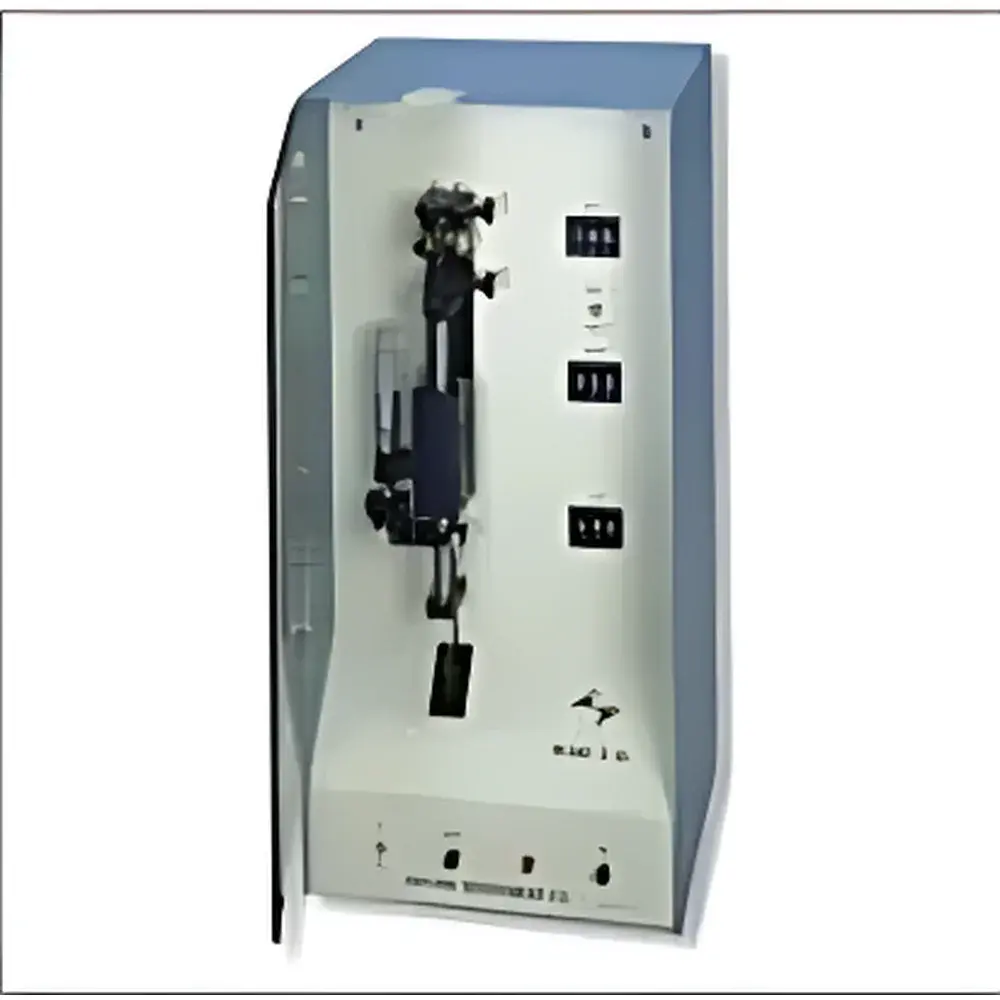
Sutter P-30 Manual Vertical Micropipette Puller
| Brand | Sutter |
|---|---|
| Origin | USA |
| Model | P-30 |
| Heating Element Options | Platinum-Iridium or Nichrome Coil |
| Dual-Pipette Capability | Yes |
| Tip Diameter Range | Down to 0.3 µm |
| Pipette Length Range | 10–15 mm |
| Control Interface | Three Digital Knobs (Heat, Pull, Velocity) |
| Precision Adjustment | Integrated Micrometer for Repeatable Pull Length |
| Power Supply | Constant-Current Source for Heater and Pull Solenoid |
| EMI Suppression | Built-in RFI Filtering |
| Voltage/Frequency Options | Dual (115 V / 60 Hz & 230 V / 50 Hz) |
| Clamp Material | Rubber-Padded Stainless Steel |
| Construction | Corrosion-Resistant Components |
| Application Focus | Patch-Clamp Electrophysiology, Intracellular Recording, Microinjection |
Overview
The Sutter P-30 Manual Vertical Micropipette Puller is an engineered solution for reproducible fabrication of glass micropipettes used in high-precision electrophysiological and microinjection applications. Designed around the principle of controlled resistive heating and mechanical tension, the P-30 employs a vertical configuration to ensure gravitational alignment and consistent capillary geometry during pull cycles. A glass capillary—typically borosilicate or aluminosilicate—is clamped vertically between two precision holders; its central region is heated by a calibrated resistive filament (either platinum-iridium or nichrome), while opposing solenoid-driven arms apply synchronized axial force. This combination of thermal softening and mechanical elongation induces controlled necking and tip formation, yielding pipettes with sub-micron tip diameters (down to 0.3 µm) and defined shank profiles. Unlike automated pullers, the P-30 provides direct tactile feedback and real-time manual intervention, making it especially suitable for protocol development, teaching laboratories, and labs requiring flexibility over full automation.
Key Features
- Manual vertical architecture ensures consistent gravity-assisted symmetry during pulling, minimizing asymmetry and tip offset.
- Dual-pipette capability enables simultaneous fabrication of two identical or functionally distinct electrodes—ideal for paired whole-cell recordings or injection/control setups.
- Integrated micrometer allows precise, repeatable control of pull length (10–15 mm range), critical for standardizing electrode resistance and access resistance in patch-clamp experiments.
- Three independently calibrated digital dials govern heat intensity, pull force magnitude, and pull velocity—each adjustable in fine increments for empirical optimization across capillary types and wall thicknesses.
- Constant-current power supply delivers stable energy delivery to both heater filament and pull solenoids, eliminating drift due to line voltage fluctuations and ensuring inter-run consistency.
- Corrosion-resistant construction—including stainless steel frames, anodized aluminum components, and rubber-padded clamps—ensures longevity in humid or saline-rich lab environments common in neurophysiology and developmental biology labs.
- RFI filtering minimizes electromagnetic interference from adjacent equipment (e.g., amplifiers, stimulators), preserving signal integrity during concurrent setup and testing.
- Field-configurable dual-voltage/frequency operation (115 V/60 Hz or 230 V/50 Hz) supports global deployment without external transformers.
Sample Compatibility & Compliance
The P-30 accommodates standard thin-walled and thick-walled borosilicate glass capillaries (e.g., Sutter BF150-110-10, Harvard 30-30-1), as well as filamented or coated variants used in single-cell electrophysiology. Its open architecture permits custom capillary geometries, including double-barrel or theta-tube configurations for iontophoresis or differential recording. While the P-30 itself is not a medical device under FDA 21 CFR Part 820, its output—micropipettes used in research-grade electrophysiology—is routinely employed in studies compliant with GLP and ISO/IEC 17025 frameworks. Pipettes fabricated on the P-30 meet ASTM F2942-14 specifications for dimensional repeatability in microelectrode manufacturing when operated within validated parameter ranges.
Software & Data Management
The P-30 operates as a standalone hardware instrument with no embedded firmware or proprietary software dependency. All operational parameters are set manually via physical controls, eliminating software validation requirements and compatibility constraints. This design aligns with laboratories maintaining strict audit trails under FDA 21 CFR Part 11 or EU Annex 11, where deterministic, non-programmable instrumentation reduces documentation burden. Users are encouraged to log pull parameters (heat setting, pull force, velocity, micrometer position) in laboratory notebooks or LIMS-integrated spreadsheets for full traceability—particularly important when correlating pipette geometry with seal formation success rate or series resistance in patch-clamp workflows.
Applications
- Whole-cell and cell-attached patch-clamp recordings in neurons, cardiomyocytes, and stem-cell-derived models.
- Intracellular sharp-electrode recordings in invertebrate and vertebrate preparations (e.g., squid giant axon, Xenopus oocytes).
- Cytoplasmic or nuclear microinjection of dyes, tracers, CRISPR/Cas9 complexes, or mRNA in developmental biology assays.
- Fabrication of low-resistance pipettes for voltage-clamp fluorometry (VCF) and simultaneous optical-electrical measurements.
- Teaching labs requiring robust, intuitive instrumentation for undergraduate neuroscience and physiology courses.
- Prototyping novel pipette geometries prior to scaling on automated pullers (e.g., Sutter P-1000).
FAQ
What types of glass capillaries are compatible with the P-30?
Standard outer diameters of 1.0–1.5 mm and wall thicknesses ranging from 0.1 to 0.3 mm are supported. Both filamented and non-filamented borosilicate capillaries (e.g., Sutter BF150-86-10, Warner Instruments G150F-4) yield reliable results.
Can the P-30 produce patch pipettes with fire-polished tips?
No—the P-30 performs only the initial pull. Fire polishing requires a separate microforge (e.g., Narishige MF-900) to refine tip geometry and reduce capacitance.
Is calibration required before use?
No routine calibration is needed; however, users should verify heat and pull settings against reference capillaries during initial setup and after filament replacement.
How does the P-30 compare to the Sutter P-1000?
The P-1000 is fully programmable and supports multi-step protocols with real-time feedback; the P-30 offers manual control, lower cost, and greater pedagogical transparency—making it complementary rather than competitive.
Does the P-30 support theta or triple-barrel pipettes?
Yes—its vertical clamping system accommodates multi-lumen capillaries, though optimal results require careful alignment and symmetric heating profile adjustment.